









- APEC Shenzhen Spotlight: Cross-Border E-Commerce Orders Promote Asia-Pacific Trade and Economic CooperationNov 08, 2026View details
- China-Europe Railway Express and CIIE Hold Business Matchmaking Event, Focusing on Cross-Border E-commerce B2B ExportsNov 07, 2026View details
- China’s Ministry of Commerce Responds to Additional Charges on Low-Value Imports Imposed by the EUNov 06, 2026View details
- Two Internet Development Reports Released at the 2026 World Internet ConferenceNov 05, 2026View details
- Internet Business Revenue of Enterprises Above the Designated Size Reached RMB 1.716 Trillion in the First Three Quarters, with Profits Up 17.6%Nov 05, 2026View details
- Shopify's Third-Quarter Revenue and GMV Fall Short of Expectations, Sending Shares Tumbling Before the Market OpensNov 04, 2026View details
Does 易营宝's multilingual website development deliver a high inquiry conversion rate?
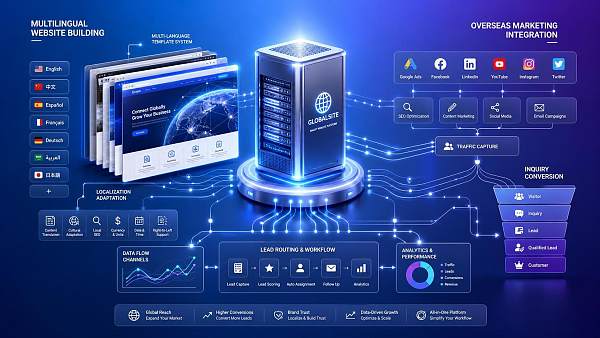
Is the inquiry conversion rate of Yiyingbao's multilingual website building high? The answer is: it may be higher, but the prerequisite is not simply “translating a website into multiple languages.” What truly determines inquiry conversion performance is whether the localized expression is appropriate, whether the page structure is designed around conversion, whether SEO and advertising work together, and whether the lead-handling process is complete.
For foreign trade companies, manufacturing plants, cross-border brands, and teams expanding overseas, the goal of building a multilingual website has never been merely to display information. It is to help visitors from different countries understand products more quickly, become more willing to leave their contact details, and ultimately generate qualified business opportunities. From this perspective, the value of Yiyingbao's multilingual website building lies in whether it can turn “traffic” into “inquiries.”
What users really want to know is not whether a website can be built, but whether it can generate qualified inquiries
Users searching for “Is the inquiry conversion rate of Yiyingbao's multilingual website building high?” are generally not trying to learn about the concept of website building. They are evaluating a practical question: Is this solution worth the investment, and can it genuinely help a company obtain more inquiries from overseas customers?
These readers are usually concerned about several aspects: whether a multilingual website is truly easier to convert than a single-language website; whether Yiyingbao's systems and services can support customer acquisition through SEO, advertising, and social media; whether the quality of inquiries will improve; and whether ongoing operations will be convenient after the project goes live.
Therefore, determining whether the “conversion rate is high” cannot be based solely on whether the pages look attractive or how many languages are supported. It must return to business results: Are the visitors more targeted? Is the page more credible? Is form submission smoother? Can the sales team effectively handle these leads?
Why multilingual website building affects inquiry conversion rates
When overseas customers visit a website, they first assess not the size of the company, but the cost of understanding the information. If users have to mentally switch between unfamiliar languages, unclear selling points, or complicated processes after entering a page, the probability that they will leave increases significantly.
The fundamental role of a multilingual website is to lower communication barriers. When customers can quickly understand product advantages, certifications and qualifications, cooperation procedures, delivery capabilities, and contact information in a familiar language, they are naturally more likely to make an inquiry. This is especially evident in B2B foreign trade scenarios.
However, not every multilingual website can improve conversion. If the pages are only mechanically translated, without localized adjustments based on the purchasing habits, communication styles, search terms, and trust factors of different countries, the browsing experience may appear complete, but the actual conversion results may not be ideal.
Therefore, whether multilingual website building can improve inquiry conversion rates does not depend on the three words “multilingual,” but on whether the marketing logic behind each language version is sound. This is also the aspect that companies most often overlook, yet should focus on most when evaluating service providers.
To assess the effectiveness of Yiyingbao's multilingual website building, first examine these four key conversion factors
First, check whether the pages are designed around the “inquiry action.” For foreign trade companies, a truly conversion-oriented website should clearly guide users to make inquiries on the homepage, product pages, application scenario pages, case study pages, and landing pages, rather than stopping at brand presentation.
Second, check whether the language versions are localized rather than directly translated. Different markets have different priorities. European customers may place greater emphasis on certifications and compliance, Southeast Asian customers may focus more on delivery efficiency, and Middle Eastern customers may care more about communication response and cooperation stability. The content cannot use a one-size-fits-all approach.
Third, check whether the SEO structure has been planned in advance. Many companies discover only after their websites go live that their pages are difficult to index, keyword placement is disorganized, and the language directory structure is nonstandard. These issues directly affect the quality of organic traffic. Without targeted traffic, even the best pages will find it difficult to generate consistent inquiries.
Fourth, check whether the backend customer-acquisition process is complete. If form submission, WhatsApp, online chat, email tracking, advertising landing pages, CRM follow-up, and other steps are disconnected, a company may lose a large number of leads during subsequent handling even after obtaining some traffic, causing the conversion rate to appear “low.”
From a business perspective, Yiyingbao's advantage lies not only in website building, but also in integrated customer acquisition
For many business managers, what they truly need is not merely a “website that can go live,” but a growth tool that can continuously generate overseas business opportunities. Yiyingbao's advantage is reflected in the way it considers website building, SEO, advertising, social media, and AI optimization within the same customer-acquisition framework.
This means that the multilingual website is no longer an isolated project, but the conversion center of the entire overseas marketing system. Whether the visits come from organic traffic generated by Google SEO, Google Ads, Facebook advertising, social media content, or even AI search entry points, they ultimately need to return to the website to complete conversion.
If the website-building platform itself can take into account technical structure, page generation efficiency, content management, multilingual deployment, and marketing expansion, companies do not need to switch frequently between multiple tools. It also becomes easier to maintain consistent brand messaging and coherent data tracking.
From the perspective of inquiry conversion, this integrated capability is important. High conversion has never been determined by a single page. It results from the combined effects of traffic sources, page content, interaction methods, and sales follow-up. The higher the system synergy, the more stable the conversion efficiency is usually likely to be.
Which companies are better suited to using a multilingual website to improve inquiry conversion
If a company's main customers come from multiple countries or regions and the purchasing decision cycle is relatively long, a multilingual website is usually more valuable than a single-language website. This is especially true for typical B2B industries such as machinery and equipment, industrial components, building materials, electronics, packaging, and chemical raw materials, where inquiry conversion depends heavily on building trust.
For manufacturing plants and foreign trade companies, a multilingual website can help them present their factory capabilities, quality inspection standards, export experience, and after-sales capabilities in a way that is more aligned with local markets. Once such information is communicated accurately, customers are often significantly more willing to leave their contact details.
For cross-border brands and B2C independent websites, multilingual pages are more suitable for advertising in different countries and for receiving and converting brand traffic. After users click an advertisement, if the landing page language, pricing logic, value propositions, and usage scenarios are consistent with local user expectations, the conversion rate is generally more stable.
By contrast, if a company's product positioning is currently unclear, its target markets are vague, its content materials are insufficient, or no one is responsible for subsequent lead follow-up, improvements in inquiry conversion may still be limited even after a multilingual website is built. Tools can amplify capabilities, but they cannot replace basic operations.
When evaluating whether the “conversion rate is high,” companies should not focus only on the number of inquiries
When assessing website performance, many companies tend to focus only on the number of form submissions. For overseas business, however, what truly matters is the proportion of qualified inquiries—that is, how many of these leads match the target market, target product category, and target customer profile, rather than simply having left their contact information.
If the website content attracts mostly low-intent traffic, or if the page messaging is overly generic, the number of inquiries may increase in the short term, but the sales team may find that communication costs are high and the probability of closing deals is low, ultimately reducing the overall return on investment.
Therefore, when evaluating the inquiry conversion rate of Yiyingbao's multilingual website building, a more reasonable approach is to consider several indicators together: the proportion of visitors from target markets, the time spent on core pages, the form completion rate, the qualified inquiry rate, sales follow-up feedback, and subsequent conversion into closed deals.
Only when these indicators develop a positive relationship can it be said that the website has not only generated visits, but also genuinely improved the quality of overseas customer acquisition. From a management decision-making perspective, this is more meaningful than simply looking at how many new inquiries were generated in a particular month.
What should companies focus on if they want a multilingual website to truly generate high conversion
First, clearly define the market and target customers corresponding to each language site, and do not mechanically duplicate all content. Markets differ, as do customers' concerns regarding product specifications, lead times, qualifications, cooperation models, and price sensitivity. Page strategies should be adjusted accordingly.
Second, prioritize optimizing high-intent pages. Rather than distributing resources evenly, companies should focus on the homepage, core product pages, industry solution pages, case study pages, and inquiry form pages, because these pages often directly determine whether customers are willing to continue the conversation.
Third, advance SEO and conversion design simultaneously. Many companies understand SEO as “working on keywords” and conversion as “adding buttons.” As a result, their websites may have traffic but fail to generate high-quality leads. In practice, search intent, page content, and the conversion path should be planned as a unified whole from the outset.
Finally, attach importance to data review. The launch of a multilingual website is not the end, but the beginning of optimization. The bounce rates, time spent, source terms, conversion actions, and device performance of pages in different languages can show companies which markets deserve continued investment and which pages need to be restructured.
Conclusion: The inquiry conversion rate of Yiyingbao's multilingual website building depends on whether it offers complete capabilities in “website building + customer acquisition + conversion”
Returning to the original question, is the inquiry conversion rate of Yiyingbao's multilingual website building high? Logically, if a company has clear objectives, a solid content foundation, and operates its multilingual website as the conversion center of its overseas marketing efforts, it does indeed have a strong opportunity to achieve higher-quality and more efficient inquiry conversion.
What truly deserves attention is not how many languages the website supports or how extensive its templates are, but whether it can help the company complete the entire process from traffic acquisition and content presentation to trust building and lead conversion. Only a multilingual website that connects this entire process has real commercial value.
For companies seeking overseas growth, multilingual website building is not a project to “create a website,” but a digital customer-acquisition deployment aimed at target markets. The key to determining whether it is worth the investment is whether it makes it easier for visitors to understand and trust the company, and ultimately encourages them to make an inquiry proactively.
Related Articles
 How effective are Yiyingbao's export business website development real-world cases?
 AI-Powered SEO Case Study: How Content Data Improves Organic Search Growth
 Does Yiyingbao's website localization service have industry case studies for reference?


Related Products
 Yiyingbao SaaS Intelligent Website Building and Marketing SystemYiyingbao SaaS Intelligent Website Building and Marketing System, AI-powered no-code website building, rapid creation of multilingual B2B international websites in 10 minutes, global server acceleration, AI-powered SEO optimization, helping businesses connect efficiently with global markets. The perfect integration of technology and operation makes building an international trade website remarkably simple
 AI+SEM Intelligent Advertising Marketing SystemAI+SEM drives intelligent ad creation, empowering full-funnel precision advertising marketing. The system automatically generates weekly/monthly reports, AI recommends keywords and target countries, monitors core metrics in real-time with intelligent alerts, and enables one-click high-conversion ad solutions to help quickly acquire customers and improve ROI.
 AI+SEO Dual-Engine System Optimization ServicesYiyingbao’s AI+SEO dual-engine optimization system helps foreign trade enterprises acquire high-quality organic traffic through AI-powered keyword research, content generation, and comprehensive technical optimization, significantly improving search rankings and conversion rates.
 AI+SNS Social Media Marketing SystemYingbao AI+SNS Social Media Marketing System - Precision social capture for the social media era. Supports one-click content synchronization across major platforms like Facebook and LinkedIn. AI intelligently rewrites posts for enhanced relevance. 24/7 AI customer service and user profiling analysis empower businesses to efficiently expand into global markets.
 AI+SEO营销解决方案易营宝AI+SEO营销解决方案,通过AI批量写作、智能生成TDK、精准关键词扩词等功能,全面优化网站SEO效果,提升流量与转化率。助力企业构建高效智能网站新生态。
 AI+SEM Advertising Marketing SolutionsAI+SEM Advertising Marketing Solution leverages AI technology to deeply empower SEM ad campaigns. It automatically generates weekly/monthly reports using AI, presenting account data across multiple dimensions for comprehensive insights into campaign performance and trends. The system precisely recommends keywords and target countries, intelligently generates high-conversion ad copy, and enables one-click activation of efficient campaign plans to help businesses rapidly acquire customers. Simultaneously, it monitors core metrics in real time, intelligently identifies abnormal fluctuations, and issues timely alerts to ensure stable, high-return advertising results.
 Domain Name ServicesEasyWin provides professional domain name services, including intelligent queries, one-stop registration, brand protection, and full lifecycle management, helping businesses build a digital brand image.
 EasyOperate B2C Cross-Border E-Commerce Platform & Independent WebsiteEasyStore B2C Cross-border E-commerce Independent Store is an intelligent website building and cross-border e-commerce integrated solution independently developed by EasyStore Information Technology (Beijing) Co., Ltd. The system is specially designed for small and medium-sized as well as large export enterprises, integrating 'website building, operation, marketing, advertising, and conversion' into one, helping enterprises quickly establish cross-border e-commerce independent stores to achieve brand globalization and global sales growth.
The platform supports multiple languages, multiple currencies, and multi-channel marketing, with built-in AI intelligent translation and SEO optimization systems, suitable for mainstream markets such as Southeast Asia, Europe and America, Latin America, and the Middle East, assisting Chinese manufacturing enterprises in efficiently deploying international e-commerce strategies. SSL证书易营宝提供专业SSL安全证书服务,包括单域名和泛域名证书,确保网站数据传输加密、身份验证和完整性保护,助力企业建立安全可信的在线业务环境。









