
I. Definition and Business Scope of Website Conversion Rate Optimization
Website conversion rate optimization is the ongoing process of improving pages, content, user journeys, and operational mechanisms around clearly defined business actions. Conversion does not refer only to online payments; it can also include trackable actions such as inquiry submissions, sample requests, quotation downloads, phone calls, WhatsApp communication, and email subscriptions.
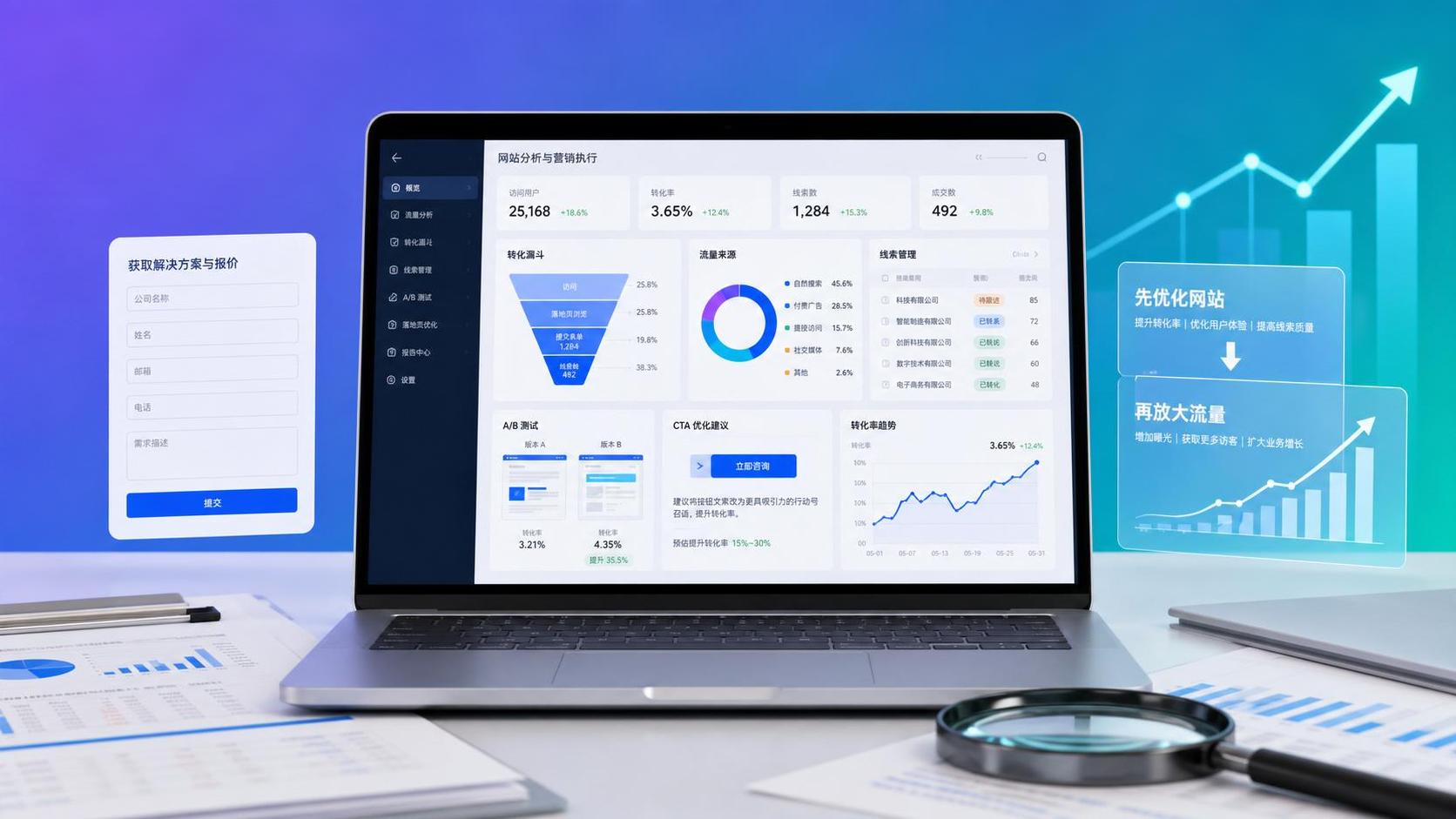
The basic calculation is generally the number of target actions divided by the number of valid visits. However, as B2B purchasing cycles are long, businesses should not focus solely on the total number of form submissions. Companies should also distinguish among qualified inquiry rate, sales follow-up rate, opportunity rate, and contribution to closed deals, avoiding the masking of actual operational issues with low-quality leads.
The scope of website conversion rate optimization includes traffic quality, page engagement, communication efficiency, and lead handling. It is neither a one-time website redesign nor merely an adjustment to button colors; rather, it creates a coherent and credible decision-making path between traffic sources, purchasing intent, and the next action.
II. Technical Principles of Page Experience and Marketing Funnels
After entering a website, visitors quickly determine whether the page is consistent with their search terms, advertising promises, or social media content. The above-the-fold section should first answer what the product is, the scenarios it is suitable for, and what capabilities the company can provide, while offering a clear, low-friction entry point for the next step to reduce cognitive gaps.
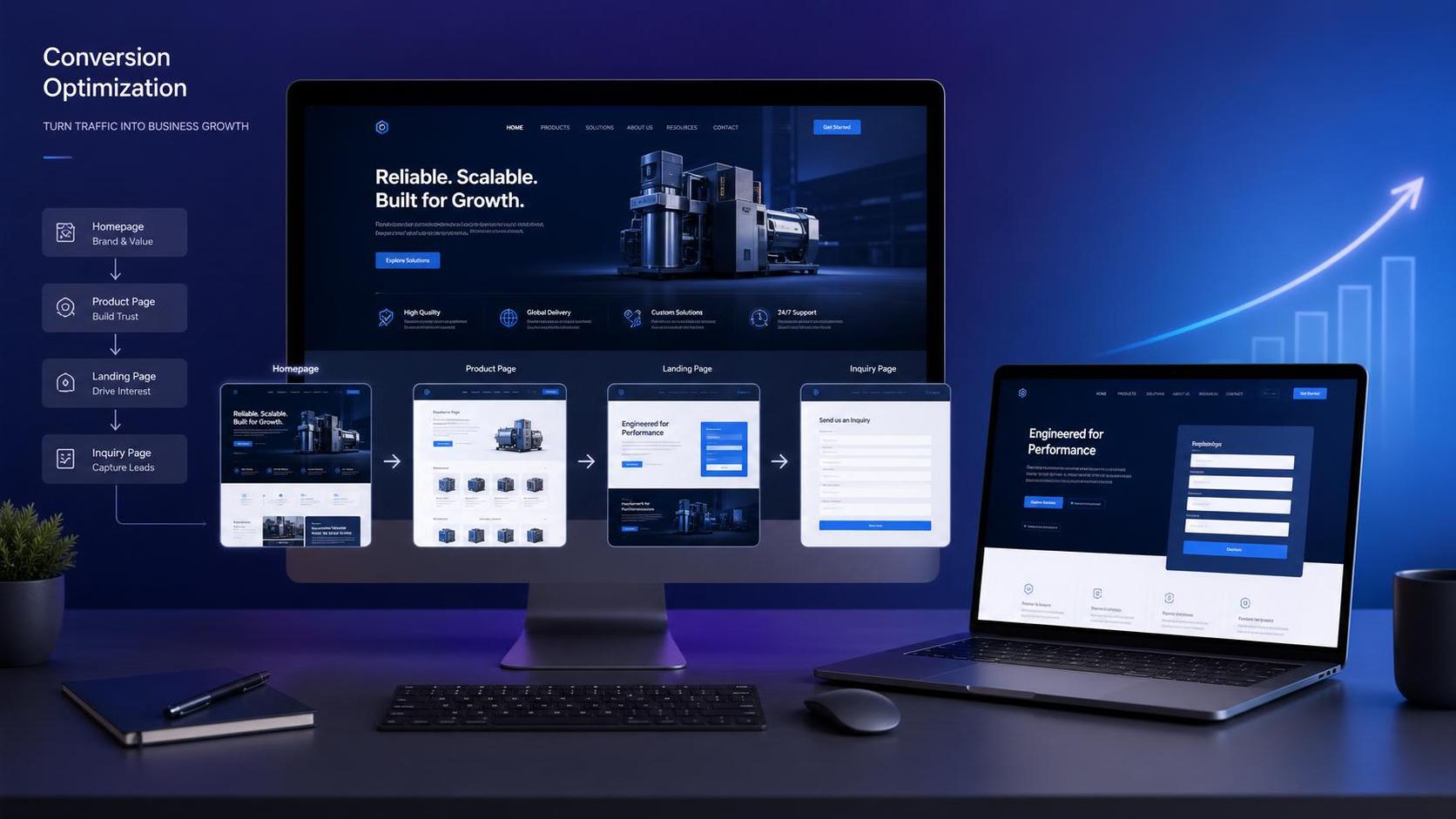
Within the funnel, the homepage establishes positioning, category pages assist with filtering, product pages explain specifications and value, case study and certification pages reduce risk, and forms or instant communication tools collect leads. Missing information at any stage may result in visitor loss or lower inquiry quality.
From a technical perspective, attention should be paid to mobile compatibility, loading speed, form usability, page stability, tracking completeness, and access security. Particularly in overseas traffic scenarios, latency, language mismatches, or complex forms can directly weaken users' willingness to continue browsing and contact suppliers.
III. Main Types and Applicable Audiences
By objective, optimization can be categorized into inquiry-oriented optimization, e-commerce optimization, brand awareness optimization, and lead nurturing optimization. Manufacturing plants and foreign trade companies generally focus on purchasing inquiries and sample requests, while cross-border brands are more concerned with add-to-cart actions, checkout completion, repeat purchases, and return on advertising spend.
By improvement focus, it can be categorized into traffic matching optimization, information architecture optimization, product detail page optimization, trust-building optimization, form optimization, and data analysis optimization. Mature projects typically advance through a combination of these measures rather than addressing a single page or channel in isolation.
Applicable groups include export companies seeking to reduce dependence on trade shows and platforms, brand owners who need to validate the market after launching a new website, teams with advertising budgets but unstable inquiries, and industrial product suppliers and service companies with complex products that require long-term buyer education.
IV. Selection Criteria and Foreign Trade Application Scenarios
When selecting website conversion rate optimization services, businesses should first confirm whether the service provider can understand the customer's purchasing journey, product technical barriers, language habits in target countries, and sales follow-up methods. Providers that offer only template-based redesigns without data diagnostics, content strategies, and review mechanisms often find it difficult to achieve sustained results.
Yiyingbao provides coordinated website development, SEO, advertising, social media, and website operation services for foreign trade B2B and cross-border standalone websites. It can configure product pages, multilingual content, inquiry entry points, and promotional landing pages in an integrated manner. Its responsive architecture and global node deployment are also suitable for companies that value the overseas browsing experience.
Industries such as laser equipment, steel, chemicals, heavy-duty trucks, machinery, new energy, and medical care typically need to present parameters, application conditions, production capacity, quality control, and delivery processes. When targeting different markets, page information should also be adjusted according to local compliance requirements, unit conventions, and purchasing habits.
V. Implementation Process, Quality Control, and Operational Methods
Implementation should begin with a baseline diagnosis, reviewing traffic volume from each channel, exit points, key landing pages, device distribution, form completion rates, and sales feedback. Priorities should then be defined, such as first resolving inconsistencies in advertising landing page information, followed by insufficient product page content or missing communication entry points.
During the page production stage, a content review mechanism should be established: technical parameters should be confirmed by business personnel, case studies and certifications should have verifiable sources, and multilingual versions should be reviewed for terminology, dimensions, and calls to action. Before launch, mobile display, links, form notifications, tracking, and page loading performance must also be tested.
After launch, periodic reviews should replace one-time assessments. Based on search terms, ad keywords, heat maps, session records, and sales evaluations, businesses can continuously adjust page hierarchy, content sequence, and conversion entry points. When AI is used to assist in content generation, human proofreading and industry fact verification should still be retained.
VI. Total Cost of Ownership and Return on Investment Evaluation
The total cost of ownership for website conversion rate optimization is not equivalent to the page design quotation. It also includes research and diagnostics, content collection, multilingual localization, development and testing, data tools, advertising landing page support, ongoing operations, and internal sales coordination. Buyers should clarify which items are delivered in stages and which are long-term services.
When evaluating return on investment, it is recommended to focus on cost per qualified lead, number of qualified opportunities, average order gross profit, and sales cycle, rather than comparing only traffic volume or the number of forms. For high-value industrial products, one high-quality lead that reaches the quotation stage may be worth more than a large number of invalid inquiries.
Companies can first select product lines with concentrated traffic and clear commercial intent to establish pilot projects, then replicate effective methods across other country and language sites. When budgets are limited, priority should be given to resolving performance, information, and trust issues that affect inquiries before expanding content production and paid traffic placement.
VII. Maintenance Cycles and Future Industry Trends
Optimization frequency should match traffic scale and business changes. For websites with active advertising campaigns or frequent product updates, the core funnel can be reviewed weekly. For websites driven mainly by organic traffic, keywords, page performance, and inquiry quality can be reviewed monthly, with a structural assessment conducted quarterly.
Future website conversion rate optimization will place greater emphasis on first-party data, cross-channel attribution, multilingual localization, and content credibility. Search, social media, advertising, and AI question-and-answer environments jointly influence purchasing decisions, and companies need to ensure that commitments made across all channels are consistent with the information on website pages.
Generative search brings new ways of presenting content. Companies can build up clear product knowledge, frequently asked questions, solutions, and entity information to increase the likelihood that their content will be understood and cited. Regardless of how tools evolve, building pages around genuine purchasing needs, verifiable capabilities, and smooth communication remains the foundation for long-term conversions.
 Website Conversion Rate Optimization or Traffic Growth: Which Should Come FirstWebsite conversion rate optimization or traffic growth: which should come first? First, assess whether your website has the capacity to convert incoming traffic, then decide whether to scale traffic. This article examines conversion paths, content completeness, data tracking, and different business scenarios to help you avoid detours and improve lead generation efficiency.
 Which pages should you start with for conversion rate optimization on an independent websiteWhich pages should you start with for conversion rate optimization on an independent website? Prioritize reviewing the homepage, product pages, landing pages, and inquiry page to quickly identify key touchpoints that affect inquiries and orders. Learn optimization approaches for high-converting pages to improve traffic handling efficiency and overseas customer acquisition results.
 How to assess website conversion rate optimization costs? Is it based on problem diagnosis, page redesign, or long-term operation?How to evaluate website conversion rate optimization costs? This article delves into three pricing models: problem diagnosis, page redesign, and long-term operation. It teaches you how to determine if a quote is reasonable, how to control hidden costs, and how to find an optimization solution that is more suitable for your business growth.
 Overseas Social Media Operations Data Analysis: Should You Focus on Engagement Rate or Conversion Rate First?Should you focus on engagement rate or conversion rate first when analyzing overseas social media operations data? Combining cold-start, customer acquisition, and website conversion scenarios, this article shows you how to identify key metrics through a holistic customer journey approach, avoid focusing only on surface-level data, and improve inquiry and conversion efficiency.