











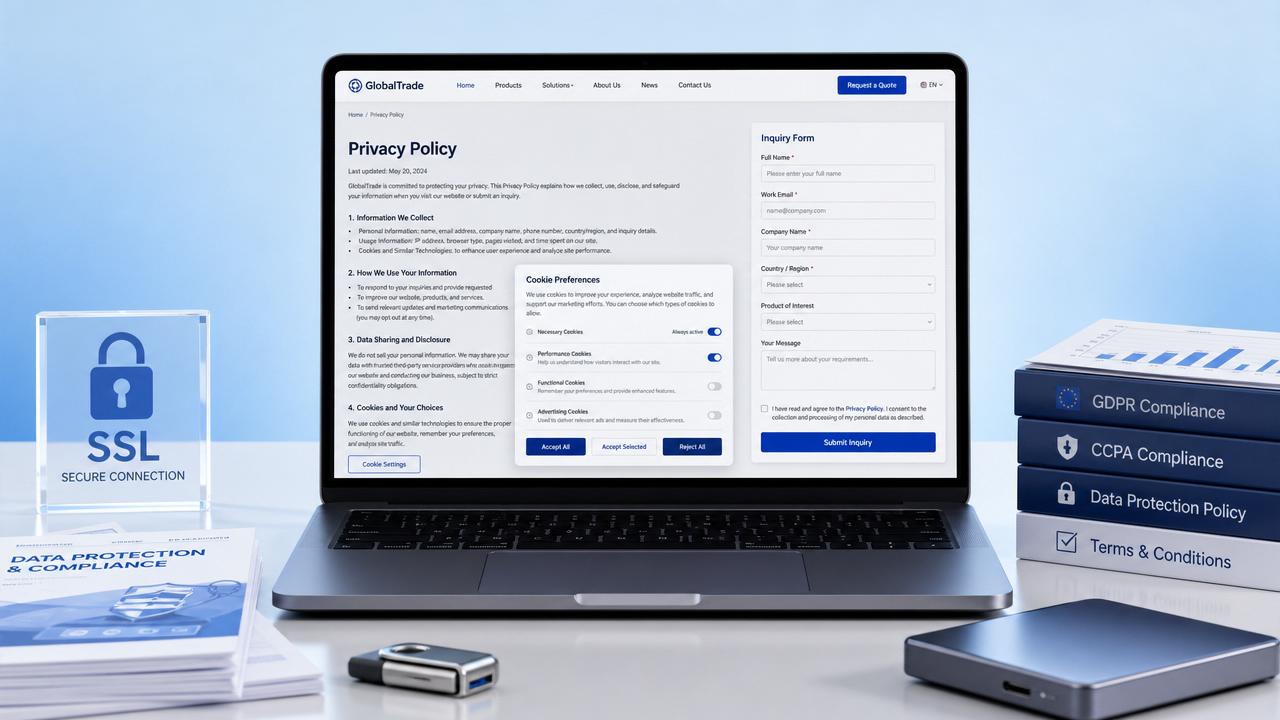


I. Definition and Scope of Compliance Configurations for Foreign Trade Websites
The compliance configurations required for a foreign trade website are essentially management mechanisms that enable companies to clearly explain, provide choices for, and trace the handling of visitor data, website content, marketing tracking, and transaction rules. This does not simply mean posting a privacy policy page; it covers the entire process of site visits, inquiries, order placement, remarketing, and after-sales communication.
For B2B export companies, names, email addresses, phone numbers, company names, purchasing requirements, document download records, and online chat content may all constitute information requiring prudent handling. Companies should clearly define the purpose of collection, retention period, scope of third-party sharing, and rights that users may exercise.
Compliance configurations also include disclosure of entity information, terms of service, disclaimers, Cookie management, encrypted transmission, marketing consent, and minor protection. Specific requirements vary according to the target market, business model, types of data actually collected, and platforms integrated, and templates should not be applied indiscriminately.
II. Core Configuration Categories and Technical Principles
A privacy policy should clearly describe the operating entity, contact details, categories of information, purposes of processing, legal basis, retention methods, and channels for user requests. The page should be consistently accessible from the footer and aligned with the actual operation of form fields, customer service tools, analytics tools, and email systems.
The technical focus of a Cookie banner is to obtain valid choices before loading non-essential tracking scripts. Essential Cookies required to maintain login sessions, shopping carts, or security protection can be explained separately from non-essential Cookies used for analytics, advertising attribution, and personalized recommendations, while retaining options to reject and modify preferences.
Form consent requires informing users of the intended use of information near the submission button and providing a link to the privacy policy. If email subscriptions, promotional quotations, or synchronization with a customer management system are planned, necessary inquiry submissions should be distinguished from optional marketing consent, avoiding the use of pre-selected checkboxes in place of users' explicit choices.
III. Configuration Priorities for Different Business Models
Inquiry-driven foreign trade websites should prioritize a privacy policy, Cookie preference management, inquiry form notices, terms of service, HTTPS encryption, and disclosure of company contact information. Pages that communicate through WhatsApp, email, or online customer service should also explain that relevant third-party tools may participate in data processing.
In addition to the above basics, B2C cross-border online stores also need to improve explanations of prices and taxes, delivery coverage, refunds and returns, payment methods, order cancellations, and consumer dispute resolution rules. When selling regulated products, product labels, restrictions, and corresponding risk notices should be added according to the destination market.
The risks of advertising landing pages are often overlooked. Before integrating advertising pixels, remarketing code, or conversion tracking, ensure that Cookie classifications and consent logic cover the relevant scripts. The compliance configurations required for a foreign trade website should not be checked only on the homepage; download pages, campaign pages, and multilingual pages should all be included in the review.
IV. Selection Criteria for Global Markets
Selection should begin by identifying the countries of origin of customers, primary customer acquisition channels, whether transactions are completed online, whether sensitive information is processed, and whether analytics, advertising, customer service, and payment services are used. The more target markets there are, the greater the need for a system that can be flexibly configured by region, language, and Cookie category, rather than relying on static pop-ups.
At the technical level, assess whether the system supports consent records, delayed script loading, withdrawal of consent, version updates, multilingual policy pages, permission management, and data export and deletion requests. SSL certificates, backups, access logs, vulnerability remediation, and third-party account permissions are also important components of data governance.
Yiyingbao is designed for multilingual standalone websites and overseas marketing scenarios, integrating responsive website building, SSL certificates, global node acceleration, form entry points, and marketing page operations into the same workflow. Companies should still confirm their specific obligations based on their own business and target markets, and regularly verify whether configurations are consistent with the actual tools used.
V. Applicable Companies and Typical Application Scenarios
Manufacturing factories, OEM and ODM companies, machinery and equipment suppliers, chemical companies, and new energy companies typically aim to obtain high-quality inquiries, with forms, sample downloads, quotation requests, and online customer service serving as key touchpoints. Compliance design should make information notices and consent procedures clearly visible without hindering communication with buyers.
Cross-border brands and online store operators need to pay additional attention to the connection between order data, payment interfaces, logistics service providers, and email automation tools. Different markets do not place exactly the same emphasis on consumer notifications, refund rules, and marketing communications. Website language switching should not be merely translation; the expression of rules should also be reviewed accordingly.
Yiyingbao has served clients in industries including laser engraving machines, steel, chemicals, heavy-duty trucks, machinery, new energy, agriculture, healthcare, and furniture, as well as companies such as Haier, Aokema, Shandong Airlines, and Xiaoya Group. Such multi-industry experience indicates that compliance pages should be configured specifically according to product characteristics, visitor regions, and customer acquisition processes.
VI. Implementation Process, Maintenance Cycle, and Quality Control
Implementation can proceed through data inventory, rule confirmation, page deployment, script configuration, cross-device testing, and pre-launch review. First, list every form, plug-in, analytics code, advertising pixel, customer service system, and email tool, then confirm what information they collect, where it is sent, and who has administrative permissions.
Pre-launch testing should cover desktop and mobile devices, different language paths, script behavior after Cookies are rejected, display of form notices, accessibility of policy links, and withdrawal options. In particular, avoid situations where analytics or advertising code has already written non-essential Cookies before users have made a choice.
A comprehensive review is recommended at least once a year. Reviews should also be conducted when adding a country-specific website, advertising platform, payment service, online customer service, data field, or email automation process. After a website redesign, old pages, cached pages, and embedded forms should also be checked to avoid discrepancies between policies and actual operations.
VII. Total Cost of Ownership and Future Development Trends
The total cost of compliance includes not only policy copywriting and plug-in fees, but also multilingual maintenance, technical integration, servers and security, team training, third-party tool reviews, and subsequent updates. For export companies, a low-cost one-time deployment that cannot adapt to new markets or marketing tools often results in higher adjustment costs later.
When evaluating return on investment, companies should also monitor valid form submission rates, the availability of advertising attribution, rejection rates, data request processing efficiency, page loading performance, and sales lead quality. Sound consent design is not simply about adding pop-ups; it establishes a sustainable balance between informed choice and conversion experience.
In the future, the compliance configurations required for foreign trade websites will place greater emphasis on region-based dynamic display, first-party data management, server-side tracking, artificial intelligence content governance, and verifiable consent records. Choosing a service system that can continuously update its website building, marketing, and data management capabilities helps companies reduce repetitive construction costs when expanding into new markets.
