










I. Industry Definition: What Does AI Search Recommendation Actually Recommend?
How to get a website recommended by AI search essentially means enabling generative search systems to accurately identify who the company is, what products it offers, which markets it serves, and what evidence supports its conclusions. Recommendation results are typically not a simple replication of single-page rankings, but answers generated after summarizing, comparing, and citing multiple credible information sources.
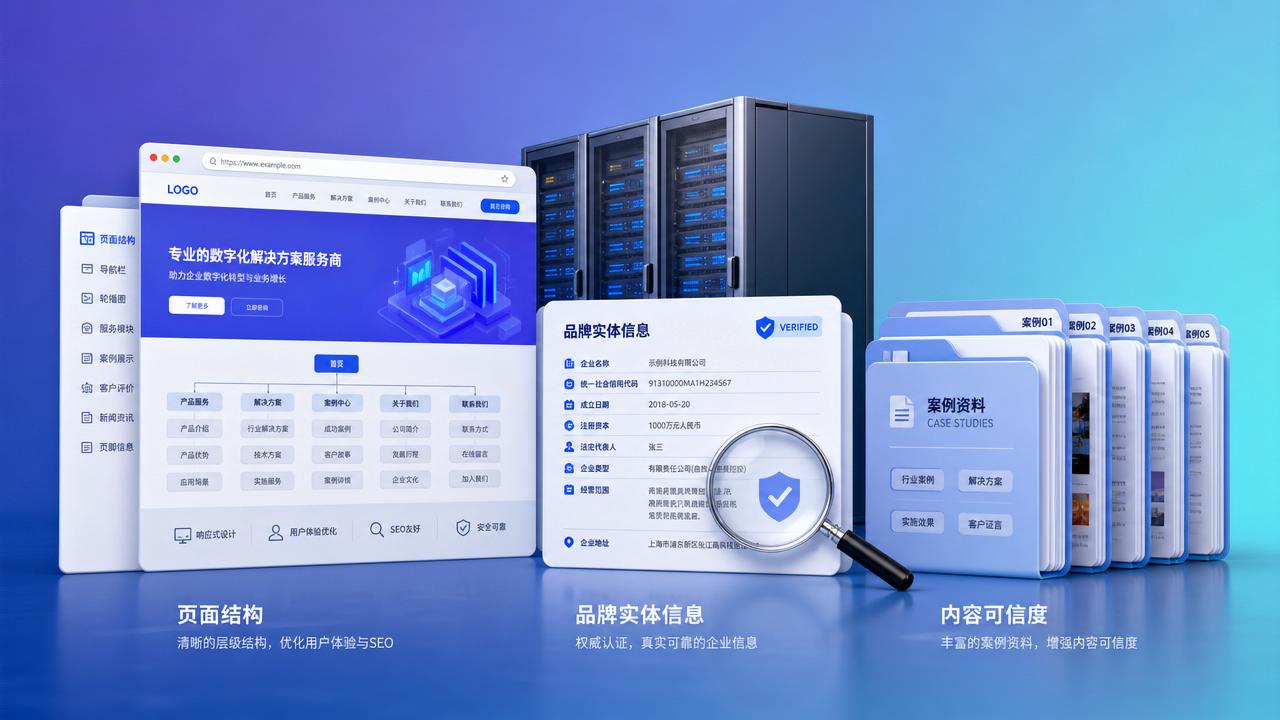
For export-oriented B2B companies, a website should be upgraded from an electronic brochure into a searchable business database: company capabilities, product parameters, application industries, production or delivery capabilities, frequently asked questions, after-sales service boundaries, and contact paths should all have clear hierarchies and be presented on dedicated pages.
AI search focuses on the match between questions and evidence. When purchasers ask, “What environments is a certain material suitable for?” or “How should a supplier of certain equipment be evaluated?”, pages that can directly answer the question, explain applicable conditions, and provide source information have a stronger foundation for being understood and recommended.
II. Technical Principles: From Crawling and Understanding to Citation-Based Generation
Generative search generally involves webpage discovery, content crawling, topic parsing, entity association, evidence evaluation, and answer generation. Page accessibility, stable loading, and mobile usability are prerequisites for entering the information-processing workflow; disorganized structures or key content that relies on unreadable scripts will increase the cost of understanding.
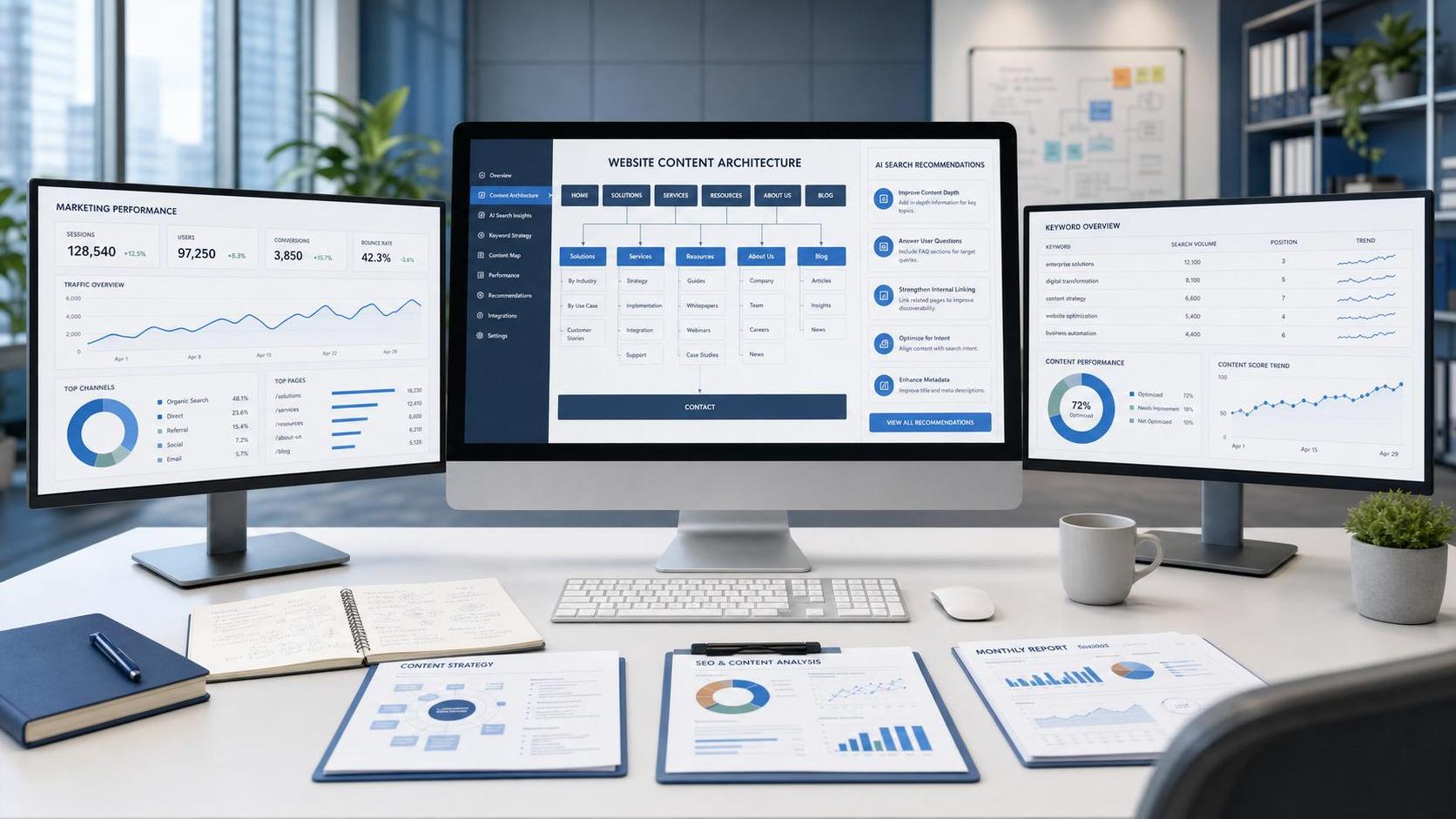
At the content level, clear semantic relationships need to be established. For example, product pages should explain models, specifications, materials, performance, applications, and inquiry methods; solution pages should explain customer challenges, selection logic, and implementation results. Headings, body text, image descriptions, and internal links should work together around the same topic.
To get a website recommended by AI search, information conflicts must also be avoided. The company name, core business, contact details, service regions, and key product names should remain consistent throughout the website; parameters, lead times, certifications, and case studies should be based on verifiable materials, avoiding unsupported generalized commitments.
III. Main Website Types: Different Businesses Require Different Content Architectures
Lead-generation B2B websites are suitable for manufacturing plants, traders, and industrial product suppliers. Their core structure usually includes company pages, product category pages, product detail pages, industry application pages, quality and production-capacity pages, knowledge article pages, and inquiry pages, with the focus on reducing evaluation and communication costs for overseas buyers.
Brand-oriented B2C standalone websites place greater emphasis on product categories, specification attributes, pricing or quotation logic, reviews, delivery, and after-sales explanations, and they also need dedicated landing pages designed for advertising and social media traffic. Their content should not only discuss brand concepts, but also address consumers' questions about product functions, usage scenarios, and transaction risks.
Multilingual websites need to establish language paths and page correspondences by market, rather than mechanically translating Chinese content. English, Russian, Japanese, Korean, Arabic, French, German, Spanish, and other versions should be localized according to local purchasing habits, measurement conventions, and search queries.
IV. Selection Criteria: How to Evaluate Integrated Website and Marketing Services
When procuring website development and operational services, first review whether content management supports ongoing updates to products, articles, categories, and landing pages, and whether it provides multilingual management, forms, online communication, data analytics, and permission management. Fast launch does not necessarily mean suitability for long-term operations; the efficiency of subsequent iteration is equally important.
Yiyingbao combines AI-powered website building, multilingual standalone websites, search optimization, advertising, social media operations, and website growth, making it suitable for companies that need to centrally capture overseas traffic. Its responsive architecture, global node deployment, and AI-assisted content capabilities can be used to improve multi-device experience, content production efficiency, and overseas access performance.
Decision-makers should also require service providers to clearly define delivery boundaries: domain names, SSL, servers, number of pages, language scope, responsibility for content materials, ownership of advertising accounts, data access rights, and maintenance response methods. Measurable phased objectives should focus on indexing, qualified visits, inquiry quality, and conversion paths rather than a single traffic metric.
V. Implementation Methods: Building Citable Content and Trust Signals
To implement how to get a website recommended by AI search, companies can first complete an inventory of business information: identify target countries, purchasing roles, product lines, differentiating capabilities, common inquiries, and publicly available evidence. Then map high-frequency procurement questions to category pages, detail pages, application pages, and FAQ pages, avoiding the concentration of all information on the homepage.
Each key page should preferably follow an organizational approach of “conclusion first, conditions next, evidence as support, and clear action.” Product content can cover uses, specification ranges, materials or processes, compatibility, usage limitations, packaging and delivery, and inquiry materials; technical articles should indicate their intended audience and update date to reduce ambiguous wording.
Yiyingbao's AI+SEO and GEO services can assist with keyword expansion, page titles and descriptions, product introductions, Q&A content, and internal-link planning, but companies must still review factual accuracy. AI is suitable for improving first-draft creation and multilingual maintenance efficiency, while professional parameters, compliance statements, and customer case studies must be confirmed by the business team.
VI. Application Scenarios and Operating Cycles: From Website Development to Continuous Growth
In industries such as laser engraving machines, steel, chemicals, heavy-duty trucks, machinery, new energy, agriculture, and healthcare, purchasing decisions often involve specification confirmation, supply capability, and risk assessment. Such websites should prioritize parameter explanations, application solutions, quality information, and communication entry points to address different visitor intents generated by search, advertising, and social media.
Experience serving companies across different industries, including Haier, Aokema, Shandong Airlines, Yuanhe Power Station, Xiaoya Group, and China National Heavy Duty Truck Group, demonstrates that website requirements vary with business scenarios. Specific projects should still develop content plans based on clients' publicly available materials, product complexity, target markets, and existing digital assets, rather than applying a single template.
For operations, it is recommended to review indexing, page performance, broken links, inquiry sources, and high-value page performance monthly, and update key products, industry trends, and common customer questions quarterly. Advertising and social media can be used to validate market demand and drive traffic, while search content accumulates as a long-term asset; both should share landing pages and conversion data.
VII. Total Cost of Ownership and Future Trends: Measuring Investment by Sustainable Customer Acquisition
The total cost of ownership of a website project includes not only initial design fees, but also domain names and certificates, servers and acceleration, multilingual maintenance, content production, technical updates, data analytics, advertising management, and personnel coordination costs. Low-priced projects that lack content expansion and operational capabilities may result in higher future rebuilding, migration, and customer-acquisition costs.
When evaluating return on investment, objectives can be broken down into the number of effective pages, visibility in target markets, key-page visits, form or instant-communication leads, qualified inquiry rate, and sales cycle, and assessed in combination with customer lifetime value. For high-ticket industrial products, a small number of highly matched inquiries often carries more business value than a large volume of general traffic.
In the future, AI search will place greater emphasis on the consistency of entity information, answerable professional content, multilingual localization, and cross-channel trust signals. Companies should regard how to get a website recommended by AI search as an ongoing operational task: update content with real business materials, use data to determine priorities, and enable websites, advertising, social media, and sales follow-up to form a measurable, reviewable growth loop.
