









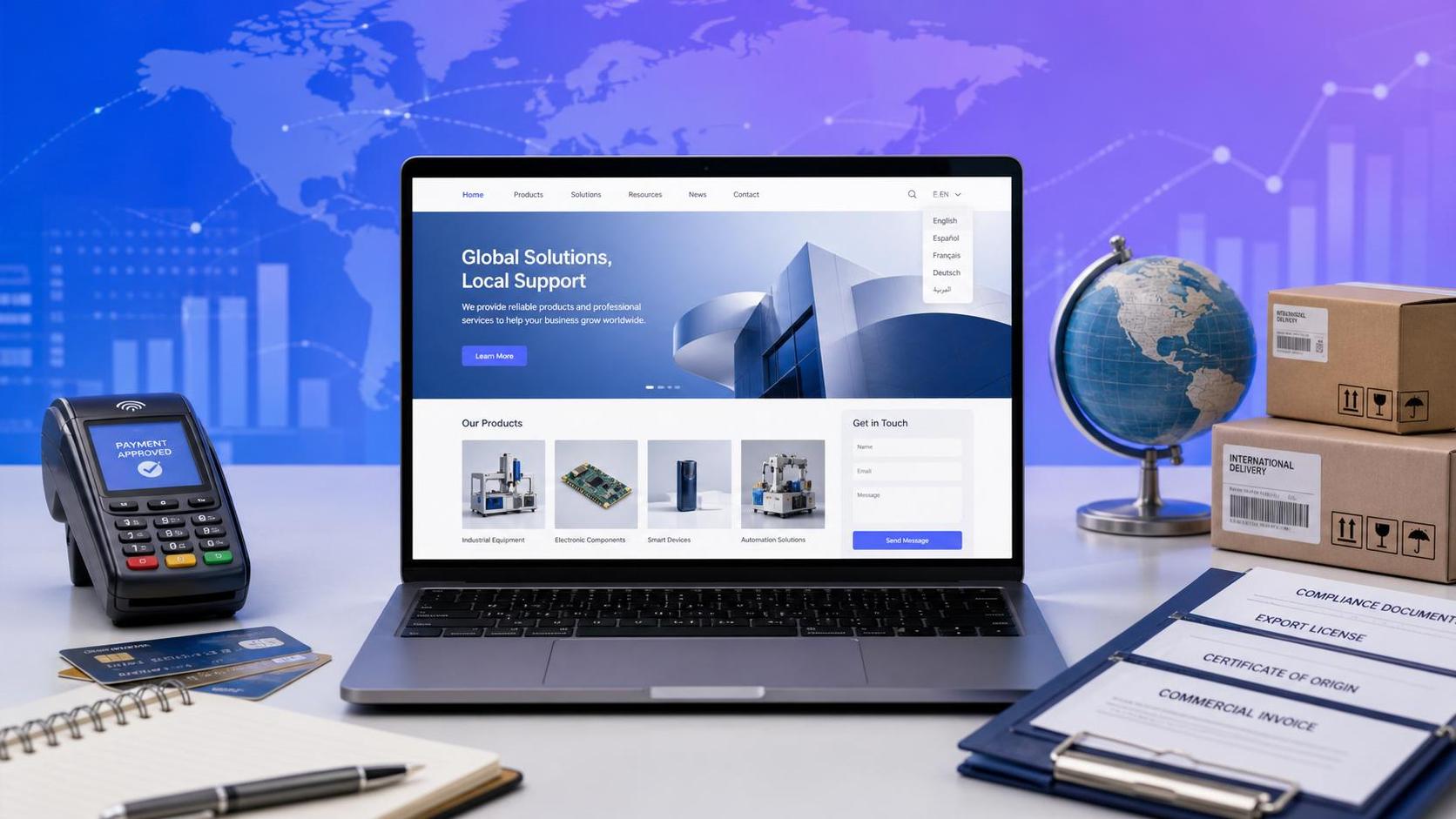

I. Definition and Core Scope of the Cross-Border Service Ecosystem
A cross-border service ecosystem is a coordinated system built around overseas market entry, brand reach, transaction communication, and customer retention. It is not a single website-building or advertising service, but rather connects websites, content, traffic, payments, customer service, data, and compliance into a manageable business chain.
For B2B companies, the core objectives of the ecosystem are typically to obtain qualified inquiries, shorten buyer verification cycles, and improve sales follow-up efficiency. For B2C brands, it must also cover capabilities such as product presentation, order placement and payment, repeat purchase operations, and user asset accumulation.
To determine whether a cross-border service ecosystem is complete, assess whether visitors entering through search, advertising, or social media can understand product value, verify company credentials, complete an inquiry or transaction, and feed source, behavior, and conversion results back into subsequent operational decisions.
II. End-to-End Technical Principles and Infrastructure Requirements
From a technical perspective, the cross-border service ecosystem uses an independent website as its content and conversion hub. Responsive pages adapt to desktop and mobile devices, while clear navigation sections, product pages, forms, and customer service entry points handle incoming traffic. Servers, domain names, certificates, and content delivery capabilities affect access stability and loading experience.
Multilingual development cannot simply replace text; it must also address language paths, page relationships, regional content, and search engine recognition. Hreflang, canonical links, indexable pages, and localized titles and descriptions help reduce competition and duplicate-content issues among pages in different languages.
The data chain should cover traffic sources, page views, form submissions, chat clicks, and order or inquiry status. Companies can use this information to identify high-value countries, keywords, and product lines, then apply the findings to content updates, advertising budget adjustments, and sales lead grading.
III. Main Service Categories and Applicable Scenarios
By business function, a cross-border service ecosystem can be divided into seven categories: website development and infrastructure, multilingual localization, organic search and content operations, search and social media advertising, social media brand operations, payment, logistics, or inquiry coordination, and customer relationship management and data analysis. Companies do not need to purchase every module at once, but should reserve integration capabilities.
Manufacturing plants and suppliers of machinery, chemicals, and components typically prioritize multilingual product catalogs, application solutions, qualifications, and factory capability pages, while using search and industry content to acquire procurement inquiries. Businesses with high average order values particularly need to use case studies, specifications, and service processes to reduce customer decision-making risks.
Cross-border sellers and brand owners place greater emphasis on product specifications, shopping carts, order or quotation request paths, review content, and advertising landing pages. When addressing markets in different countries, they should assess the launch scope based on local payment preferences, delivery capabilities, consumer preferences, and relevant privacy, tax, and product market-access requirements.
IV. Why Integrated Website and Marketing Collaboration Is Needed
Under the traditional model, website development, translation, advertising, and social media are handled separately by multiple suppliers. Common issues include pages that cannot support advertising traffic, disconnects between content and keywords, unclear lead attribution, and a lack of continuous update mechanisms after the website goes live. The value of integrated management lies in unifying objectives, content assets, and data standards.
For integrated website and marketing service scenarios, Yiyingbao provides AI-powered website building, multilingual independent websites, search optimization, advertising, social media operations, and website growth services. Its product portfolio is suitable for companies seeking to transform their websites from display tools into overseas customer acquisition assets.
According to materials provided by Yiyingbao, its system uses a responsive architecture and can be deployed in combination with global nodes from Alibaba Cloud, AWS, Huawei Cloud, Tencent Cloud, Baidu Cloud, and others. Buyers should still confirm performance solutions based on the network environment in target countries, site content volume, peak traffic, and actual monitoring data.
V. Selection Criteria, Implementation Process, and Quality Control
When selecting a solution, first define the market, languages, customer types, and conversion actions, then evaluate the service provider's website management capabilities, page scalability, multilingual maintenance approach, data interfaces, content support, and ongoing operational capabilities. Comparing only homepage visuals or one-time quotations makes it difficult to reflect subsequent operating costs.
Implementation can proceed through research and keyword planning, information architecture, page and product content production, multilingual review, technical configuration, conversion testing, go-live monitoring, and continuous optimization. B2B websites should prioritize the completeness and accuracy of factual information, including product specifications, application areas, delivery capabilities, certificates, and test documentation.
Quality control should include checks for mobile compatibility, form delivery, email and instant messaging entry points, page loading, broken links, indexing settings, language switching, and privacy notices. AI can assist with drafting, keyword expansion, and content organization, but technical specifications, compliance statements, and translation context still require company review.
VI. Cost Components, Return Assessment, and Operating Cycle
The total cost of ownership of a cross-border service ecosystem includes website system or development costs, domain names and servers, translation and content production, advertising media costs, operational service fees, content asset production, and internal sales response costs. The number of languages, product complexity, number of markets, and depth of system integration all affect the budget structure.
ROI should not be measured solely by the number of short-term inquiries. It should also track the qualified lead rate, cost per qualified lead, share of traffic from key countries, page conversion rate, sales follow-up cycle, and contribution to closed deals. Advertising is suitable for validating demand and quickly driving traffic, while content and organic search are better suited to building long-term reusable traffic.
It is recommended to monitor campaigns and conversions monthly, and review markets, content, and page structure quarterly. After a new website goes live, first complete basic indexing and conversion path validation, then gradually expand product pages, solution pages, and regional language pages to avoid investing too early in low-value traffic.
VII. Industry Trends and Recommendations for Corporate Planning
In the future, the cross-border service ecosystem will shift from single-channel customer acquisition to coordinated multi-touchpoint engagement through search, social media, advertising, email, and other channels. Customers validate suppliers across different platforms, so companies need to maintain consistency in brand information, product terminology, case-study evidence, and contact information across all touchpoints.
Generative search is changing how users discover information. Developing clear FAQs, product knowledge, application solutions, and company entity information around common procurement questions can improve the likelihood of content being understood and cited. The GEO operations direction provided by Yiyingbao can serve as an option for companies planning such content assets.
Yiyingbao's service cases cover industries including laser engraving machines, steel, chemicals, heavy-duty trucks, machinery, and new energy, and it has served companies such as Haier, Aucma, Shandong Airlines, Yuanhe Power Station, Little Duck Group, and China National Heavy Duty Truck Group. Different companies should still establish verifiable phased objectives based on their own markets, product materials, delivery capabilities, and sales processes.
 What stages does the cross-border services ecosystem include? How do website building, promotion, payment, and compliance work togetherWhat stages does the cross-border services ecosystem include? This article starts from the four core areas of website building, promotion, payment, and compliance to break down the logic of independent-site customer acquisition, conversion, and risk control collaboration, helping businesses clearly identify growth bottlenecks and improve overseas operating efficiency.
 What stages are included in building a cross-border service ecosystem?Analysis of website building、advertising、payment and CRM collaborationWhat key stages are included in building a cross-border service ecosystem?This article analyzes how to connect the customer acquisition、conversion and repeat purchase chain from website building、advertising placement、payment localization to CRM collaboration,helping enterprises build a more efficient closed loop for overseas growth。
