
I. Definition and Scope of Foreign Trade Marketing Solutions
Foreign trade marketing solutions comprise a set of methods, tools, and operational mechanisms that help export companies acquire overseas customers and grow their brands. Their core is not purchasing a specific traffic channel, but configuring accessible, understandable, trackable, and convertible digital touchpoints around target markets, customer decision-making journeys, and sales objectives.
In B2B scenarios, solutions typically use multilingual standalone websites as the central hub, connecting upstream to search engines, paid advertising, social media, industry content, and post-exhibition follow-up, and downstream to forms, email, instant communication tools, customer segmentation, and sales follow-up.
Therefore, when evaluating foreign trade marketing solutions, brand exposure, effective visits, marketing leads, qualified inquiries, and sales opportunities should be distinguished. Traffic volume itself is not the result; whether buyers can quickly verify product capabilities, qualifications, delivery terms, and communication channels determines the commercial value of traffic.
II. Operating Principles: From Traffic Reach to an Inquiry Closed Loop
An effective foreign trade marketing solution typically follows a closed loop of “market research—content development—channel traffic acquisition—landing-page conversion—conversion tracking—continuous optimization.” Countries, languages, application industries, purchasing roles, and core products are defined first, followed by decisions on keywords, page architecture, advertising targeting, and content topics.
At the technical level, a website needs responsive display, a clear information hierarchy, logical language paths, basic internationalization settings, indexable pages, and conversion-event tracking. Product specifications, application cases, FAQs, factory capabilities, and compliance materials should respectively serve search engine understanding and buyer verification.
At the conversion level, entry points should be set up for different levels of intent: users at the initial research stage can download catalogs or view cases, while high-intent prospects can submit RFQs, schedule consultations, or contact the company through WhatsApp or email. Lead quality should then be tracked by source, country, page, and product line to avoid evaluating campaign performance solely by cost per click.
III. Main Channel Categories and Applicable Scenarios
Organic search is suitable for manufacturing companies with numerous product models, clearly defined technical questions, and long purchasing cycles. Covering buyers’ search needs through product pages, solution pages, and industry knowledge content can gradually build long-term traffic, but requires ongoing maintenance of content quality, indexing status, and page conversion capability.
Search advertising is suitable for new product promotion, capturing peak-season traffic, testing key countries, and acquiring customers through high-intent keywords, allowing market demand to be validated relatively quickly. Social media content and advertising are more suitable for building awareness and demonstrating production processes, application results, and brand credibility. Both channel types should direct traffic to targeted landing pages rather than uniformly to the homepage.
For industries with complex decision-making, such as heavy equipment, chemicals, and new energy, content marketing and remarketing are particularly important. Buyers often need to compare suppliers repeatedly. Companies should continuously reduce decision uncertainty through technical materials, FAQs, case studies, and sales outreach rather than relying on a single click to complete a transaction.
IV. Who Should Deploy It and How to Choose a Service Model
Foreign trade marketing solutions are suitable for manufacturing factories, OEM/ODM companies, trading companies, industrial product suppliers, cross-border sellers, and global expansion teams seeking to reduce their reliance on a single platform or trade shows. Company size is not the only threshold; the key is having stable products, clear market direction, and the sales capability to handle inquiries promptly.
Before selection, objectives should be clarified: acquiring wholesaler inquiries in a specific country, entering non-English-speaking markets, promoting high-margin products, or establishing an independent brand presence. Different objectives correspond to different priorities. For example, new market validation can begin with advertising, while companies with complex product lines need a stronger foundation in information architecture and search content.
When selecting suppliers, key areas to review include website-building autonomy, data ownership, language management, technical support, content operation capabilities, advertising transparency, and data reporting standards. Buyers should also confirm account permissions, asset ownership, lead handover rules, and post-exit migration arrangements to reduce the risk of future operational dependency.
V. Yiyingbao Integrated Applications and Industry Practices
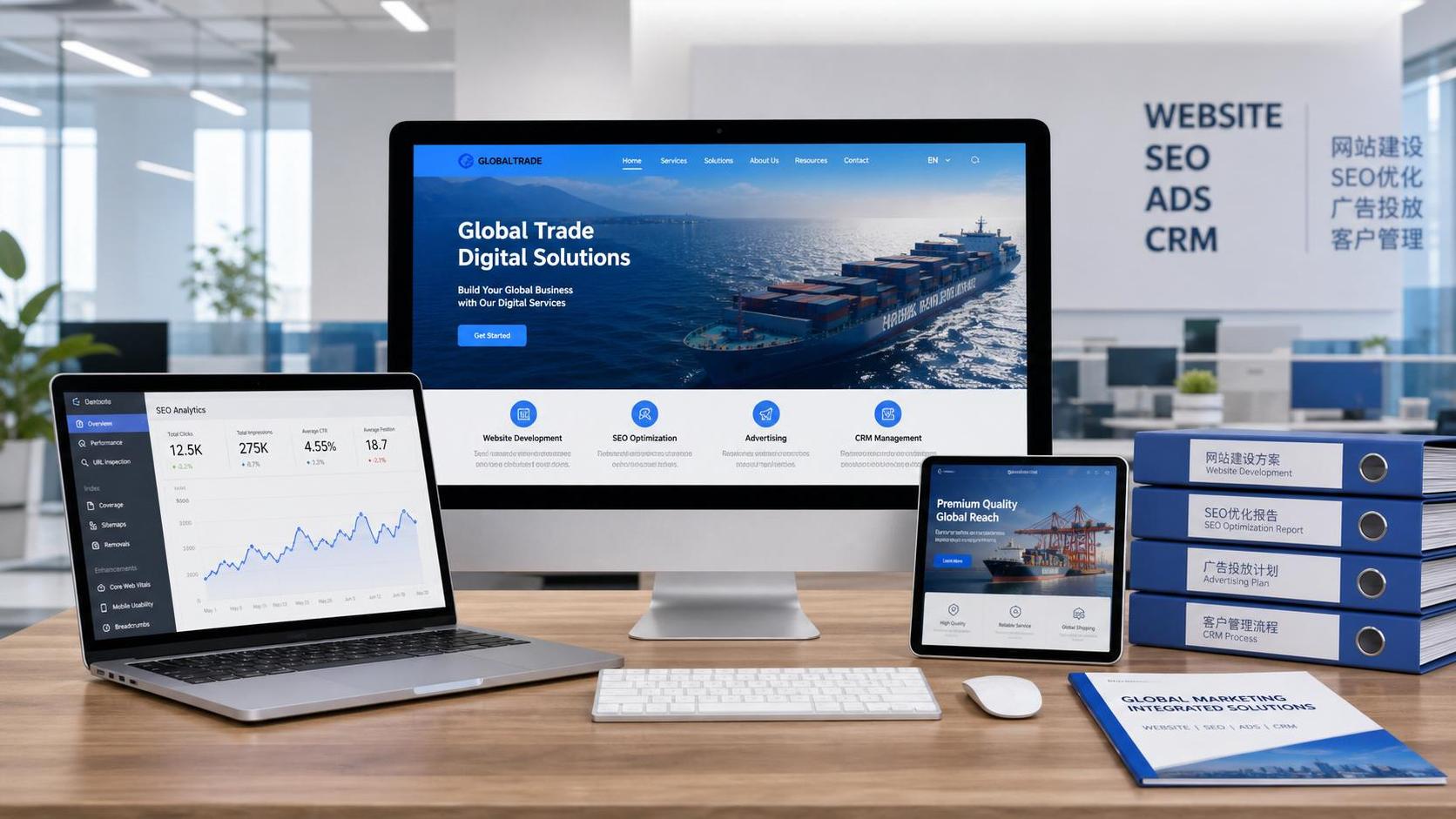
For integrated website and marketing service requirements, Yiyingbao provides AI-powered website building, multilingual standalone websites, search optimization, overseas advertising, social media operations, and website growth services. For companies lacking technical or overseas marketing teams, this type of integrated foreign trade marketing solution helps shorten the coordination chain among multiple suppliers.
Its responsive website-building capabilities support access from both PC and mobile devices, while its multilingual system covers common market languages including English, Russian, Japanese, Korean, Arabic, French, German, and Spanish. Companies can integrate product catalogs, factory strengths, industry applications, inquiry forms, and instant communication entry points into a unified website.
Yiyingbao’s publicly disclosed service scope covers industries including laser engraving machines, steel, chemicals, heavy trucks, machinery, new energy, medical care, and furniture, and lists service cases such as Haier, Aucma, Shandong Airlines, and Little Duck Group. Specific projects should still be planned based on product complexity, regional policies, sales cycles, and existing data.
VI. Implementation Steps, Quality Control, and Performance Evaluation
At the project initiation stage, product and market interviews should be completed to identify target countries, competitor pages, frequently asked customer questions, differentiated selling points, and technical materials that can be made public. A keyword map and website structure should then be established to avoid repeating the same product across different pages or leaving important pages without clear search and inquiry objectives.
Pre-launch quality control includes multi-device browsing, page loading, language switching, form delivery, link validity, privacy notices, and data-tracking tests. For multiple language markets, it is also necessary to check whether translations suit the product context and whether units, delivery times, certification statements, and contact information are consistent.
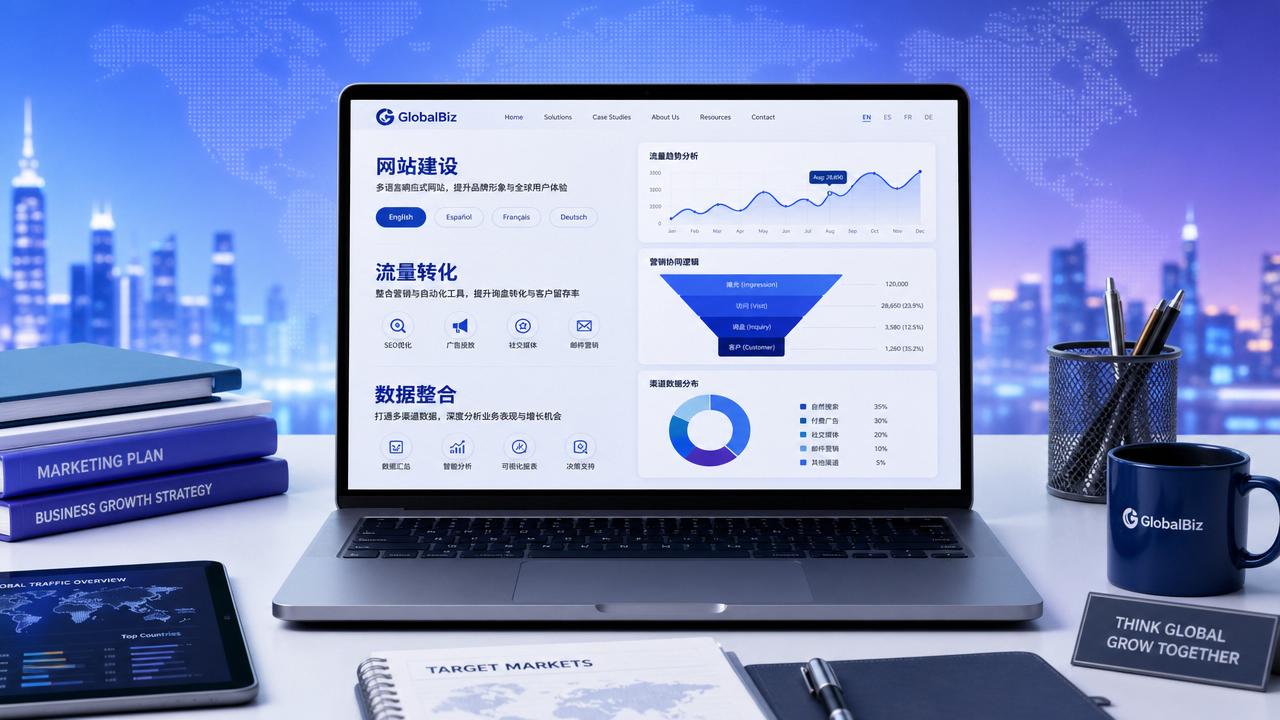
Performance evaluation should be broken down by funnel: impressions and rankings reflect coverage; visits and engagement reflect page relevance; forms, instant communications, and valid inquiries reflect conversion quality; while quotations, samples, and transactions reflect sales coordination. It is recommended to review channels, countries, product pages, and lead validity rates monthly rather than focusing solely on total traffic.
VII. Total Cost of Ownership, Return on Investment, and Future Trends
The total cost of ownership of foreign trade marketing solutions includes website development and infrastructure, multilingual content, design and technical maintenance, advertising media costs, operational service fees, data tool fees, and internal sales follow-up costs. Low-cost website development without content, tracking, and iteration capabilities may create higher hidden costs during subsequent customer acquisition stages.
ROI should not be calculated based on a single inquiry alone. Buyers can assess investment using cost per valid inquiry, opportunity conversion rate, average order gross margin, customer lifetime value, and the share of organic traffic. When budgets are limited, priority should be given to developing key product pages and measurable conversion paths before gradually expanding country, language, and content coverage.
In the future, generative search environments will place greater emphasis on brand entity information, structured Q&A, professional content, and multilingual consistency. Yiyingbao has already developed capabilities in AI + GEO, AI + SEO, and advertising intelligence. Companies should use AI to improve content production and analysis efficiency while retaining human responsibility for reviewing technical accuracy, market messaging, and lead assessment.
 How do you develop a foreign trade marketing solution? First clarify the channels, content, and conversion pathHow do you develop a foreign trade marketing solution? Don’t just look at advertising; you also need to clarify channel layout, content strategy, and conversion path. This article starts from SEO, advertising, social media, to multilingual website integration, helping enterprises build an executable overseas customer acquisition loop.
 How are the costs of foreign trade marketing solutions calculated? Breakdown of website building, SEO, advertising, and content investment.How to calculate the cost of foreign trade marketing solutions? Don't just look at the total price. This article breaks down the logic of website building, SEO, advertising, and content investment to help you understand your budget structure, customer acquisition costs, and conversion value, and quickly determine which solution is more worthwhile to invest in.
 Which Stages Are Most Suitable for Customized Foreign Trade Marketing Solutions for Manufacturing Companies?Customized foreign trade marketing solutions are most suitable for manufacturing companies at the stage of expanding their brands overseas, facing difficulties in customer acquisition, or upgrading their channels. By optimizing overseas visibility, inquiry conversion, and sales follow-up systems, these solutions help manufacturing companies improve customer acquisition efficiency, reduce lead waste, and quickly identify a growth path suited to their business.