I. Definition and Business Value of LinkedIn Content Operations
LinkedIn content operations are a systematic process that uses a company page, key management accounts, and employees’ professional accounts to continuously publish industry insights, product capabilities, application cases, and procurement knowledge, while driving B2B business opportunity conversion through engagement and data review. It is not simply about posting content, but about the coordinated management of brand, content, relationships, and conversion paths.
For manufacturing plants, OEM/ODM companies, and technology service providers, buyers typically conduct further supplier verification after making contact through trade shows, search, email, or advertising. Consistent LinkedIn content operations can demonstrate factory capabilities, team professionalism, and delivery experience, reducing information asymmetry and initial communication costs for overseas buyers.
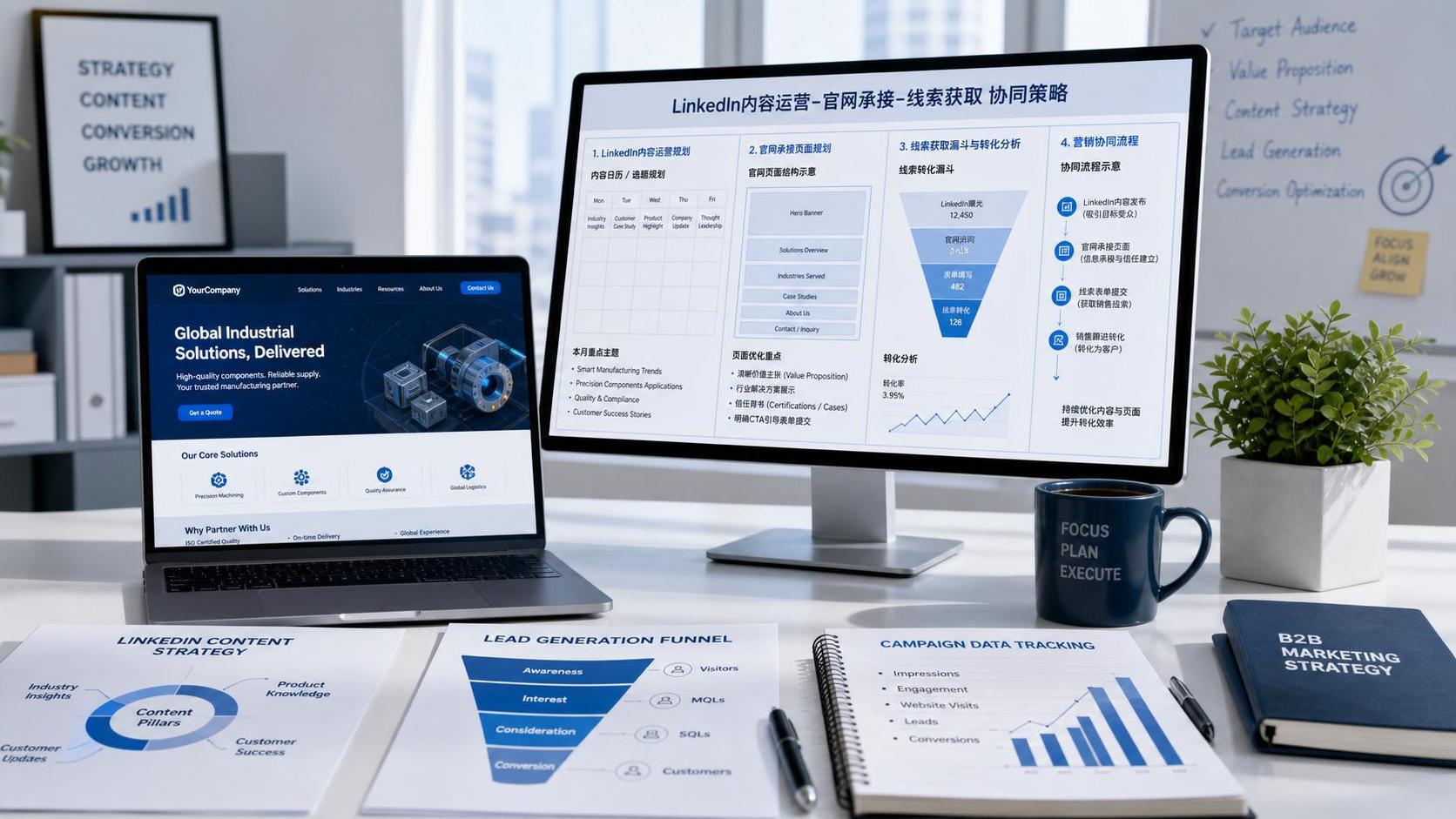
The ultimate value of content should not be measured solely by likes or follower counts, but by decision-maker reach in target regions, page visits, content clicks, website sessions, form submissions, and sales follow-up results. Only by linking social media content to product pages, solution pages, or booking pages can a measurable lead-generation funnel be formed.
II. Account Positioning and Content Mechanisms
Account positioning should first answer three questions: which countries or industries are served, what problems in the procurement process are solved, and why the company is trustworthy. Companies should not position themselves vaguely as “high-quality suppliers,” but should establish clear labels based on product categories, certification capabilities, delivery coordination, customization experience, or specific application scenarios.
The distribution performance of LinkedIn content is typically influenced by relevance, engagement quality, publisher credibility, and content dwell performance. Content should be organized around customers’ actual concerns, such as material selection, technical specifications, quality control, installation and maintenance, delivery processes, and project risks, rather than repeatedly listing corporate slogans.
It is recommended to establish a collaboration mechanism between the company page and personal accounts: the company page accumulates brand assets and formal cases, management accounts express professional judgment, and sales or engineering personnel participate in industry discussions. Before publishing, unify terminology, image authorization, customer confidentiality boundaries, and inquiry allocation rules to prevent inconsistent information from undermining trust.
III. Main Content Categories and Applicable Audiences
Common content can be divided into brand trust content, product solution content, industry knowledge content, project proof content, and engagement and conversion content. Brand trust content showcases teams, production lines, and service processes; product solution content explains specifications and applications; industry knowledge content answers procurement challenges; project proof content presents publicly available results; and engagement and conversion content guides users to download materials, visit the website, or schedule a discussion.
Machinery, chemical, new energy, medical, building materials, and component companies with high average order values and long decision cycles need to build long-term awareness through professional knowledge. Cross-border e-commerce brands can add content about product usage, user reviews, and brand stories, but landing pages should still provide key information such as pricing, specifications, delivery, and inquiry submission.
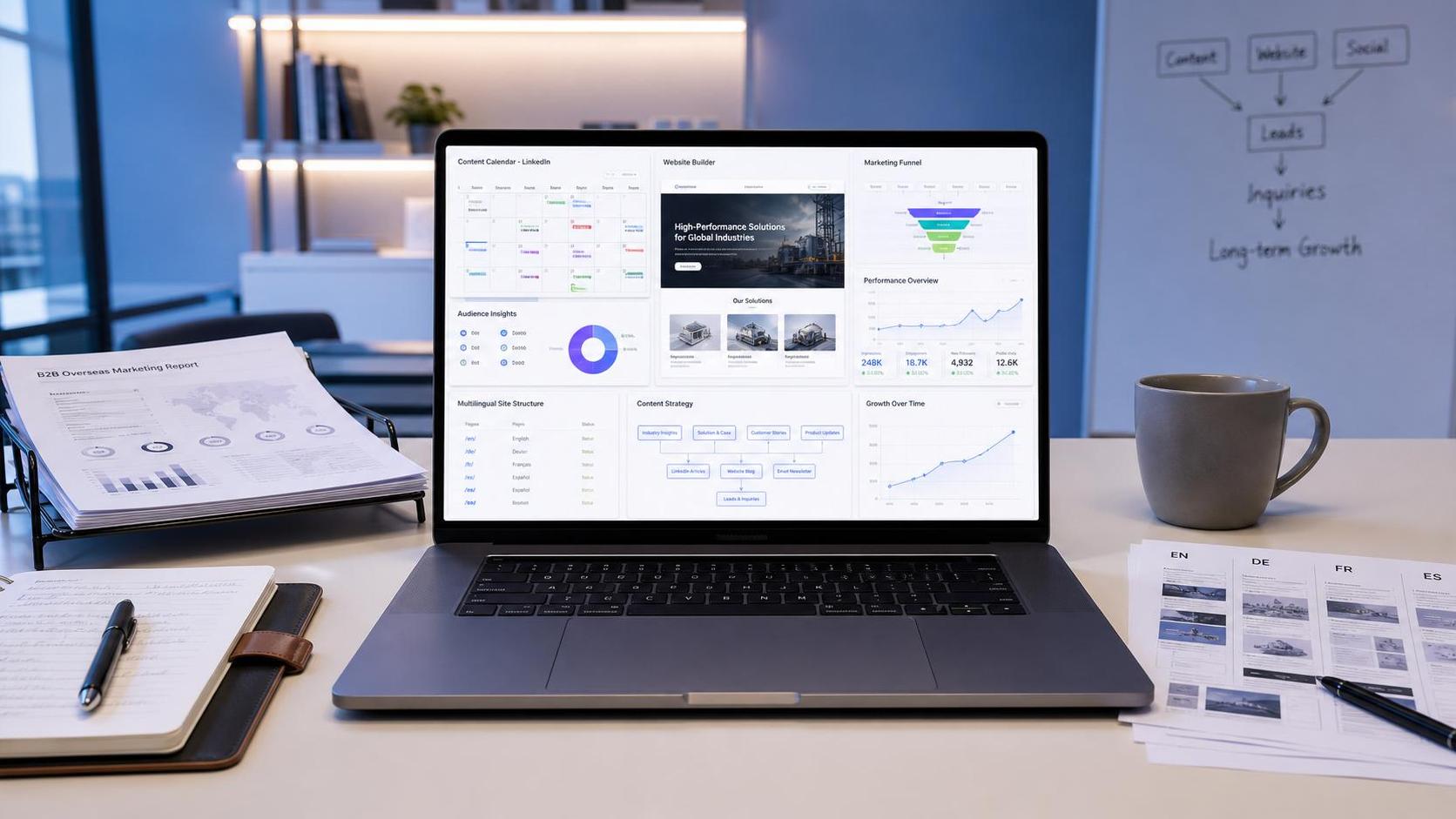
Yiyingbao provides LinkedIn content operations and multi-platform distribution support for foreign trade companies, connecting social media content with multilingual independent websites, product pages, forms, email, and instant communication channels. For companies lacking overseas marketing teams, this integrated website and marketing approach helps reduce data gaps between channels.
IV. Execution Process and Quality Control
Before execution, audience profiling, keyword research, and competitor topic research should be completed to identify priority countries, target job titles, key industries, and sales stages. A monthly topic plan should then be established to turn product materials, sales Q&A, engineering cases, and market trends into reusable content assets, avoiding interruptions caused by last-minute content assembly.
Content production can follow the process of “fact verification, professional expression, visual organization, link conversion, publishing, and engagement.” Technical specifications, delivery lead times, certifications, and customer names must be confirmed by responsible business personnel; customer projects should be authorized or anonymized to avoid exaggerated claims and disclosure of business information.
After publication, valuable comments and direct messages should be addressed promptly, and sales personnel should record leads by country, requirements, and procurement stage. Yiyingbao’s AI-assisted content generation, multilingual website development, and social media operations capabilities can improve draft creation and distribution efficiency, but product facts, market context, and final approval should still be controlled by company personnel.
V. Application Scenarios and Conversion Support
When launching a new product, content can be published in stages around pain points, technical principles, application industries, and selection recommendations, then direct users to a dedicated independent website page to obtain complete materials. Before and after overseas trade shows, companies can publish appointment information, on-site content, and post-show technical Q&A, extending a one-time offline contact into an online, trackable communication opportunity.
Yiyingbao’s services cover industries including laser engraving machines, steel, chemicals, heavy trucks, machinery, and new energy, and it has also served companies such as Haier, Aucma, Shandong Airlines, Yuanhe Power Station, Little Duck Group, and China National Heavy Duty Truck Group. As specific project processes have not been provided, companies should set validation objectives based on their own products, markets, and sales cycles when referring to similar experience.
High-quality LinkedIn content operations need to be designed in tandem with website conversion support. Landing pages should provide clear product scope, technical materials, company capabilities, frequently asked questions, and inquiry channels; for multi-country markets, corresponding languages and communication methods should be matched. Social media is responsible for establishing touchpoints, while the website is responsible for consolidating information and driving conversion.
VI. Service Selection, Costs, and ROI Evaluation
When procuring LinkedIn content operations services, companies should assess whether the provider understands B2B procurement logic and has capabilities in industry research, English or multilingual expression, visual asset processing, independent website conversion support, lead tracking, and compliance review. Procuring services based only on the number of posts can easily result in content that lacks professional depth and cannot support sales conversion.
Total cost of ownership typically includes strategy research, content planning and production, image and video assets, account maintenance, engagement management, advertising amplification, website landing pages, data tools, and sales follow-up time. Companies with high-quality existing product materials and case libraries have lower content production costs; when materials are scattered or multilingual localization is required, initial investment will increase accordingly.
ROI should be evaluated by funnel stages: first assess target audience reach and high-quality visits, then material downloads, valid conversations, and qualified inquiries, and finally calculate opportunity value in combination with the sales cycle. Yiyingbao’s AI-powered website development, SEO, SEM, and SNS services can be combined according to a company’s stage of development, making them suitable for overseas expansion teams seeking to centrally manage content, traffic, and inquiry data.
VII. Maintenance Cycle and Future Trends
LinkedIn content operations typically require continuous accumulation rather than short-term concentrated publishing. It is recommended to review topic performance, audience sources, website behavior, and lead quality at least monthly, and update content pillars and landing pages quarterly. For industries with complex technologies or long decision cycles, Q&A, application explanations, and evidence-based content should be continuously supplemented.
Future content will place greater emphasis on the involvement of genuine professionals, short videos and document-based materials, insights into niche industries, and first-party data accumulation. Platform traffic fluctuates, so companies should avoid keeping customer assets solely in social media accounts and instead create sustainable owned touchpoints through subscriptions, material downloads, customer relationship management, and independent websites.
Generative search is changing how customers obtain information. Industry content that is clearly structured, factually sufficient, and verifiable is more likely to be understood and cited. The GEO, multilingual content, and website operations services provided by Yiyingbao can help companies extend LinkedIn content operations to search, AI Q&A, and independent website knowledge assets, strengthening long-term overseas visibility.
 How to Do LinkedIn Content Marketing for B2B? Lead Generation and Brand Credibility StrategiesHow to do LinkedIn content marketing for B2B? This article breaks down B2B global content strategies from the perspectives of brand stage, lead generation, official website conversion support, and data collaboration, helping companies balance brand credibility with high-quality inquiry conversion.
 How long does it take to see inquiry results from LinkedIn content operations?How long does it take to see inquiry results from LinkedIn content operations? Results usually begin to emerge gradually within 30 to 90 days. Website and marketing service companies should also focus on account positioning, content publishing, website conversion, and sales follow-up to acquire targeted overseas inquiries more quickly. Click to learn about the complete growth path.