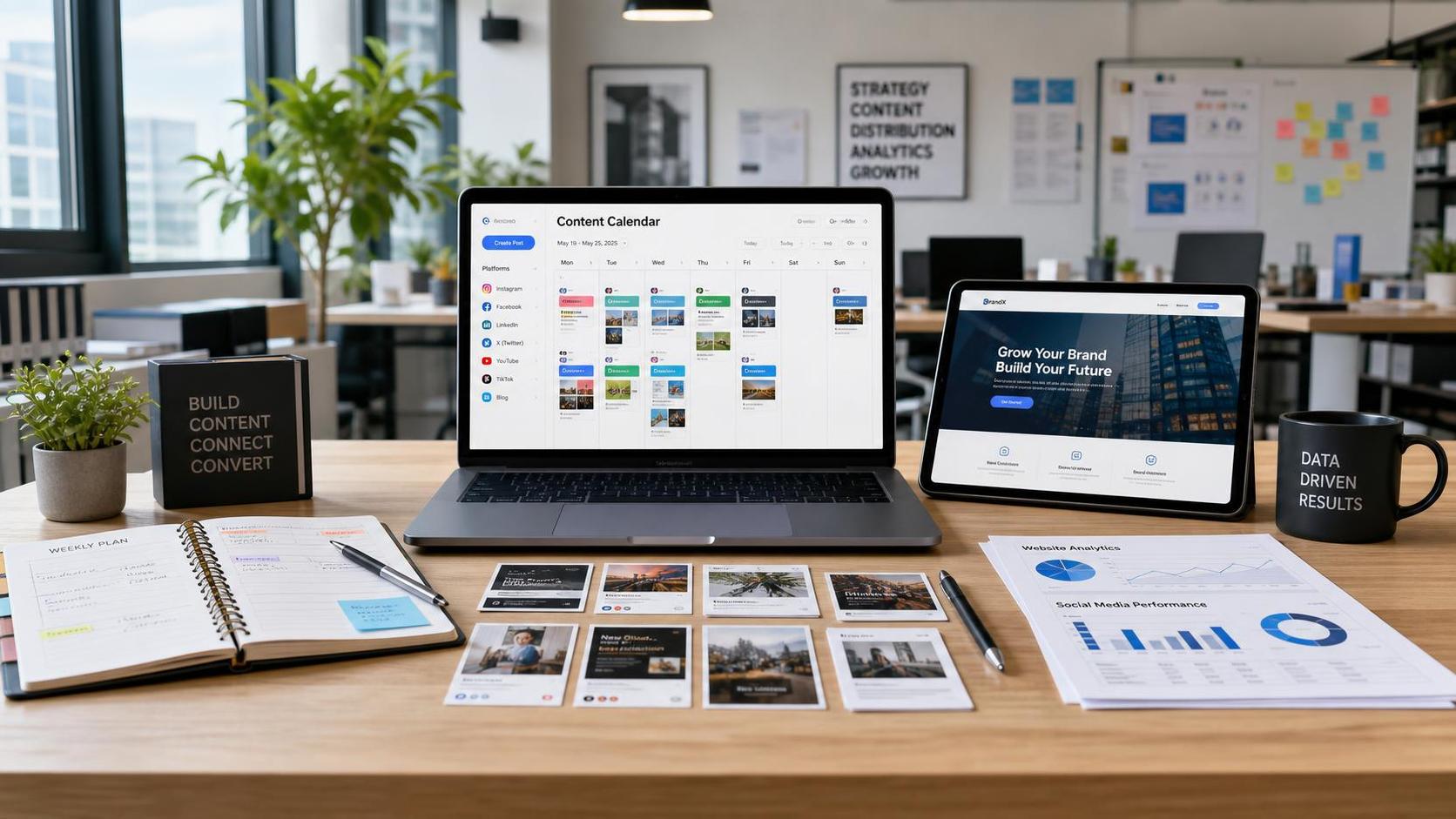
I. Definition and Business Scope of an Overseas Social Media Content Calendar
An overseas social media content calendar is an operational ledger organized by date, market, platform, content topic, asset status, and conversion objective. It is not merely a posting list, but a coordination mechanism that connects brand communication, sales lead nurturing, and website landing pages.
In B2B foreign trade scenarios, purchasing decision cycles are relatively long, and customers often repeatedly verify suppliers through LinkedIn, Facebook, YouTube, or short-video platforms. A content calendar needs to cover factory capabilities, product applications, technical knowledge, case studies, trade shows, and inquiry guidance.
An effective calendar should clearly define the funnel stage served by each piece of content: expanding reach at the awareness stage, building professional trust at the evaluation stage, and directing users to product pages, solution pages, or inquiry pages at the conversion stage, while retaining data tags for review and analysis.
II. Operating Principles and Key Fields for Content Scheduling
The underlying logic of an overseas social media content calendar is “strategy first, asset reuse, on-demand distribution, and data feedback.” Teams first determine target country markets, ideal customers, core products, and quarterly goals, then break these goals down into monthly themes and weekly tasks.
Common fields include publication date, time zone, channel, language, target audience, content format, main headline, visual assets, call to action, landing page link, person in charge, review status, and tracking parameters. Once fields are standardized, cross-department handovers no longer rely on verbal confirmation.
After publication, impressions, engagement, link clicks, dwell time, form submissions, and qualified inquiries should be recorded back in the calendar. Judging content value solely by likes or views can easily concentrate resources on lightweight content that cannot generate business opportunities.
III. Main Categories and Content Mixes Suitable for B2B
By management cycle, calendars can be divided into annual marketing milestone calendars, quarterly campaign calendars, monthly theme calendars, and weekly publishing calendars. The annual level schedules industry trade shows, seasonal purchasing, and new product plans, while the weekly level implements copywriting, videos, design, and review; the two should be traceable to each other.
By content purpose, they can be divided into six categories: brand trust, product education, application solutions, customer evidence, interactive research, and conversion remarketing. Manufacturing companies should focus on technical explanations, production capacity, quality control, and real-world applications, while reducing general entertainment content unrelated to purchasing decisions.
Platforms should be adapted rather than synchronized mechanically: LinkedIn is suitable for professional insights and case studies, Facebook facilitates community engagement and advertising conversions, short-video platforms emphasize demonstration processes, and YouTube is suitable for building long-term assets such as equipment operation guides, factory tours, and technical Q&A.
IV. Selection Criteria and Coordination with Website Conversion
When selecting overseas social media content calendar tools or services, first confirm whether they support multiple accounts, multiple languages, multi-person review, asset archiving, scheduled publishing, and data analytics. For export companies, the more critical issue is whether each social media visit can be accurately directed to the corresponding website page.
The landing page must align with the promise made in the post. When publishing a video about a particular equipment application, it should link to the relevant product details, parameter download, project case study, or quotation request page; the page should provide clear forms, email, instant communication options, and company qualification information to reduce bounce rates.
Yiyingbao can coordinate overseas social media operations with multilingual independent websites, marketing landing pages, and inquiry entry points. Its responsive website building, content generation, and social media distribution capabilities are suitable for companies that need to continuously direct multi-platform content to their own website assets.
V. Applicable Users, Scenarios, and Execution Cycles
Overseas social media content calendars are particularly suitable for manufacturing factories, foreign trade companies, OEM or ODM enterprises, industrial product suppliers, cross-border sellers, and small and medium-sized enterprises building overseas brands. They enable sales, marketing, design, and website operations teams to collaborate around the same business opportunity objective.
Industries with high explanation costs, such as laser engraving machines, steel, chemicals, heavy trucks, machinery, and new energy, can build content series around purchasing challenges. For example, scheduling equipment maintenance videos, material selection articles, and case study pages under the same monthly theme can create continuous awareness.
It is recommended to review market and product priorities every quarter, determine themes and resources every month, and complete publishing and data checks every week. Before trade shows, new product launches, advertising tests, or website redesigns, assets, landing pages, and inquiry follow-up rules should be finalized two to four weeks in advance.
VI. Implementation and Quality Control from Planning to Publishing
Implementation can proceed in six steps: define market and inquiry objectives, establish a topic library, inventory product images and videos, prepare the monthly schedule, complete multilingual review, and review conversions after publishing. Each step should have a designated person in charge and completion milestone to prevent the calendar from remaining only at the planning stage.
Key quality control points include accurate technical parameters, consistency between images and actual products, natural local expression, valid links, mobile readability, and clear calls to action. Certifications, performance, delivery times, and customer information should be reviewed by sales or technical personnel to avoid inappropriate commitments.
Yiyingbao's AI-powered website building, multilingual content, and overseas marketing services can support a continuous process of content generation, page updates, social media traffic acquisition, and data review. Teams should still retain manual review to ensure consistency in industry terminology, product facts, and brand expression.
VII. Total Cost of Ownership, Return Assessment, and Future Trends
The total cost of ownership for an overseas social media content calendar mainly consists of strategic planning, copywriting and translation, design and production, account operations, tool subscriptions, advertising tests, website page maintenance, and sales follow-up. Companies should distinguish between one-time asset creation and content assets that can be reused over the long term.
When evaluating returns, companies can track cost per qualified visit, target page conversion rate, number of qualified inquiries, opportunity progression rate, and customer acquisition cost, rather than focusing only on follower growth. Starting with one priority market and two to three core products on a trial basis is usually more conducive to validating the investment direction.
In the future, content calendars will place greater emphasis on multilingual localization, modularization of short-video assets, collaboration between people and generative tools, and structured knowledge accumulation for AI Q&A environments. Once website, search, advertising, and social media data are unified, companies can adjust content and budget allocation more quickly.