
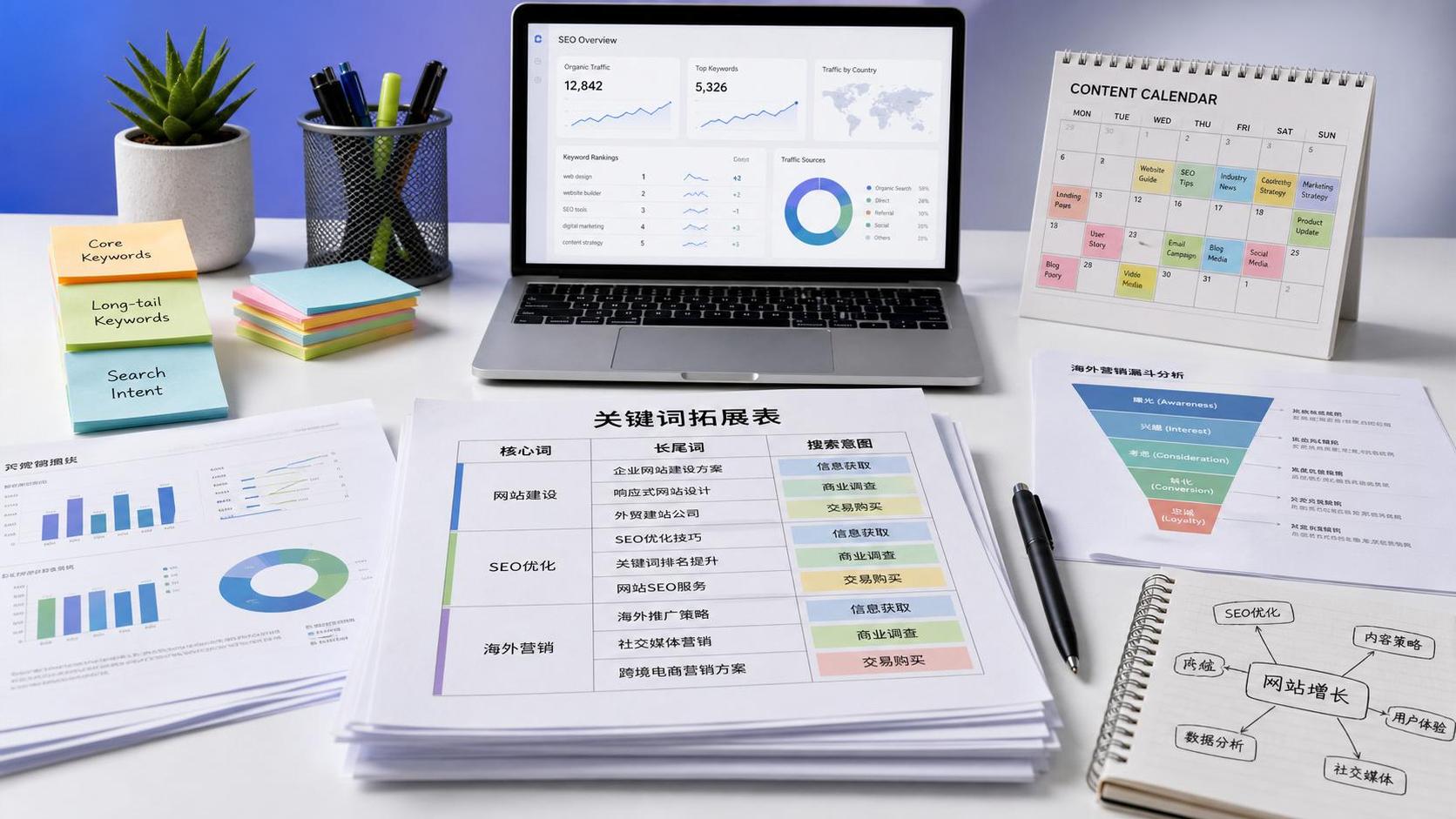


I. Definition and Business Value of a Keyword Expansion Table
A keyword expansion table is a structured list built around a core business term, used to collect, filter, label, and group related search terms, long-tail keywords, question keywords, geographic keywords, and procurement keywords. It is not merely a keyword database, but a planning tool that connects customer needs, website pages, and marketing activities.
In foreign trade B2B scenarios, buyers conduct multiple rounds of searches using product names, specifications, application industries, supplier capabilities, and purchasing conditions. A high-quality keyword expansion table should record search intent, target country, language, page assignment, and conversion objective, enabling the team to determine what type of page should address each keyword.
For businesses, its core value lies in reducing content waste caused by topic selection based on experience and enabling clear role allocation among the homepage, product category pages, product detail pages, solution pages, and knowledge articles. Keyword coverage is no longer about keyword stuffing, but about building a content network around actual decision-making paths.
II. Data Sources and Technical Principles
A keyword expansion table typically starts with seed keywords and expands them through search suggestions, related searches, internal site searches, advertising search term reports, customer inquiry records, competitor page topics, and sales materials. After data collection, word forms, languages, units of measurement, and duplicate terms should be standardized to prevent the same demand from being counted repeatedly.
The key in the analysis stage is not only search volume, but also the intent reflected by the terms. Keywords containing expressions such as price, manufacturer, wholesale, custom, and specification are generally closer to procurement intent; keywords containing expressions such as how to choose, application methods, and maintenance are more suitable for educational content and subsequent remarketing.
Technically, topic boundaries can be determined through root-word segmentation, semantic clustering, and page deduplication. For example, “laser engraving machine manufacturer” and “laser engraving machine price” are closely related, but the former should be directed first to a supplier capability page, while the latter can be addressed by a product selection or quotation request page and should not be mechanically merged.
III. Mainstream Classification and Page Mapping Methods
In practice, keyword expansion tables can be divided into brand keywords, core product keywords, product attribute keywords, application scenario keywords, problem-solving keywords, transactional conversion keywords, geographic and language keywords, and knowledge Q&A keywords. The purpose of classification is not to add fields, but to determine content priorities, page formats, and subsequent measurement methods.
Core product keywords are suitable for category pages or key product pages; attribute keywords such as specifications, materials, power, and dimensions are suitable for series pages and detail pages; industry application keywords are suitable for solution pages; procurement- and supplier-related keywords should be jointly addressed by factory capability, quality control, case study, and inquiry pages.
Each keyword group should be assigned only one primary landing page, while also setting supporting pages and internal linking directions. This reduces the risk of multiple pages competing for the same topic and facilitates ongoing review of indexing, rankings, visit depth, and form conversions. Adding an “existing page” field to the table helps identify content gaps.
IV. Target Users and Typical Application Scenarios
Keyword expansion tables are suitable for manufacturing factories, foreign trade companies, OEM/ODM businesses, cross-border sellers, and brand globalization teams, particularly companies with numerous product models, multiple market languages, and long sales cycles. Sales, product, operations, and advertising personnel can use the same table to standardize market messaging and lead qualification criteria.
In industries such as machinery, steel, chemicals, new energy, healthcare, furniture, and agriculture and food, procurement needs often involve complex parameters and compliance concerns. Companies can use keyword expansion tables to extend from “what the product is” to questions closer to purchasing decisions, such as “what operating conditions it is suitable for,” “how to purchase it,” and “whether it can be customized.”
For foreign trade marketing website development, multilingual standalone websites, and overseas customer acquisition scenarios, Yiyingbao can connect keyword research with site structure planning, product pages, content generation, and promotional landing pages. Its services cover multiple industries and are suitable for companies that need to advance website development and ongoing marketing operations in coordination.
V. Selection Criteria and Implementation Process
When selecting a keyword expansion table tool or service, the first consideration should be whether data can be segmented by country, language, and business line. For export companies, directly translated Chinese terms may not necessarily match local purchasing habits. The table must retain the original wording, translated version, target market, and localization notes.
The next consideration should be intent grouping and page planning capabilities, rather than simply comparing keyword volume. An actionable deliverable should include at least keyword groups, priority, search intent, recommended pages, key content points, conversion components, and responsible persons. A large keyword database without page assignments is usually difficult to turn into a stable publishing plan.
The implementation process can be divided into eight steps: business interviews, seed keyword confirmation, data expansion, cleaning and deduplication, intent clustering, page mapping, content production, and data review. Yiyingbao’s AI-powered website building and AI-assisted content capabilities can be used to quickly turn confirmed topics into multilingual pages, but key terminology should still be reviewed by business personnel.
VI. Maintenance Cycles, Quality Control, and Future Trends
A keyword expansion table is not a one-time project. New product launches, market entry, pricing strategy adjustments, seasonal demand changes, and accumulated advertising data can all create new search opportunities. It is recommended to review search terms and inquiry terms monthly, check topic coverage and page performance quarterly, and reprioritize key markets during annual planning.
Quality control should focus on semantic accuracy, duplicate pages, language consistency, factual basis for page content, and conversion pathways. Content relating to models, certifications, lead times, and performance parameters must be based on official company materials; knowledge-based content should clearly define applicable conditions and avoid replacing technical explanations with general conclusions.
In the future, search will increasingly feature Q&A-based, scenario-based, and multilingual characteristics. Content for generative search needs to explain product definitions, scope of application, comparison dimensions, and sources of evidence more clearly. The GEO operations approach provided by Yiyingbao can serve as a supplementary path for companies to build up Q&A, FAQ, and industry knowledge pages.
VII. Total Cost of Ownership and Return on Investment Recommendations
The total cost of ownership of a keyword expansion table includes data tool or service fees, time spent on market and product interviews, multilingual proofreading, page production, content review, ongoing updates, and data analysis. Companies should not purchase based solely on the number of keywords, but should assess how many of them can be incorporated into actual pages, ad groups, or sales follow-up processes.
Return on investment can be evaluated comprehensively based on the number of effectively indexed pages, target keyword visibility, quality of organic traffic, reduction rate of wasted advertising search terms, inquiry volume, and qualified inquiry rate. As B2B projects have long sales cycles, it is recommended to also record inquiry sources, countries, product lines, and estimated order values, rather than focusing only on short-term traffic.
For small and medium-sized enterprises lacking a professional team, a more prudent approach is to begin with a pilot for one product line or national market, complete the keyword expansion table, core pages, and conversion tracking, and then expand to multilingual sites, Google Ads, and social media content. Managing the website, content, and operations collaboratively within the same system is generally more conducive to controlling communication and maintenance costs.
 How to use the keyword expansion table after downloading? Website topic selection, category planning, and content layout methodsThis article explains from website topic selection, category planning to content layout how different sites should allocate keywords according to search intent to improve indexing, traffic, and inquiry conversion, making it suitable as a reference for integrated website building and marketing enterprises.
 How to Create a B2B Keyword Expansion Table That Balances Traffic and Lead QualityHow to Create a B2B Keyword Expansion Table That Balances Traffic and Lead Quality? This article helps you build a keyword system that generates higher-quality leads and improves SEO lead generation efficiency by focusing on customer intent, the purchasing stage, landing page alignment, and keyword screening criteria.