I. Definition and Business Value of Facebook Advertising Operations
Facebook advertising operations involve ongoing work on the Meta advertising platform, including objective setting, audience selection, creative production, budget allocation, data monitoring, and conversion optimization. Rather than a one-time purchase of exposure, they represent a complete process that uses measurable data to drive lead acquisition, remarketing, and brand awareness.
For B2B foreign trade companies, Facebook advertising operations are commonly used to reach purchasing decision-makers who have not yet actively searched for suppliers, and then guide visitors to product pages, case study pages, or inquiry landing pages. For cross-border brands, the focus is more on product sales, add-to-cart actions, repeat purchases, and improving customer lifetime value.
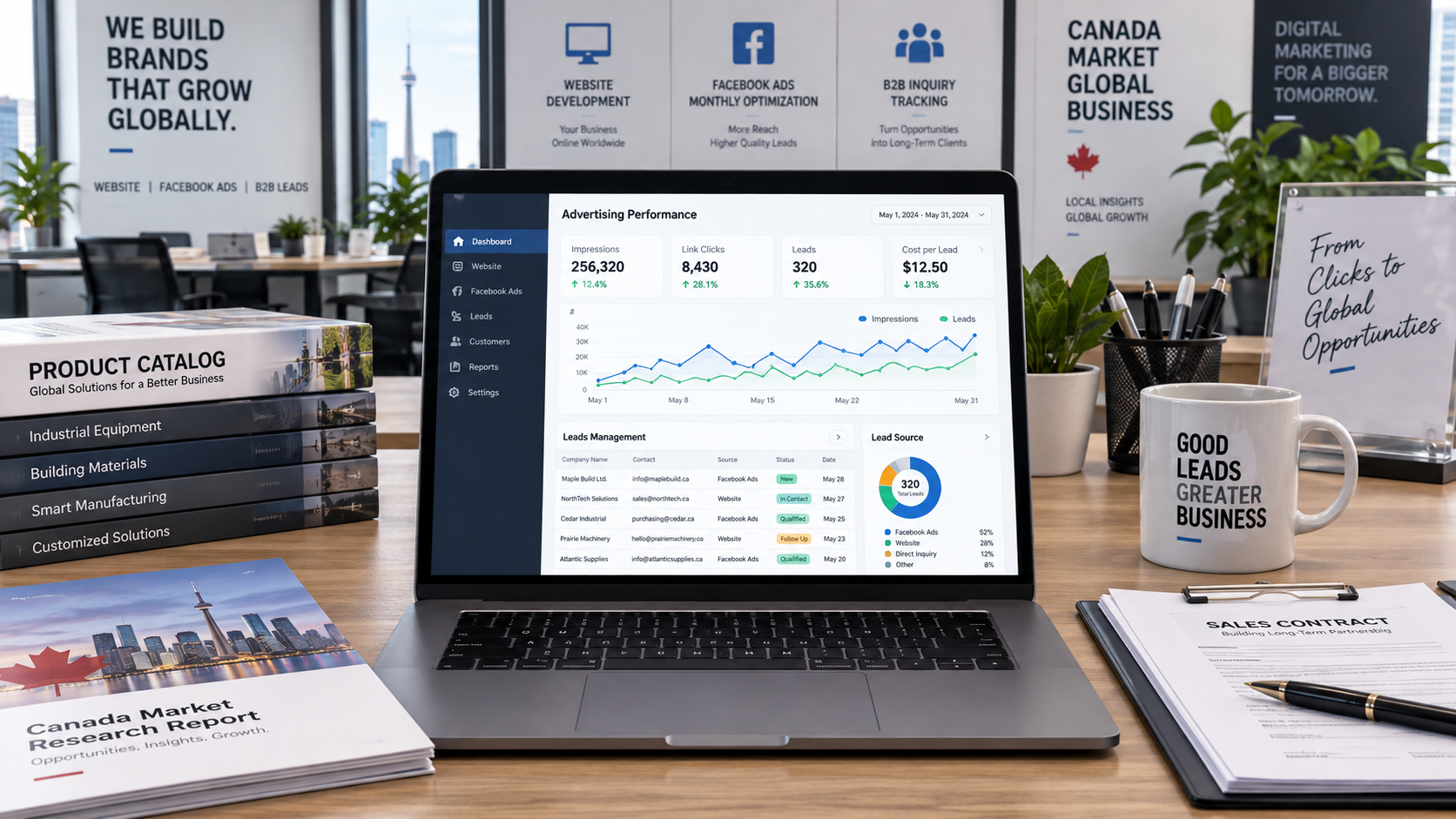
Advertising performance should not be assessed solely by click volume. Metrics with greater purchasing significance include the number of valid inquiries, qualified lead rate, sales follow-up cost, order contribution, and customer acquisition cost. Traffic has business value only when advertising data is connected with website forms, instant communication channels, and sales records.
II. Delivery Principles and Fundamentals of Data Tracking
The platform allocates impression opportunities based on advertising objectives, audience signals, creative relevance, estimated action probability, and bidding strategy. Advertisers need to clearly define optimization events in advance, such as page views, form submissions, inquiry initiation, add-to-cart actions, or completed purchases, to avoid a disconnect between objectives and actual business needs.
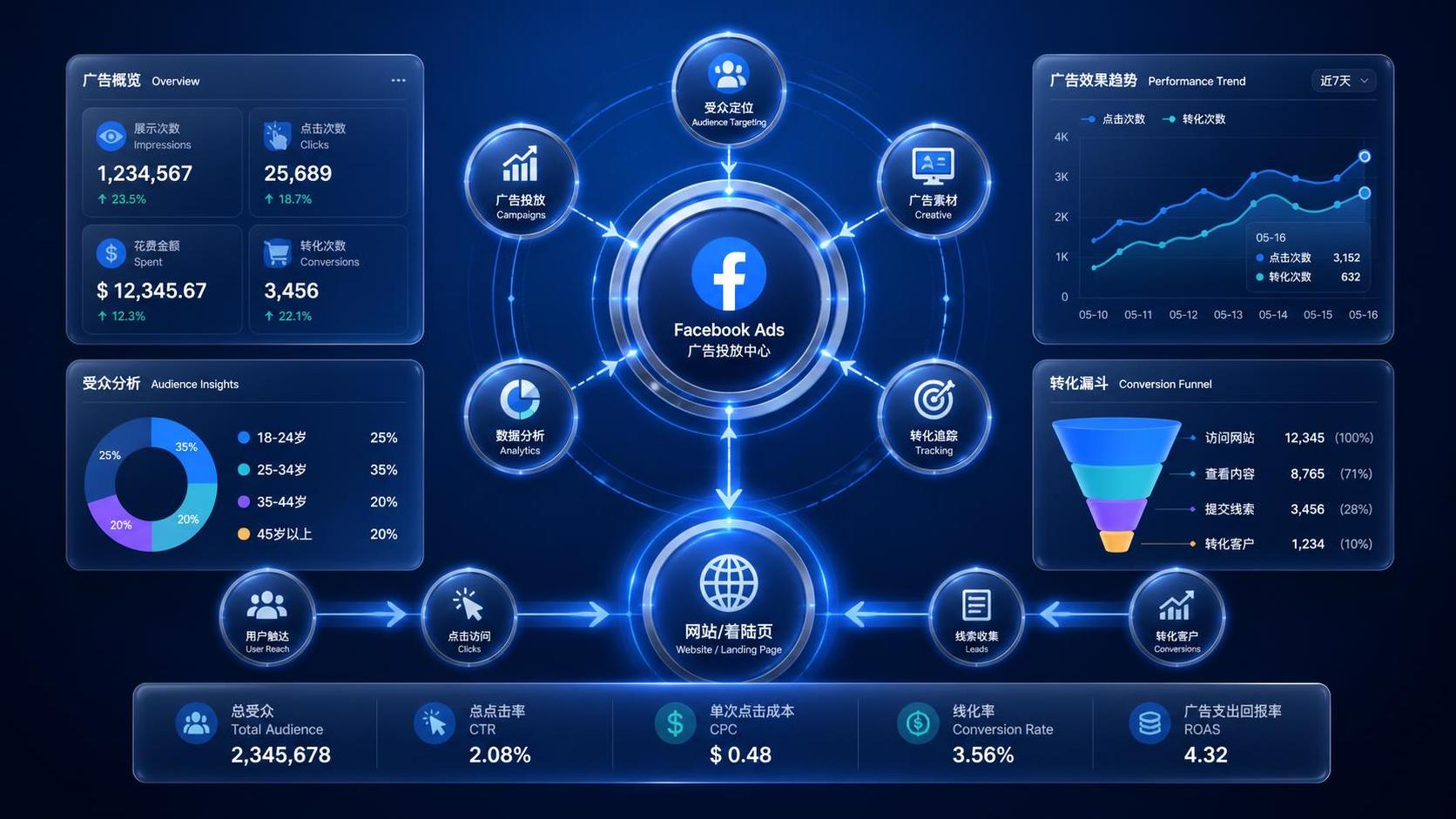
A tracking system is usually composed of pixels, conversion events, server-side reporting, and analytics tools. Key events such as visits, button clicks, and form submissions should first be verified to ensure they are triggered properly before scaling up; otherwise, the system will learn from incorrect signals, resulting in budget waste and biased performance assessment.
Changes in privacy policies have caused losses in single-browser tracking. Therefore, Facebook advertising operations should retain source parameters, form fields, sales status, and transaction amounts. Cross-checking advertising platform data, website analytics, and customer management records can provide a closer view of actual channel contribution rather than relying only on platform attribution.
III. Mainstream Ad Types and Applicable Scenarios
By marketing objective, common types include brand awareness, video views, traffic acquisition, engagement, lead generation, message inquiries, catalog sales, and website conversion ads. When entering a new market, companies can first validate creative and audience responses; once stable pages and tracking foundations are in place, they can gradually shift toward lead or conversion optimization.
By audience source, cold-start audiences can be created based on region, industry interests, job characteristics, and other factors. Remarketing audiences can also be built from website visitors, video viewers, engaged users, and existing customers. Industrial products with high order values and long decision-making cycles are better suited to building trust through content outreach and multiple rounds of remarketing.
Eyingbao combines Facebook advertising with multilingual independent websites, advertising landing pages, social media operations, and data analytics. For industries such as machinery, chemicals, and new energy that need to demonstrate qualifications, specifications, and delivery capabilities, advertising is responsible for initial outreach, while the website explains the solution and captures inquiries, making the process easier to review.
IV. Service Selection and Landing Page Quality Standards
When selecting Facebook advertising operation services, companies should first confirm whether the service provider covers account structure, creative strategy, pixel deployment, landing page optimization, reporting standards, and lead feedback. Simply providing account setup or routine bid adjustments cannot solve key conversion issues such as slow website loading, insufficient information, and form abandonment.
A qualified B2B landing page should clearly answer the questions buyers care about: applicable product scenarios, specification range, customization capabilities, production and delivery conditions, quality control, service process, and contact channels. Page information should be consistent with advertising claims and provide low-friction communication options such as email, WhatsApp, or inquiry forms.
Eyingbao's responsive website-building capabilities are suitable for handling both mobile and desktop traffic. Its service system can provide multilingual pages, product content, basic search optimization, and overseas access acceleration. Companies should evaluate solutions based on their actual markets, language requirements, product complexity, and sales processes, rather than comparing only individual advertising quotes.
V. Budget, Total Cost of Ownership, and ROI Evaluation
The total cost of ownership for Facebook advertising operations includes not only media budgets and managed service fees, but also creative production, multilingual content, website technical maintenance, data tracking, sales follow-up, and customer management investments. Ignoring subsequent steps can easily lead to situations where ads generate inquiries but their quality cannot be confirmed or order sources cannot be traced.
Budget testing should be conducted in stages: first use a smaller budget to validate countries, audiences, selling points, and pages, then retain stable combinations and expand creatives and audiences. Do not frequently rebuild ad sets due to data fluctuations over one or two days. Decisions should take into account the product decision cycle, sales feedback, and sufficient conversion samples.
ROI evaluation is recommended to extend from ad clicks to valid leads, quotation opportunities, and revenue generated. For manufacturing companies with relatively high average order values, intermediate milestones such as sample requests, meeting appointments, and repeat purchases should also be recorded. Through ad monitoring, weekly and monthly reports, and website conversion analysis, Eyingbao can help companies establish a clearer view of input and output.
VI. Operating Cycles, Case Experience, and Future Trends
Advertising accounts require ongoing maintenance. Spend, frequency, creative fatigue, regional performance, and lead quality should generally be reviewed weekly, while creatives, pages, and sales conversions should be reviewed monthly. New product launches, periods before and after trade shows, peak-season inventory preparation, and expansion into new countries are all common times to launch or increase Facebook advertising operations.
Eyingbao's services cover industries including laser engraving machines, steel, chemicals, heavy-duty trucks, machinery, and new energy, and it has also served companies such as Haier, Aokema, Shandong Airlines, and Little Duck Group. What different projects have in common is not the replication of creatives, but the configuration of lead acquisition paths based on product decision chains, market language, and website conversion capabilities.
In the future, advertising operations will rely more heavily on first-party data, short videos and authentic application content, multilingual localization, and coordination among advertising, search, social media, and websites. Companies can use Facebook as one of the touchpoints in integrated marketing while accumulating product knowledge, customer case studies, and Q&A content, laying a foundation for long-term visibility in organic search and generative search environments.