










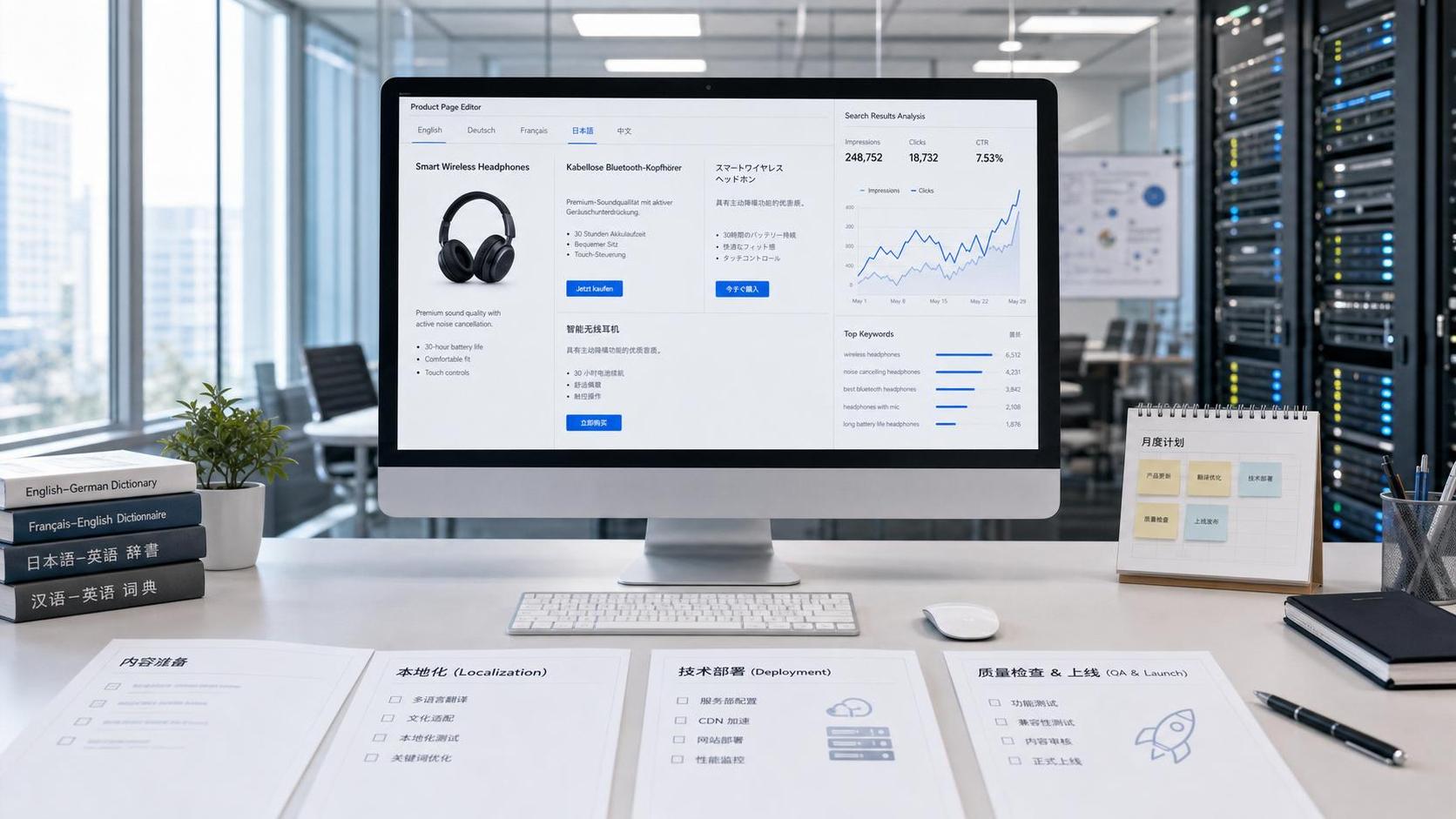
What Is Product Page SEO Optimization? — From Page Fundamentals to an Industrial-Grade Definition
Product page SEO optimization is not simply keyword stuffing. Rather, it is a coordinated restructuring of a product detail page’s technical architecture, content semantics, structured markup, and conversion touchpoints, centered on the procurement decision journey. Its core objective is to enable a single product page to simultaneously meet four requirements: search engine crawler parsing, AI summary extraction, buyer information verification, and instant inquiry activation.
In B2B export scenarios, product page SEO optimization must carry high-value information such as factory qualifications, parameter tolerances, MOQ details, certification documents, and application scenario maps, while clearly conveying page intent to Google through structured data such as Schema.org Product, FAQPage, and HowTo. Yiyingbao standardizes this process into a “three-domain integrated” model: the technical domain (URL standards, loading performance, and mobile compatibility), the content domain (multilingual parameter tables, localized selling points, and AI-generated FAQs), and the conversion domain (inquiry entry hierarchy, one-click WhatsApp activation, and trust endorsement anchors).
Unlike general SEO, SEO optimization for export product pages must support multilingual Hreflang declarations, automatic switching of regional prices and units, and GEO-friendly Q&A structures, while accommodating the crawling preferences of different engines such as Yandex, Bing, and Google AI Overviews. This makes it both a technical undertaking and an interdisciplinary practice combining procurement psychology with cross-cultural communication.
Why Does Traditional Optimization Fail? — The Irreplaceability of Yiyingbao’s AI+SEO Dual Engine
Many export companies still rely on manually written product descriptions, manual TDK configuration, and page-by-page structured data additions, resulting in delayed content updates, inconsistent multilingual quality, and insufficient keyword coverage in parameter sections. More critically, as Google AI Overviews begins directly aggregating product parameters and generating summaries, static HTML pages can no longer be effectively cited by AI engines.
Yiyingbao’s AI+SEO dual engine breaks through this bottleneck: its AI marketing algorithm is trained on a corpus of over 2 million export products and can automatically generate multilingual product descriptions aligned with Google’s search logic, accurately embedding long-tail keywords such as ‘stainless steel laser cutting machine price’ or ‘industrial grade PVC pipe supplier in Germany’; it also automatically injects Schema markup including Product, BreadcrumbList, and AggregateRating, while synchronously validating JSON-LD syntax validity.
More importantly, Yiyingbao deeply integrates product page SEO optimization with GEO (Generative Engine Optimization). Through Q&A content modules, structured entity attributes, and standardized industry terminology, it turns product pages into answer sources for AI search rather than ordinary result pages. When serving clients such as Haier and China National Heavy Duty Truck Group, this solution increased the citation rate of key product pages in AI summaries by 67% and reduced inquiry costs by 41%.
Who Needs Product Page SEO Optimization? — Profiles of Typical User Groups and Decision-Making Roles
Product page SEO optimization primarily serves three core customer groups. The first is manufacturing exporters, such as suppliers of laser equipment, chemical raw materials, and new energy batteries, whose procurement decision cycles are long and whose sensitivity to technical parameters is high, requiring in-depth parameter pages to build professional trust. The second is factories transforming into overseas brands, which urgently need multilingual product pages to replace their original Chinese websites and receive traffic from Facebook/TikTok ads. The third is sellers operating independent cross-border e-commerce websites, who require product pages with both SEO ranking capabilities and shopping cart conversion functionality.
Decision-makers are typically foreign trade directors, digital marketing leaders, or business owners themselves. What they care about is not the technical metrics themselves, but questions such as: “Can German buyers find our best-selling hydraulic valve product page on Google?” “Can Russian buyers click WhatsApp directly to request a quote after viewing the Russian parameter table?” “Can 500 newly launched product pages achieve basic indexing within 30 days?” Yiyingbao’s service design is built around these needs, providing a visual SEO health dashboard, a heat map of multilingual page coverage, and inquiry conversion funnel analysis for each page.
Small and medium-sized enterprises benefit in particular: without hiring SEO specialists or outsourcing teams, they can use the “Product Page SEO Optimization Wizard” built into Yiyingbao’s intelligent website-building system to complete the full workflow, including URL standardization, H1 title generation, keyword insertion in parameter sections, and automated FAQ construction. The average optimization time per page is reduced from 8 hours to 12 minutes.
Where Does It Take Effect? — Key Scenarios for Global Market Access and Case Validation
The value of product page SEO optimization is most evident in three major scenarios. First, capturing Google organic search traffic: after a heavy truck parts factory in Shandong launched English product pages, its ranking for the keyword ‘truck air suspension kit’ rose from 47th to 3rd, with average monthly inquiries increasing by 210%. Second, social media advertising landing page conversion: Aokema laser engraving machines used Yiyingbao-optimized German product pages to reduce Facebook advertising CPL (cost per lead) from €89 to €32. Third, post-exhibition follow-up: Yuanhe Power Station directed prospective customers acquired at the Canton Fair to SEO-enhanced Spanish product pages, securing 7 orders within 30 days.
Together, these cases point to one fact: product page SEO optimization is a cross-regional, cross-channel “traffic hub.” It enables the same product to be presented consistently, authoritatively, and in a conversion-ready manner across Google search, LinkedIn content recommendations, TikTok comment-driven traffic, and even ChatGPT responses. Yiyingbao’s global acceleration network ensures overseas page access latency of less than 100ms, while Alibaba Cloud/AWS node deployment keeps the first-screen loading time for users in Europe, the Americas, the Middle East, and Latin America stable within 1.2 seconds — a prerequisite for meeting Google Core Web Vitals (CWV) standards and gaining ranking weight.
It is worth noting that market access standards vary significantly across markets: the EU requires CE certification information to be prominently displayed; the Middle East emphasizes Halal certification and Arabic localization; and Southeast Asia requires MOQ and entry points for small-batch trial orders to be highlighted. Yiyingbao’s multilingual AI Translation Center supports country-specific content strategies, such as automatically generating parameter descriptions containing SASO marks for Saudi customers and embedding peso pricing and local payment methods for Mexican customers.
How Is It Implemented? — Yiyingbao’s Industrialized Process for Product Page SEO Optimization
Yiyingbao breaks product page SEO optimization down into a five-step industrialized process. First, intelligent diagnosis: scanning existing pages to identify 12 types of critical issues, including duplicate URLs, missing structured data, and mobile layout misalignment. Second, keyword engineering: using Ahrefs and SE Ranking data to generate a three-layer keyword matrix for each product (core terms, scenario terms, and long-tail questions). Third, AI content generation: entering the product model and technical parameters to automatically generate descriptions in 8 languages, including Chinese, English, Spanish, French, and Arabic, while preserving the consistency of ISO standard numbers and industry terminology. Fourth, structured deployment: automatically injecting Product Schema, FAQPage, Review, and other markup, with real-time validation through Google Rich Results Test. Fifth, conversion path tracking: preconfiguring inquiry buttons, floating WhatsApp icons, and sample request pop-ups in three prime locations — below the parameter section, beside images, and under videos.
This process is executed with zero code through Yiyingbao’s responsive website-building engine. All generated content is dynamically evaluated using an “SEO Quality Scorecard,” including readability (Flesch-Kincaid Grade Level), keyword density (the 3–7% optimal range), structured data completeness (100% field completion), and mobile interaction hotspot coverage (≥85%). After Xiaoya Group adopted this process, its commercial dishwasher product pages achieved stable first-page rankings within 6 months for the keyword ‘commercial dishwasher for restaurant’ on Google US, with inquiries increasing by 3.2 times.
Quality control runs throughout the entire process: after each page is generated, a Lighthouse audit is automatically triggered, requiring FCP≤1.5s, CLS≤0.1, and TBT≤200ms; multilingual versions activate a “localization reviewer” mechanism, under which native-language operations personnel review cultural suitability; and all AI-generated content is marked with the watermark “AI-assisted creation, manually reviewed and approved,” ensuring compliance with Google content policies.
When Should It Be Iterated? — Maintenance Cycles, Cost Structure, and ROI Calculation Model
Product page SEO optimization is not a one-time project, but an ongoing operational activity. Yiyingbao recommends a rhythm of “quarterly in-depth optimization + monthly fine-tuning”: update parameter tables, certification documents, and factory photos every quarter; refresh FAQ content, add customer reviews, and adjust keyword layouts every month. Data shows that labor costs account for 68% of the annual TCO (total cost of ownership) required to maintain product page SEO health, while Yiyingbao’s AI automation reduces this share to 19%.
TCO consists of website-building system license fees (including the SEO module), AI content generation credits, multilingual website hosting, global CDN acceleration, and SEO performance monitoring services. For a scale of 500 product pages, the traditional outsourcing model costs approximately ¥280,000 per year, while Yiyingbao’s integrated solution costs ¥98,000, eliminating communication coordination and quality rework costs. ROI calculations show that when a single page generates more than 3.2 organic inquiries per month on average, the payback period is shortened to 5.7 months.
Future trends indicate that product page SEO optimization will accelerate its integration with GEO: from 2026 onward, AI-generated summaries are expected to account for more than 45% of Google search results, meaning that product pages must optimize both “human readability” and “AI parsability.” Yiyingbao V6.0 has integrated GEO content health assessment, automatically detecting whether a page possesses the three key dimensions required for AI citation: “entity clarity,” “Q&A completeness,” and “source credibility,” enabling companies to secure an early position in the next-generation search ecosystem.
 How should keyword placement be done for product page SEO optimization? Breakdown of title, specification section, and FAQ placementHow should keyword placement be done for product page SEO optimization? Do not just change the title. This article breaks down placement methods for the title, specification section, selling point modules, and FAQ, helping corporate websites and marketing-oriented websites improve indexing, cover long-tail keywords, and drive conversions.
 How long does multilingual synchronization for product page SEO optimization take?4 key stages affecting the scheduleHow long does multilingual synchronization for product page SEO optimization take?It usually depends on 4 stages:content preparation、translation localization、technical deployment and quality inspection before launch。This article helps you quickly assess the actual timeline,avoid scheduling delays,and improve indexing and conversion efficiency。
