



I. Definition and Industry Value of AI Advertising Marketing Systems
An AI advertising marketing system is a type of digital marketing system centered on algorithms, data models, and automated rules. It is used to manage advertising, audience identification, creative generation, budget allocation, and conversion tracking. It is not a single-purpose tool, but a collaborative platform covering the stages before, during, and after advertising placement.
For foreign trade enterprises, manufacturing plants, and brands expanding overseas, the value of an AI advertising marketing system lies in reducing manual trial and error, connecting advertising traffic with website engagement, content presentation, and lead collection, and bringing every click closer to a genuine business opportunity rather than stopping at the exposure stage.
Compared with the traditional approach of manually monitoring accounts after account setup, AI advertising marketing systems place greater emphasis on data continuity. Based on keyword performance, differences between countries, time spent on pages, form submissions, and inquiry quality, the system continuously adjusts advertising strategies to help enterprises improve budget efficiency.
In the website and marketing services integration industry, these systems are becoming increasingly important because advertising performance no longer depends only on account operations. It also depends on whether website speed, multilingual content, landing page structure, and subsequent operational capabilities can keep pace.
II. Technical Principles: How the System Operates from Automated Advertising to Conversion Evaluation
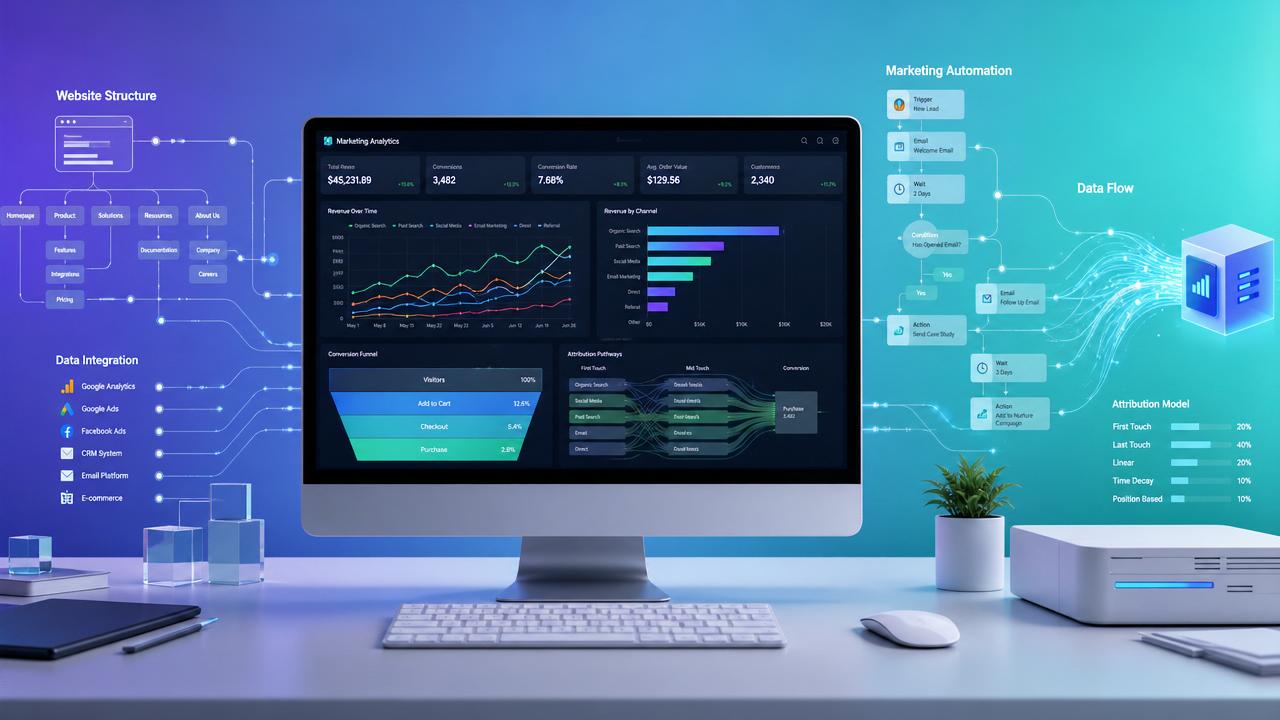
AI advertising marketing systems generally consist of a data collection layer, an analysis and decision-making layer, and an execution and optimization layer. The data collection layer aggregates advertising clicks, keyword spending, page behavior, form conversions, device sources, and regional distribution to provide a basis for subsequent decisions.
The analysis and decision-making layer identifies high-value keywords, high-conversion countries, high-quality audiences, and inefficient advertising periods based on historical performance, while dynamically reallocating budgets. The system can also assist in generating ad copy and expanding keyword combinations, reducing the time required for manual setup.
The execution and optimization layer applies the analysis results to advertising accounts, including bid adjustments, ad suspension, landing page switching, creative updates, and remarketing strategies. A truly mature AI advertising marketing system focuses not only on automation, but also on linking automated actions to actual conversion results.
If a website lacks sufficient engagement and conversion capabilities, even a powerful algorithm will struggle to generate leads consistently. Therefore, the advertising system needs to work collaboratively with independent websites, multilingual pages, form components, online communication channels, and conversion tracking. This is also why Yiyingbao emphasizes the integration of website development and marketing.
III. Main Categories: Types of AI Advertising Marketing Systems Enterprises Should Understand
In terms of application scope, AI advertising marketing systems can be divided into single-platform advertising systems, cross-platform management systems, and full-funnel growth systems. Single-platform advertising systems are suitable for enterprises that only run Google advertising or social media advertising. Their functions are focused, but their support for downstream engagement and data integration is relatively limited.
Cross-platform management systems are more suitable for enterprises that advertise simultaneously on channels such as Google Ads and Facebook. They emphasize unified viewing across multiple accounts, budget comparison, creative reuse, and analysis of differences between national markets, making it easier to manage multiple product lines or target regions.
Full-funnel growth systems integrate advertising, websites, SEO, content, multilingual capabilities, and data analysis into a single business process. These AI advertising marketing systems are more suitable for B2B foreign trade enterprises because inquiry-to-deal cycles are long, and customers often require multiple touchpoints and continuous trust building.
Yiyingbao is closer to the third approach. Its AI+SEM intelligent advertising system can work collaboratively with AI website development, multilingual independent websites, SEO optimization, social media operations, and website operation services. It is suitable for enterprises that want to turn traffic into long-term digital assets rather than focusing only on short-term click volume.
IV. Who Is It Suitable For: Target Enterprise Types and Typical Application Scenarios
AI advertising marketing systems are particularly suitable for three types of enterprises. The first type consists of enterprises launching new websites and urgently needing to validate overseas markets through traffic. The second type consists of manufacturing enterprises that have long relied on exhibitions, platforms, or sales representatives for business development and want to establish an online inquiry channel. The third type consists of overseas brands advertising in multiple countries with limited internal teams.
In B2B scenarios, industries such as machinery and equipment, steel, chemicals, heavy trucks, new energy, packaging, and agricultural food commonly face challenges including long decision-making cycles, highly specialized products, and complex procurement chains. In such cases, an AI advertising marketing system should not focus solely on the number of forms submitted, but also on lead quality and subsequent follow-up efficiency.
In B2C or brand internationalization scenarios, systems place greater emphasis on creative testing, product page engagement, purchase paths, and remarketing strategies. If an enterprise also needs to cover Russian-, Japanese-, Spanish-, or Arabic-speaking markets, multilingual landing pages and localized content capabilities will directly affect conversion performance after clicks.
Based on its disclosed service industries, Yiyingbao has practical experience in areas including laser engraving machines, machinery, automobiles, healthcare, furniture, and education. This shows that AI advertising marketing systems are not suitable only for a single industry, but are better suited to enterprises with clear requirements for overseas customer acquisition efficiency.
V. Selection Criteria: What to Focus on When Purchasing an AI Advertising Marketing System
When selecting a system, enterprises should first examine whether the data loop is complete. A usable AI advertising marketing system should at least cover advertising placement, landing page engagement, conversion tracking, lead attribution, and performance review. If a system can only display clicks and spending, its decision-making value will be significantly limited.
Second, enterprises should examine its content and website support capabilities. Advertising conversions for foreign trade enterprises often fail because pages load slowly, content is unprofessional, forms are overly complex, or the mobile experience is poor. Yiyingbao uses a responsive architecture and combines AI website development with multilingual content generation, making it more suitable for enterprises that need rapid launch and continuous iteration.
Third, enterprises should assess internationalization capabilities, including multilingual page management, advertising recommendations for different countries, global access speed, and server deployment capabilities. For enterprises targeting multiple markets, the advertising account is only the entry point. What truly determines conversion is often the website access experience and whether localized communication is properly implemented.
Fourth, enterprises should consider whether the service team understands the industry. An AI advertising marketing system is not simply a software purchase; it is more like the development of a growth mechanism. A team with experience in search algorithms, website development, advertising, SEO, and content operations can better help enterprises avoid unnecessary detours. Yiyingbao's core team comes from companies including Google, Alibaba, and HC360, which is particularly valuable for complex projects.
VI. How Much: How to Evaluate Total Cost of Ownership and Return on Investment
When evaluating an AI advertising marketing system, enterprises should not look only at software or outsourced operation fees, but also at the total cost of ownership. Common costs include website development, multilingual content production, advertising account management, creative assets, data tracking configuration, server and acceleration resources, and ongoing investment in personnel for optimization.
If an enterprise purchases website development, translation, advertising placement, SEO, and data analysis services separately, coordination costs are usually higher, communication chains are longer, and problems are more difficult to identify. The value of an integrated solution lies in reducing interface-related losses and keeping traffic, pages, and lead analysis within the same business logic.
When evaluating return on investment, it is not advisable to focus only on the cost per click. Enterprises should also consider the effective inquiry rate, lead quality in target countries, sales follow-up conversion rate, and the organic traffic accumulated after advertising is paused. If the system can also improve SEO and content assets, long-term ROI is often more stable.
For small and medium-sized enterprises with limited budgets, choosing an AI advertising marketing system that can be expanded gradually is more practical. Building a high-quality independent website and basic conversion process first, and then gradually adding multilingual capabilities, advertising, and social media operations, is generally easier to manage risks than launching everything at once.
VII. Application Scenarios and Implementation Paths: From Traffic Acquisition to Inquiry Conversion
The implementation sequence of an effective AI advertising marketing system usually begins with defining target markets and keywords, followed by building matching landing pages, launching advertising tests, and then continuously optimizing based on form submissions, inquiry sources, and page behavior. This approach is more reliable than launching advertising first and supplementing the pages later.
For a B2B foreign trade enterprise, for example, the system needs to configure product detail pages, factory capability pages, qualification pages, case study pages, WhatsApp or email access points, and clear inquiry forms at the same time. After an advertising click brings a visitor to the site, purchasers can quickly assess the enterprise's capabilities, thereby reducing the bounce rate.
The value of Yiyingbao's integrated approach lies in the fact that it provides not only AI+SEM intelligent advertising, but also connects multilingual websites, basic SEO optimization, global acceleration networks, and website operation services within the same process. For enterprises that need to cover multiple countries, this collaborative approach makes unified management and continuous review more convenient.
Based on the range of service cases, enterprises in different fields such as industrial manufacturing, energy, healthcare, and education may face similar challenges: advertising receives clicks but generates no inquiries, inquiries are inaccurate, page trust is insufficient, and advertising data is difficult to review. The value of an AI advertising marketing system lies precisely in providing quantifiable improvements in these areas.
VIII. Future Trends: How AI Advertising Marketing Systems Will Evolve
In the future, AI advertising marketing systems will further evolve from “advertising optimization tools” into “omnichannel growth operating systems.” Advertising placement, content, SEO, social media, customer communication, and data attribution will continue to converge, while enterprises will gradually reduce their dependence on single-purpose tools.
Another clear trend is that systems will place greater emphasis on brand visibility in generative search environments. As AI answers and search summaries influence user decisions, advertising-based customer acquisition will no longer exist in isolation. Content authority, structured information, and brand entity development will affect overall conversion efficiency.
Multilingual and localization capabilities will also become key barriers to entry. In the future, enterprise competition will depend not only on whether advertising can be run, but also on whether the same AI advertising marketing system can be quickly replicated across different countries while maintaining stable page communication, access speed, and lead quality.
For enterprises seeking to establish a long-term overseas customer acquisition system, a more reliable approach is to choose a platform-based service provider with integrated capabilities in website development, advertising, SEO, GEO, and operations. Yiyingbao's integrated layout across these modules can serve as an important reference when enterprises evaluate AI advertising marketing systems.
 Guide to Choosing an Intelligent Marketing Platform: How to Evaluate Automation Capabilities, Data Integration, and Attribution AnalysisHow do you choose an intelligent marketing platform? This article focuses on three core dimensions—automation capabilities, data integration, and attribution analysis—to examine the key evaluation points for an integrated website-and-marketing scenario, helping businesses understand platform value and improve lead generation efficiency and conversion decision-making.
 What are the LinkedIn ad formats? Lead gen ads, message ads, and content ads explainedWhat are the LinkedIn ad formats? Quickly understand the differences and use cases of lead gen ads, message ads, and content ads to help you determine which is better suited for lead generation, brand exposure, and overseas customer acquisition, improving ad efficiency and conversion results.
 Which repetitive tasks can AI marketing systems replaceWhich repetitive tasks can AI marketing systems replace? This article focuses on website + marketing service integration scenarios, analyzing high-frequency tasks such as content generation, ad optimization, lead cleaning, and data analysis, helping businesses improve lead generation efficiency and conversion results faster.
 What Are the Core Values of Integrated Website and Marketing ServicesWhat Are the Core Values of Integrated Website and Marketing Services? It is not just about building a website; it is a growth engine that connects SEO, ad placement, content delivery, and online conversion, helping businesses improve indexing, obtain qualified inquiries, and achieve sustainable customer acquisition.
 What Changes Are Coming to B2B Foreign Trade Marketing in 2026B2B foreign trade marketing is shifting in 2026 from chasing traffic to competing for judgment. This article examines the new changes in websites, SEO, multilingual content, and multi-channel coordination to help businesses improve lead quality, lower customer acquisition costs, and seize overseas growth opportunities.
 Overseas Promotion Solutions for Lowering Customer Acquisition RiskOverseas Promotion Solutions for Lowering Customer Acquisition Risk? This article focuses on website development, SEO optimization, ad placement, and social media coordination to analyze practical approaches for helping businesses achieve stable traffic generation and improved conversion rates, driving more stable and efficient overseas growth.
 Is Google Ads more stable for B2B independent sites to acquire leads?Independent site Google Ads or Facebook Ads: which is more suitable for B2B? This article starts from search intent, lead quality, conversion paths, and budget allocation to explain why Google Ads acquires leads more stably and how to use marketing-oriented independent sites to improve inquiry and deal conversion rates.
 What is the difference between a multilingual corporate website and a standard foreign trade website? Understand the value from the customer acquisition pathHow is a multilingual corporate website different from a standard foreign trade website? This article analyzes the core value from the perspectives of customer acquisition paths, search indexing, advertising support, localized content, and long-term ROI, helping companies determine which type of official website is more suitable for overseas growth.