









I、What Is Enterprise Entity Information Optimization
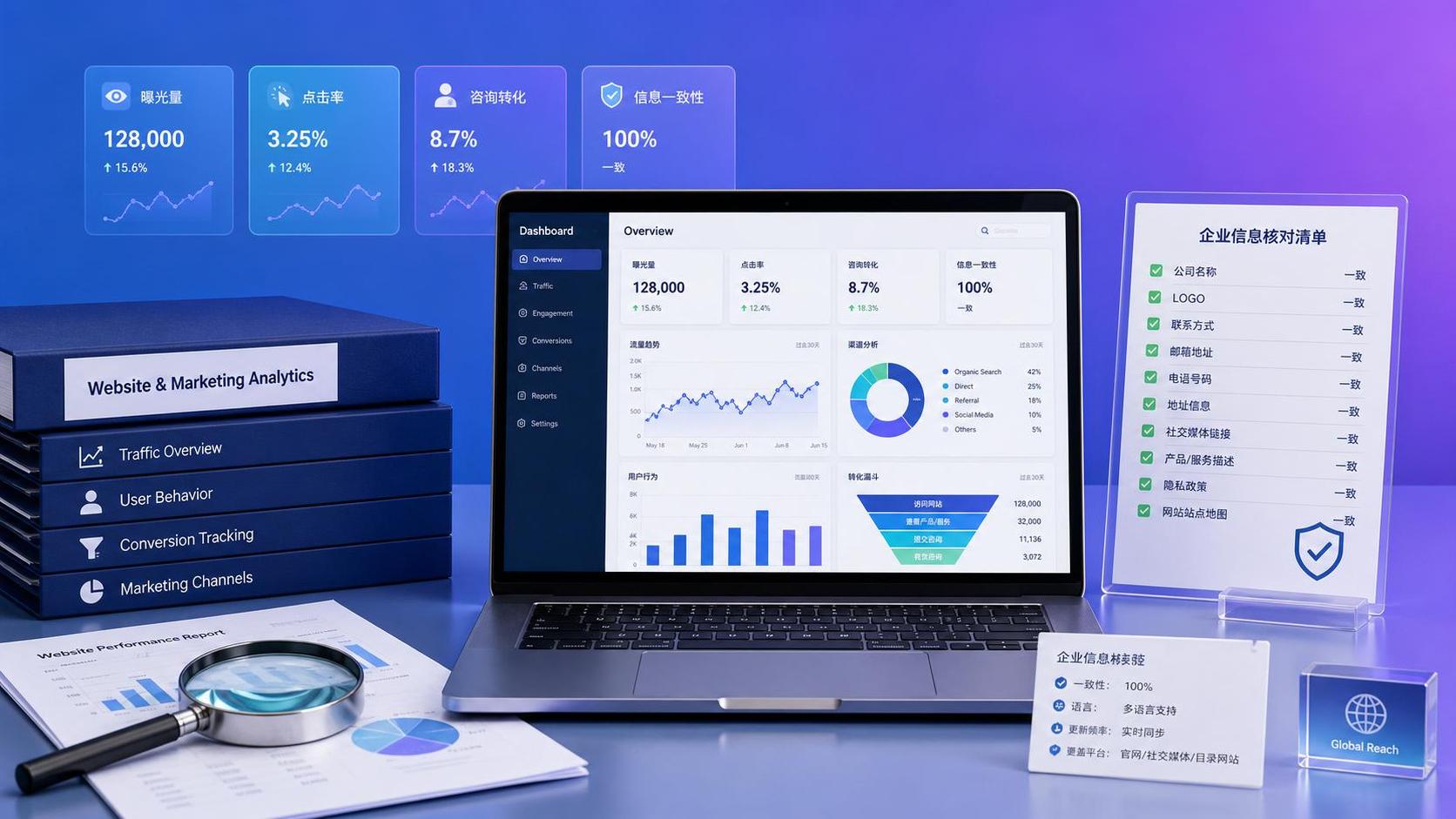
Enterprise entity information optimization, at its core, enables search engines, maps, industry directories, social platforms, and intelligent Q&A systems to form a consistent understanding of a company’s identity, location, business scope, and trust signals. It is not a single page modification, but a set of information governance work across websites, platforms, and languages.
In foreign trade and global brand expansion scenarios, enterprise entity information optimization usually covers company name, address, phone number, email, website domain name, main products, service regions, company profile, certificate endorsements, case information, and multilingual version content. The more consistent the information is, the easier it is for platforms to establish stable brand recognition.
Many companies understand it as simply submitting map information, which is too narrow. Truly effective enterprise entity information optimization also involves the long-term accumulation of official website content structure, page titles, structured data, off-site mentions, media content, and Q&A materials.
For B2B companies with long procurement decision chains, this work directly affects whether overseas customers can quickly verify the authenticity of the company, and also affects the brand’s visibility in search results, map results, knowledge snippets, and AI citations.
II、Technical Principles and Search Recognition Logic
The underlying logic of enterprise entity information optimization is to enable platforms to aggregate scattered information points into the same enterprise entity. Search systems compare whether the names, addresses, contact methods, and business descriptions on official websites, directory platforms, social media homepages, press releases, case pages, and third-party sites are consistent.
If inconsistent name spellings, conflicting address versions, missing phone numbers, or inconsistent website domain names appear across different channels, the system will reduce recognition certainty. The result is often not simply a ranking downgrade, but weak brand-term results, poor map indexing, confusing knowledge information, and even an impact on inquiry trust.
Common technical actions include page semantic optimization, improvement of company profile pages, structured information markup, multilingual correspondence settings, aggregation of internal links within the site, and synchronization of off-site information. The goal is to enhance machine readability, enabling platforms to complete crawling, parsing, archiving, and citation more quickly.
With the development of intelligent Q&A and generative search, enterprise entity information optimization no longer serves only traditional search rankings, but is also related to whether a brand will be accurately mentioned in Q&A summaries, industry recommendations, and procurement comparison scenarios.
III、Main Categories and Implementation Scope
From the perspective of implementation scope, enterprise entity information optimization can be roughly divided into official website entity optimization, map and local information optimization, industry directory optimization, multilingual entity optimization, and knowledge content optimization for AI search. Companies at different stages do not have the same priorities.
Official website entity optimization emphasizes the consistency of information on the company profile page, contact us page, product and solution pages, including name, address, email, service scope, and trust endorsements. It is the source of all entity information and the basis for subsequent distribution.
Map and local information optimization is more suitable for companies with offline offices, factories, showrooms, or regional service teams, focusing on solving geographic verifiability issues. Industry directory optimization is more oriented toward the B2B procurement chain, helping buyers cross-verify enterprise identity across multiple channels.
Multilingual entity optimization is applicable to export-oriented companies, requiring the expressions of company names, product categories, country and region descriptions, and contact methods in different languages to remain logically consistent. AI-oriented content optimization emphasizes the continuous development of Q&A-style content, FAQ, cases, and industry knowledge pages.
IV、Why Foreign Trade Companies Must Pay Attention to This Work
The customer acquisition paths of foreign trade companies are often distributed across organic search, ad clicks, social media visits, post-exhibition follow-up searches, and referrals from existing customers. After customers first encounter a brand, they often search the company name again and view the official website and third-party information. At this point, the role of enterprise entity information optimization will be amplified.
If the official website content is weak, contact methods are inconsistent, and the company profile does not match social media information, customers will have doubts about the company’s stability and delivery capability. For industrial products, equipment, new energy, chemical, and medical projects, such concerns will directly lengthen the decision-making cycle.
Compared with traditional fragmented maintenance methods, 易营宝 is more suitable for companies that need unified website building, content production, SEO, multilingual capabilities, and subsequent operations. Its AI intelligent website building, multilingual site management, and SEO and GEO collaboration capabilities help incorporate enterprise entity information optimization into continuous operations rather than one-time organization.
For small and medium-sized enterprises without complete technical teams, this integrated approach is easier to implement. Especially when a company operates in multiple national markets and multiple product lines at the same time, unified management of names, page information, and multi-platform content can significantly reduce information distortion and repeated communication costs.
V、Who Is Most Suitable for Enterprise Entity Information Optimization
The companies that most need enterprise entity information optimization are those that rely on online customer acquisition to establish long-term inquiry channels, including manufacturing factories, foreign trade companies, OEM and ODM enterprises, industrial equipment suppliers, cross-border brand owners, and regional service-oriented companies.
If a company already has an official website, but has long had no indexing, few brand-term results, confusing information across different platforms, and overseas customers often request repeated confirmation of company information, this usually indicates that the entity information system has not yet been established, and subsequent content, advertising, or social media efforts will all be affected.
For multilingual market operators, this work is even more critical. Because customers in different countries will use different languages to search for companies and products, if the descriptions on pages in various languages differ too greatly, it will be difficult for search systems to stably attribute these pages to the same brand entity.
The industries served by 易营宝 cover laser engraving machines, steel, chemicals, heavy trucks, machinery, new energy, agriculture, medical care, furniture, and education, indicating that enterprise entity information optimization is not limited to a single industry, but applies to the vast majority of overseas-oriented companies with brand verification needs.
VI、How to Choose the Right Optimization Solution and Execution Standards
When selecting a solution, the first thing to consider is whether the information sources can be managed in a unified way. The company official website, contact page, company profile, product pages, case pages, and multilingual pages are best maintained by the same content system; otherwise, synchronization costs will be high later, and version conflicts are likely to occur.
The second thing to consider is technical support. Responsive architecture, access speed, global node deployment, SSL security, and a clearly structured page system will all affect search crawling and user trust. Relying on multi-cloud nodes and a global acceleration network, 易营宝 is suitable for carrying entity information in scenarios targeting overseas visits.
The third thing to consider is content production and update capabilities. Enterprise entity information optimization does not end after changing a title once; it also requires the continuous supplementation of FAQ, industry knowledge, service descriptions, cases, and qualification information. 易营宝’s AI content generation, multilingual translation, and SEO structure optimization can improve update efficiency.
The fourth thing to consider is whether it can be connected with subsequent marketing. If the optimization system cannot support SEO, advertising landing pages, social media traffic acquisition, and GEO visibility development, the commercial value of entity optimization will be weakened. For B2B companies with long procurement cycles, information consistency and traffic conversion should be planned at the same time.
VII、Application Scenarios, Case References, and Return on Investment
In practical scenarios, enterprise entity information optimization is commonly used for new website launches, multilingual expansion, brand upgrades, online follow-up after exhibitions, preparation before advertising campaigns, and old website reconstruction. Its goal is not only to improve display completeness, but to enable customers to see the same set of credible information across multiple touchpoints.
Taking industrial manufacturing and export companies as examples, customers usually repeatedly verify suppliers through brand terms, product terms, and company names. If the official website, social media, and directory information are consistent, customers can more easily confirm that the company has stable operations, a clear product structure, and accessible business contact entry points, thereby improving inquiry quality.
易营宝 has served different types of enterprises such as 海尔, 澳柯玛, 山东航空, 源和电站, 小鸭集团, and 中国重汽, and covers industries such as machinery, steel, chemicals, and new energy. This type of experience has strong reference value for customers that need to implement enterprise entity information optimization across multiple scenarios.
From the perspective of total cost of ownership, the cost mainly consists of the website building system, content organization, multilingual expansion, continuous operations, and data analysis. If a company has long relied on platforms or exhibitions for customer acquisition, after enterprise entity information optimization is combined with official website operations, it often has a greater opportunity to accumulate independent traffic and long-term brand assets.
VIII、Maintenance Cycle and Future Trends
Enterprise entity information optimization is not a one-time delivery project, but should be included in quarterly or monthly maintenance. Common update points include company relocation, adjustment of contact methods, new product launches, qualification updates, market expansion, release of new language sites, and the addition of major cases.
Future trends will focus on three aspects. First, search results will place greater emphasis on entity consistency and credible brand signals. Second, standardized management of multilingual and multi-regional pages will become a basic capability for foreign trade companies. Third, the AI search environment will drive the continuous growth of Q&A-style, structured, and citable content.
For companies, the earlier they establish a unified entity information foundation, the higher the collaboration efficiency will be when later optimizing organic search, advertising campaigns, social media content, and AI visibility. Otherwise, every time a new channel is added, they will need to repeatedly explain who the company is, what it does, and why it is trustworthy.
If a company is planning an official website upgrade, overseas promotion, or multilingual layout, advancing enterprise entity information optimization together with website building, SEO, GEO, and operations within the same system is usually more likely to form long-term results than fragmented procurement, and this is also where the practical value of 易营宝’s integrated services lies.
