









1. What Is Q&A-Based Content Development
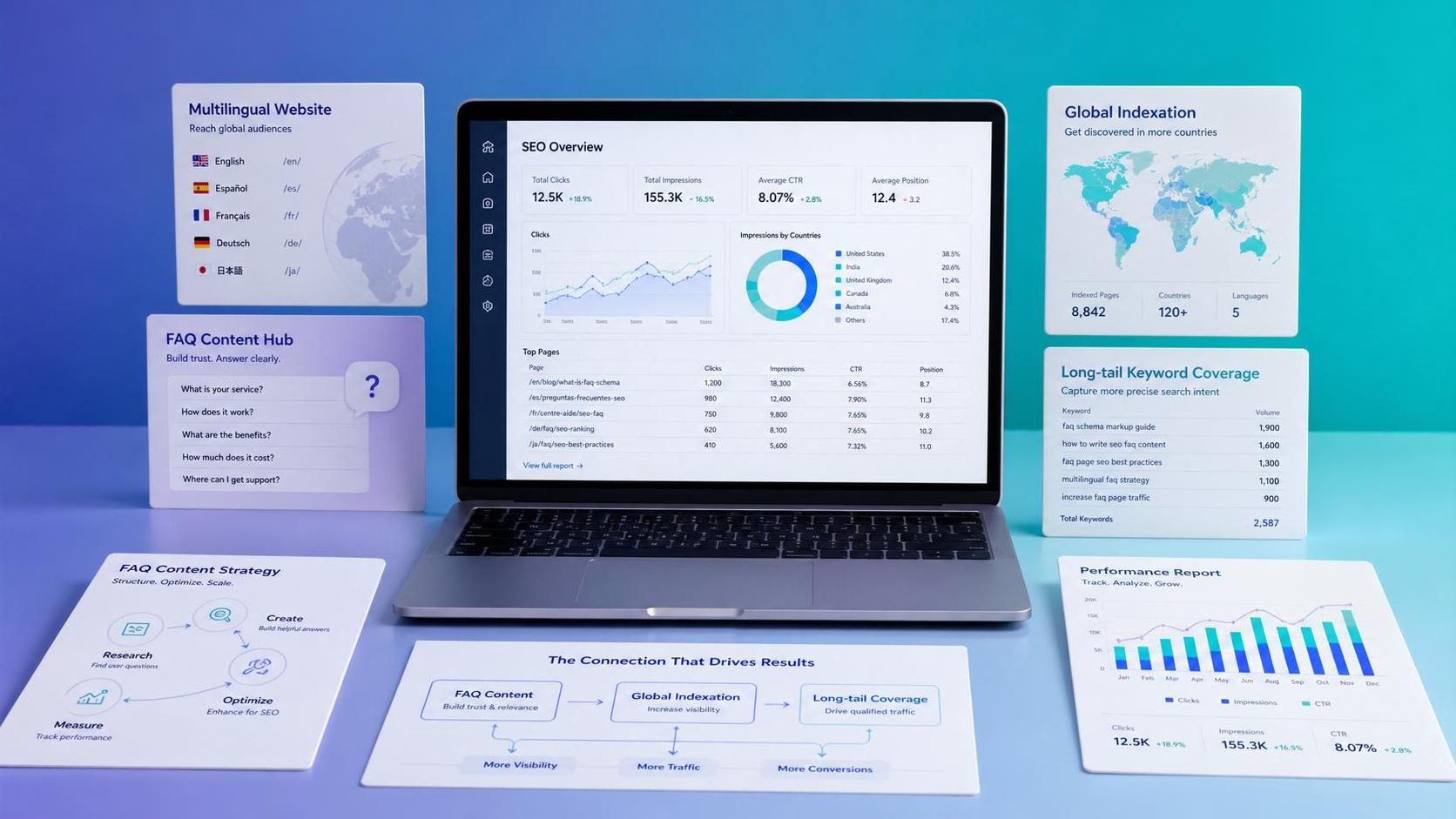
Q&A-based content development is a content methodology that systematically creates question-and-answer pages, topic pages, product FAQ pages, and industry knowledge pages around the real questions customers ask during procurement, price comparison, evaluation, after-sales support, and other stages. It is not simply a matter of piling up frequently asked questions. Instead, it turns enterprise knowledge into searchable, readable, and consultable content assets.
In foreign trade and global expansion scenarios, Q&A-based content development is especially important because overseas buyers are more accustomed to using search engines, industry searches, social media discussions, and AI Q&A tools to conduct preliminary screening before deciding whether to send an inquiry. The earlier a company answers the buyer's questions, the more likely it is to enter the procurement shortlist.
From the perspective of website operations, this type of content serves three purposes at the same time: covering long-tail demand, building professional trust, and shortening the consultation journey. For manufacturers, B2B suppliers, and brands expanding overseas, it has become an important infrastructure for integrated website and marketing growth.
2. How the Technical Logic and Content Structure Work
The underlying logic of Q&A-based content development is to break down user intent into question nodes, and then support those nodes with pages through a clear structure. Common nodes include product specifications, delivery time, minimum order quantity, certification requirements, application industries, pricing factors, after-sales support, and regional adaptability. These questions directly correspond to the procurement decision-making path.
When content is organized into Q&A units with clear titles, focused semantics, and complete context, search engines can understand the page topic more easily, and AI Q&A systems can more easily extract facts, definitions, comparisons, and conclusions from it. As a result, the content is not only written for human readers, but also becomes more suitable for retrieval, summarization, and citation.
For corporate websites, truly effective Q&A-based content development usually needs to work together with page structure, internal linking, the completeness of product page information, multilingual expression, and the mobile reading experience. Only when the website foundation, content production, and marketing entry points are connected can question-based content be steadily converted into traffic and inquiries.
The value of 易营宝 in this process lies in integrating AI-powered website building, multilingual independent websites, content generation, SEO optimization, and GEO deployment into one system, enabling Q&A content to go online faster and form a sustainably expandable knowledge structure within the website.
3. Main Categories and Applicable Scenarios
From a practical business perspective, Q&A-based content development can usually be divided into four categories. The first category is brand and company awareness content, which answers questions such as who you are, what you can do, which markets you serve, and what proof of capability you have. It is suitable for homepages, About Us pages, solution pages, and company profile pages.
The second category is product procurement decision-making content, focusing on parameters, materials, applications, delivery time, certifications, packaging, shipping, payment methods, and after-sales processes. This type of content is best placed on product detail pages, industry application pages, and dedicated FAQ pages, and is one of the most commonly used high-conversion modules for B2B inquiry websites.
The third category is comparison and selection content, used to answer questions such as which solution is more suitable, what the differences are between different models, and how to choose between a factory and a trading company. It is more suitable for industrial products and equipment businesses with high unit prices, high technical thresholds, and long decision-making cycles.
The fourth category is pre-sales and after-sales support content, including installation, maintenance, troubleshooting, update cycles, and usage recommendations. It can both improve the customer experience and strengthen the company's professional image in return. For multilingual markets, Q&A-based content development should also distinguish between countries, languages, and industry terminology to avoid misunderstandings caused by direct translation.
4. Which Companies Should Prioritize This Strategy
Q&A-based content development does not require the same level of investment from every company. However, for companies that rely on online customer acquisition, need to build professional trust, and have relatively long sales journeys, its priority is significantly higher. Foreign trade factories, machinery and equipment companies, chemical and materials companies, auto parts suppliers, new energy companies, medical device companies, and OEM and ODM suppliers are all typical applicable groups.
These companies share common characteristics: customers make decisions cautiously, product information is complex, procurement values are relatively high, and cross-border communication costs are substantial. Customers usually do not place an order immediately because of a single advertisement. Instead, they first verify through many questions whether the supplier is professional, stable, and suitable for long-term cooperation.
For cross-border e-commerce independent websites and brands expanding overseas, Q&A-based content development is also useful, but the focus shifts from inquiries to conversions. For example, product comparisons, usage instructions, logistics timelines, return and exchange policies, compatibility explanations, and answers to user concerns can directly affect order conversion rates and repeat purchase rates.
If a company already has a website but has lacked updates for a long time, or if traffic quickly drops after advertising is paused, then prioritizing Q&A-based content development is often more effective than simply increasing the number of pages, because it is closer to real search behavior and real procurement questions.
5. How to Select and Implement It to Avoid Content That Does Not Convert
When a company starts Q&A-based content development, it should first determine whether it has a clear content carrier. Without a reasonably structured website, even a large amount of content will be difficult to accumulate value. Ideally, the website should support collaboration among categories, articles, product pages, landing pages, multilingual pages, and internal links, rather than publishing answers to questions in a scattered way across different platforms.
Second, it is necessary to determine whether the content sources are authentic. High-quality Q&A should not be created solely by writers from imagination. It should come from sales records, customer service conversations, inquiry emails, trade show communications, search term reports, and advertising keyword data. The closer the questions are to customers' original wording, the more likely the pages are to bring effective visits and consultations.
Third, it is important to check whether the system supports continuous updates and multilingual expansion. 易营宝's integrated solution is suitable for this scenario because, based on AI-powered website building, it can quickly generate category structures, page copy, product introductions, and multilingual content, while working with SEO, GEO, advertising landing pages, and social media traffic generation to form a closed loop.
Fourth, technical and experience details should be reviewed, including mobile adaptation, page loading speed, form paths, WhatsApp or email entry points, and overseas access stability. Content itself is important, but if the website loads slowly, has a poor reading experience, or makes consultation inconvenient, the value of Q&A-based content development will be significantly weakened.
6. Application Scenarios and Case References
In industries such as laser engraving machines, steel, chemicals, heavy trucks, machinery, new energy, agriculture, and healthcare, customers commonly conduct intensive searches on technical and procurement questions before contacting suppliers. At this stage, Q&A-based content development can help companies move knowledge that was originally scattered across sales communications onto the website in advance, completing the first round of screening and education.
Taking manufacturing and industrial product companies as examples, common high-value questions include whether the product supports customization, what the minimum order quantity is, whether certain export documents are available, how long the production cycle is, which national markets the product is suitable for, and how installation and maintenance are carried out. If these questions are answered in advance by the website, the sales team's communication efficiency will improve significantly.
易营宝 has served multiple industries, including laser engraving machines, machinery, new energy, automobiles, furniture, and education, and has also covered complex business scenarios represented by cases such as Haier, Aucma, Shandong Airlines, Yuanhe Power Station, Xiaoya Group, and Sinotruk. For companies of this type, Q&A-based content development is usually not a standalone action, but is advanced in parallel with website building, SEO, advertising, and social media.
Especially in multilingual markets, Q&A content also undertakes the task of market adaptation. Customers in different countries have different concerns, so pages must not only be translated, but also adjusted in terms of expression order, professional terminology, and the way evidence is presented. This is why multilingual website building and content localization must work together.
7. Cost Structure, Total Cost of Ownership, and ROI Evaluation
From a procurement perspective, the cost of Q&A-based content development is not simply how much one article costs. It consists of the website system, content planning, keyword research, multilingual processing, page publishing, continuous updates, data analysis, and conversion optimization. If these elements are purchased separately, communication and maintenance costs are usually higher.
The key factors that truly affect total cost of ownership mainly include three aspects: first, whether multilingual and multi-market coverage is required at the same time; second, whether the product is complex and requires industry-specific knowledge organization; third, whether the company already has a website and operations team capable of receiving traffic. The weaker the foundation, the more important systematic construction is in the early stage.
From the perspective of return on investment, the benefits of Q&A-based content development are usually reflected in broader long-tail exposure, lower dependence on customer acquisition channels, more stable organic traffic, longer page dwell time, and clearer inquiry quality filtering. It may not scale up immediately in the short term like advertising, but it has stronger compounding value for medium- and long-term customer acquisition.
For companies without a complete digital team, adopting an integrated website plus marketing service such as 易营宝 makes it easier to control project collaboration costs. Advancing website building, content, SEO, SEM, SNS, and GEO within the same system can reduce duplicated investment and is also more conducive to later review and continuous optimization.
8. 2026 Trend: Content Competition from Search Answers to AI Citations
By 2026, the competitive focus of Q&A-based content development will no longer be limited to traditional search rankings, but will also include visibility in AI search, intelligent summaries, and conversational recommendations. The more structured, professional, and close to real questions the content is, the more easily it can be recognized and invoked by the next generation of information distribution mechanisms.
In the future, companies will pay more attention to three capabilities: first, the accumulation of multilingual knowledge assets; second, the linkage between on-site content and advertising and social media; third, continuous updates around brand entities, product capabilities, and industry solutions. Q&A-based content development will evolve from supporting content into a core layer of enterprise digital assets.
In this process, a website will no longer be merely a display business card, but a combination of a marketing system, knowledge system, and conversion system. Whoever can continuously provide credible, complete, and easy-to-understand answers to questions will be more likely to obtain stable traffic and high-quality inquiries.
For companies that want to build long-term overseas growth, Q&A-based content development should now be included in the annual operations plan and implemented in coordination with website building, multilingual content, SEO, advertising, and social media. Only a content system formed in this way will have the opportunity to continue delivering value in the competitive environment of 2026.
