









- How to Choose Topics for an Industry News Section to Attract More Organic Search TrafficJul 29, 2026View details
- Can Zhejiang foreign trade independent websites still be developed today? Look at changes in traffic and lead generationJul 28, 2026View details
- What New Signals Are Emerging in Enterprise Services SaaS Marketing ReportsJul 27, 2026View details
- What Does a Global Traffic Ecosystem Service Provider Do? What Are the Differences from a Single Advertising AgencyJul 16, 2026View details
- What should you focus on in the latest enterprise SaaS report? From renewal rates and delivery costs to overseas growth opportunitiesJul 12, 2026View details
- What signals are worth paying attention to in a cross-border marketing trend report? B2B companies should look at these 6 signalsJul 11, 2026View details
Portuguese independent website development What should cross-border e-commerce pay attention to?Payment、logistics and local expression details
Portuguese Independent Website Development,Why It Cannot Be Just Translation
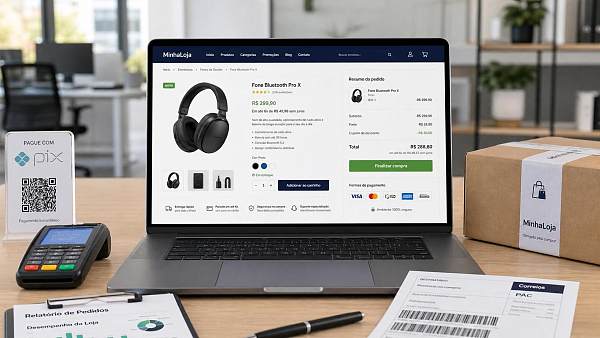
When building a Portuguese independent website,many teams first think of page translation。This direction is not wrong,but it is far from enough。What truly affects conversion in cross-border e-commerce is often not the language itself,but whether users are willing to place an order,whether they can pay smoothly,how long it takes to receive the goods,and whether the page expression matches local reading habits。
Especially in Portuguese-speaking markets,although Portugal and Brazil both use Portuguese,their consumption habits,price sensitivity,payment preferences,and logistics expectations are not completely the same。If these differences are ignored during the Portuguese independent website development stage,the subsequent customer acquisition cost,customer service pressure,and refund risk of cross-border e-commerce usually increase significantly。
From the perspective of project execution,Portuguese independent website development is more like a systematic project。Front-end copywriting,payment integration,logistics commitments,tax and fee explanations,SEO structure,and advertising landing pages must be planned together。Only in this way can a cross-border e-commerce independent website be not just “able to go live”,but truly “able to generate transactions”。
Define the Market First:A Portuguese Website Is Not a Single Market
The first thing Portuguese independent website development needs to solve is not the translation,but the segmentation of target markets。Whether targeting Portugal,Brazil,or multiple Portuguese-speaking countries at the same time will directly affect the website structure,currency display,shipping rules,and content expression。
If the business focus is Brazil,cross-border e-commerce pages need to emphasize installment payments,delivery timeliness,tax and fee explanations,and after-sales commitments。Brazilian users are more sensitive to payment convenience and price transparency。If targeting Portugal,users usually pay more attention to brand credibility,delivery stability,and the completeness of website information。
In actual business,it is recommended to divide Portuguese independent website development into two levels:one is the language version,and the other is the market version。The same language does not mean that page content,campaign rules,and conversion paths should also be exactly the same。If this step is handled in detail,many later problems will be greatly reduced。
Three Basic Settings Recommended for Priority Confirmation
- Target countries and traffic sources,whether SEO is the main focus or advertising is the main focus。
- How currency,taxes,and shipping fees are displayed,and whether they switch automatically by country。
- Whether on-site content distinguishes between Brazilian Portuguese and European Portuguese expressions。
Payment Design Is the First Conversion Threshold in Portuguese Independent Website Development
A common problem for cross-border e-commerce independent websites is not the lack of traffic,but serious loss after users add items to the cart。A large part of the reason comes from mismatched payment methods。If Portuguese independent website development only integrates international credit cards,conversion is often clearly limited。
Taking the Brazilian market as an example,some consumers are more accustomed to localized payment methods and also value installment capabilities more。If the payment page has complicated steps,unclear currency,or non-transparent explanations of additional handling fees,users can easily exit at the final step。For cross-border e-commerce,this kind of loss is more regrettable than a front-end bounce。
Therefore,Portuguese independent website development should treat payment as part of the conversion page,not merely as a technical interface。Payment page text,failure prompts,refund rules,and billing explanations are best localized together to avoid uncertainty among users at critical stages。
What Should Be Checked Carefully in the Payment Process
- Whether commonly used local payment methods and mainstream bank card payments are supported。
- Whether the settlement currency is clear,and whether exchange rates or handling fees are explained in advance。
- Whether installments are supported,and whether installment costs are displayed clearly。
- Whether the prompt after payment failure is concise and easy to understand。
- Whether refunds,order cancellation,and after-sales entry points are easy to find。
Logistics Commitments Cannot Just Sound Good,They Must Be Deliverable
In Portuguese independent website development,logistics is often handled later,resulting in a disconnect between front-end promotion and back-end fulfillment。Once cross-border e-commerce encounters delivery delays,tax and fee disputes,or untimely tracking updates,orders generated by earlier advertising investment can easily turn into customer service and refund pressure。
A more reliable approach is to define fulfillment boundaries before the website goes live。For example,which regions can be shipped to directly,which products require pre-sale,what the average delivery time is,who bears taxes and fees,and how long abnormal shipments are handled。What cross-border e-commerce users fear most is not waiting,but not knowing how long they need to wait。
This also means that the logistics copy in Portuguese independent website development must be truthful。Do not only write “fast delivery” or “global shipping”,but provide perceptible information,such as estimated dispatch time,transportation time ranges,customs duty reminders,and traceable milestones。The more specific the information,the more stable the conversion。
A Logistics Page Should Include at Least These Contents
- Explanations of deliverable countries and undeliverable regions。
- Order processing cycle and estimated delivery time。
- Shipping fee calculation rules and free shipping thresholds。
- Tax and fee responsibility methods and customs clearance risk reminders。
- Parcel tracking methods and abnormal shipment handling process。
Local Expression Determines Trust,Simple Translation Is Not Enough
Many cross-border e-commerce websites appear to have completed Portuguese independent website development,but users can feel at first read that “this is not a local site”。The reason is usually not grammar,but the way of expression。Headlines that look like machine translation,stiff button wording,and awkward after-sales commitments can all weaken trust。
Truly effective Portuguese independent website development should view local expression within the conversion path。Whether the homepage title matches search habits,whether product selling points are close to local concerns,whether checkout buttons are clear and direct,and whether the FAQ answers real concerns are all more important than “literal accuracy”。
Judging from recent changes,users are making faster judgments about the authenticity of a website。Once a page shows an obvious translation tone,confusing units of measurement,or inconsistent date formats,cross-border e-commerce advertising traffic will be lost more quickly,and the dwell time of SEO pages will also be affected。
Expression Details Most Easily Overlooked
- Whether button copy is natural,avoiding stiff imperative expressions。
- Whether price,date,address,and phone number formats are localized。
- Whether units for size,weight,and delivery time are consistent。
- Whether returns and exchanges,warranty,and privacy terms are clear and easy to read。
- Whether search terms,category terms,and product terms match local usage。
From Website Development to Customer Acquisition,Project Execution Should Follow One Complete Chain
If Portuguese independent website development is driven only by design or development alone,the final result often becomes “the pages are completed,but the business is not connected”。A more efficient approach is to place website development,SEO,advertising landing pages,payment,logistics,customer service,and data tracking within the same project rhythm。
For cross-border e-commerce,an independent website is not a display window,but a transaction system。Page structure needs to consider search engine indexing,product details need to balance advertising conversion,and forms and checkout processes need to serve lead accumulation and repeat purchase operations。When the front and back links are connected,investment is easier to amplify。
For a platform like 易营宝 that provides integrated website and marketing services,its value lies in placing AI intelligent website development,multilingual content,localized SEO,advertising placement,and data optimization within the same system。Doing so not only shortens the launch time,but also reduces deviations caused by repeated cross-team communication。
A More Practical Execution Sequence
- First define the target market,product scope,and conversion goals。
- Then build the information architecture for Portuguese independent website development。
- Confirm payment,logistics,taxes,and after-sales rules in parallel。
- Complete local expression optimization and SEO content deployment。
- Finally integrate advertising,data tracking,and a continuous iteration mechanism。
Conclusion:Move Key Details Forward,and Portuguese-Speaking Markets Will Be Easier to Penetrate
In summary,the difficulty of Portuguese independent website development has never been only language。For cross-border e-commerce to truly build up Portuguese-speaking markets,payment adaptation,logistics fulfillment,local expression,and the marketing chain all need to be considered together。The earlier these fundamentals are organized,the higher the efficiency of later promotion will be。
If you are currently planning Portuguese independent website development,you can start by checking the payment list,logistics rules,and core page copy。Complete the key nodes that affect conversion one by one,then continue testing with SEO and advertising,and the cross-border e-commerce independent website will enter a stable growth state more quickly。
Related Articles
Related Products
 Yiyingbao SaaS Intelligent Website Building and Marketing SystemYiyingbao SaaS Intelligent Website Building and Marketing System, AI-powered no-code website building, rapid creation of multilingual B2B international websites in 10 minutes, global server acceleration, AI-powered SEO optimization, helping businesses connect efficiently with global markets. The perfect integration of technology and operation makes building an international trade website remarkably simple
 AI+SEM Intelligent Advertising Marketing SystemAI+SEM drives intelligent ad creation, empowering full-funnel precision advertising marketing. The system automatically generates weekly/monthly reports, AI recommends keywords and target countries, monitors core metrics in real-time with intelligent alerts, and enables one-click high-conversion ad solutions to help quickly acquire customers and improve ROI.
 AI+SEO Dual-Engine System Optimization ServicesYiyingbao’s AI+SEO dual-engine optimization system helps foreign trade enterprises acquire high-quality organic traffic through AI-powered keyword research, content generation, and comprehensive technical optimization, significantly improving search rankings and conversion rates.
 AI+SNS Social Media Marketing SystemYingbao AI+SNS Social Media Marketing System - Precision social capture for the social media era. Supports one-click content synchronization across major platforms like Facebook and LinkedIn. AI intelligently rewrites posts for enhanced relevance. 24/7 AI customer service and user profiling analysis empower businesses to efficiently expand into global markets.
 AI+SEO营销解决方案易营宝AI+SEO营销解决方案,通过AI批量写作、智能生成TDK、精准关键词扩词等功能,全面优化网站SEO效果,提升流量与转化率。助力企业构建高效智能网站新生态。
 AI+SEM Advertising Marketing SolutionsAI+SEM Advertising Marketing Solution leverages AI technology to deeply empower SEM ad campaigns. It automatically generates weekly/monthly reports using AI, presenting account data across multiple dimensions for comprehensive insights into campaign performance and trends. The system precisely recommends keywords and target countries, intelligently generates high-conversion ad copy, and enables one-click activation of efficient campaign plans to help businesses rapidly acquire customers. Simultaneously, it monitors core metrics in real time, intelligently identifies abnormal fluctuations, and issues timely alerts to ensure stable, high-return advertising results.
 Domain Name ServicesEasyWin provides professional domain name services, including intelligent queries, one-stop registration, brand protection, and full lifecycle management, helping businesses build a digital brand image.
 EasyOperate B2C Cross-Border E-Commerce Platform & Independent WebsiteEasyStore B2C Cross-border E-commerce Independent Store is an intelligent website building and cross-border e-commerce integrated solution independently developed by EasyStore Information Technology (Beijing) Co., Ltd. The system is specially designed for small and medium-sized as well as large export enterprises, integrating 'website building, operation, marketing, advertising, and conversion' into one, helping enterprises quickly establish cross-border e-commerce independent stores to achieve brand globalization and global sales growth.
The platform supports multiple languages, multiple currencies, and multi-channel marketing, with built-in AI intelligent translation and SEO optimization systems, suitable for mainstream markets such as Southeast Asia, Europe and America, Latin America, and the Middle East, assisting Chinese manufacturing enterprises in efficiently deploying international e-commerce strategies. SSL证书易营宝提供专业SSL安全证书服务,包括单域名和泛域名证书,确保网站数据传输加密、身份验证和完整性保护,助力企业建立安全可信的在线业务环境。









