









I. Industry Definition and Website Development Scope
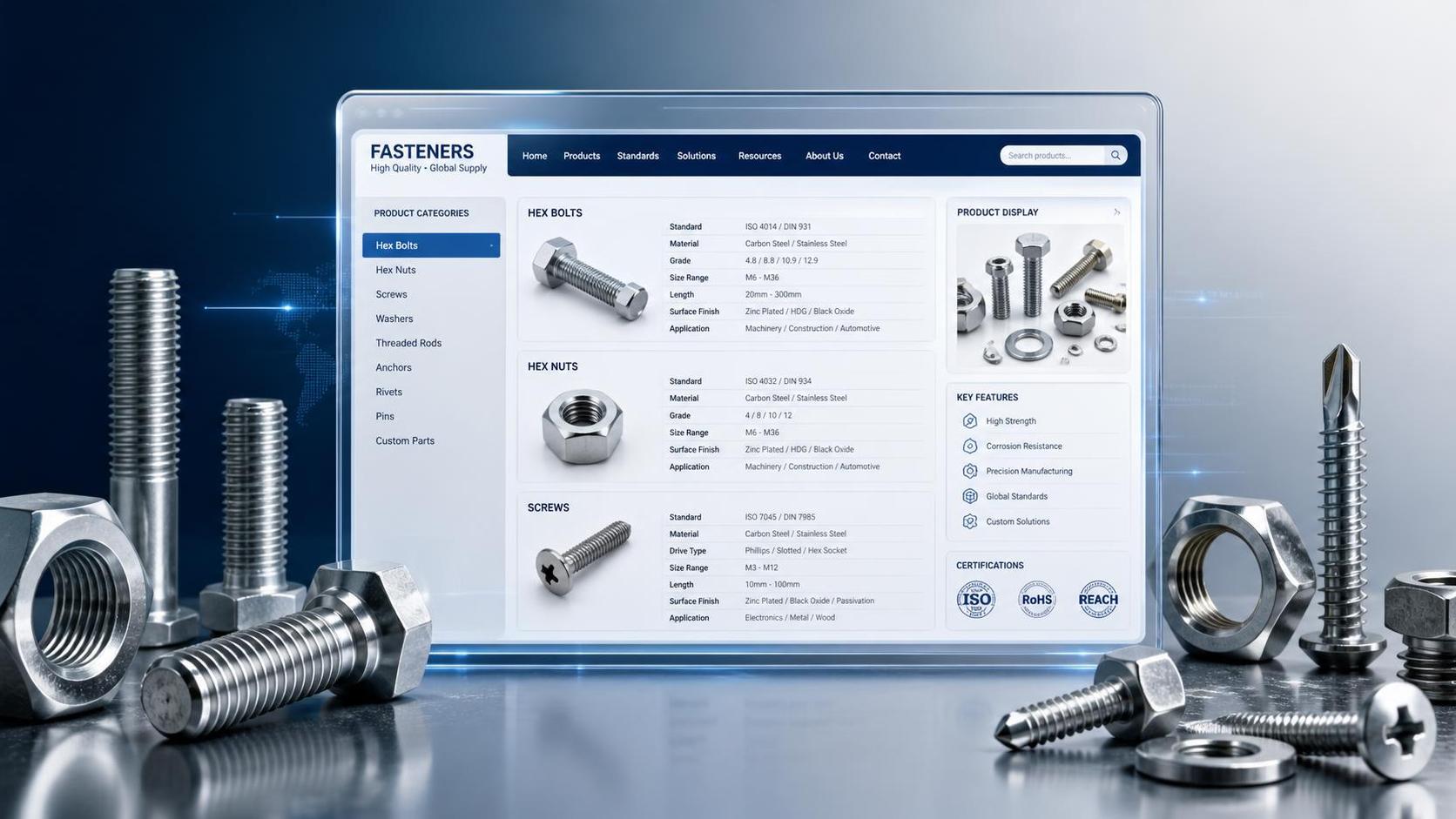
Foreign trade website development for hardware fasteners involves building a digital procurement portal for the export business of bolts, nuts, screws, washers, rivets, anchors, and custom fastening components. Its core purpose is not merely visual presentation, but enabling overseas buyers to understand product specifications, materials, performance grades, delivery capabilities, and cooperation methods.
Compared with general corporate websites, fastener websites need to support frequent parameter comparisons. Buyers typically search for products by standard, thread, diameter, length, surface treatment, material, strength grade, or application industry. Therefore, the category structure, filtering logic, and product detail page fields directly affect inquiry efficiency.
A complete project generally includes domain name and server configuration, page design, product data migration, multilingual content, inquiry pathways, traffic analytics, and ongoing promotion. For OEM and non-standard orders, the website should also provide entry points for drawing uploads, sample requests, and customized parameter descriptions, enabling the sales team to obtain more complete lead information.
II. Buyer Requirements and Suitable Businesses
Foreign trade website development for hardware fasteners is suitable for manufacturing plants, trading companies, OEM/ODM suppliers, inventory wholesalers, and businesses seeking to develop their own export brands. Customers in automotive parts, construction installation, machinery and equipment, energy projects, furniture, and electronics assembly each follow different purchasing decision paths for fasteners.
Overseas purchasing personnel first focus on whether products match drawings or existing standards, then assess quality control, minimum order quantity, packaging, lead time, and trade terms. Engineers place greater importance on material composition, salt spray requirements, mechanical properties, dimensional tolerances, and test reports. The website should address the concerns of these different roles separately.
For businesses that rely on trade shows, marketplace stores, or sales representatives for customer development, an independent website can accumulate product and brand assets while receiving traffic from search, advertising, and social media. It does not replace on-site factory audits or technical confirmation, but it can reduce information asymmetry before initial contact and improve the starting point for effective communication.
III. Information Architecture and Technical Implementation Principles
The technical architecture should be based on how buyers search for information: the homepage explains the supplier positioning; the product center is organized by category and standard; detail pages provide verifiable parameters; industry application pages explain supporting scenarios; the factory page presents equipment and processes; the resource center accumulates product selection knowledge; and the inquiry page shortens the contact process.
Product detail pages should not contain only images and brief selling points. It is recommended to present the product name, standard reference, specification range, raw materials, surface treatment, performance indicators, packaging method, application areas, and customizable options in a structured format. Actual supply parameters should be subject to drawings, orders, and inspection requirements confirmed by both parties.
Responsive pages, compressed media resources, stable secure access protocols, form anti-spam mechanisms, and data analytics are fundamental configurations. Multilingual websites should use clear language paths and corresponding page relationships, avoiding the direct bulk publication of machine-translated content that may cause terminology ambiguity or duplicate pages.
IV. Standard Content and Trust Information Development
Fastener procurement relies heavily on standard terminology. Websites may describe common standard references such as DIN, ISO, ANSI, ASTM, and JIS according to the company’s actual business scope, but standard names should not be used as generalized promotional labels. Each page should clearly state its scope of application and remind buyers to complete final confirmation based on project specifications, drawings, and contract requirements.
The factory capability page should present actual production equipment, inspection procedures, packaging capacity, export experience, and quality documentation processes. If the company has third-party testing, system certifications, or project cases, it should display their validity scope, update time, and applicable products based on publicly verifiable materials, avoiding vague accumulation of credentials.
At this stage, E-Yingbao can incorporate product catalogs, factory introductions, inquiry forms, WhatsApp, and email entry points into marketing-oriented pages, while supporting multilingual content management and basic search optimization. Its services are suitable for export businesses that need to build websites and subsequent promotion processes in an integrated manner. Specific functional configurations should still be determined according to product complexity and target markets.
V. Implementation Process from Launch to Inquiries
Before a project begins, product review and market positioning should first be completed: identify key product categories, higher-margin specifications, customization capabilities that can be delivered consistently, and priority countries. Then establish keyword-to-page mapping to avoid having one page serve all products and all market demands at the same time, which can dilute both the topic and conversion objective.
The development stage typically includes website structure confirmation, visual and component configuration, product material organization, content localization, form setup, mobile testing, link checking, and data tool integration. E-Yingbao’s AI-powered website building and content assistance capabilities can reduce repetitive data entry, but material, specification, and commitment information should still be reviewed by the company’s technical and business personnel.
After the website goes live, Google organic search, Google Ads, LinkedIn, Facebook, video content, or industry email can be used in combination according to the market stage. Advertising landing pages must align with target keywords and product pages, and source countries, visited pages, form fields, and sales follow-up results must be recorded to assess the actual lead quality generated by each channel.
VI. Total Cost of Ownership and Return Assessment
The total cost of ownership for foreign trade website development for hardware fasteners should not be assessed solely by comparing initial design quotations. Key components also include product material organization, language localization, image or video production, domain name and security services, servers and overseas access experience, content maintenance, promotion budgets, sales response, and data analysis investment.
Key variables affecting investment include the number of product SKUs, the complexity of non-standard parameters, the number of target languages, whether e-commerce functionality is required, whether a customer management system is integrated, and whether content, advertising, and social media operations will be conducted continuously. Low-cost templates that cannot support subsequent expansion may increase hidden costs related to material rework, page revisions, and lost customer acquisition opportunities.
Return assessment should focus on qualified inquiries rather than traffic volume alone. Businesses can track the share of organic traffic, visits from target countries, cost per inquiry, qualified drawing request rate, quotation conversion rate, sample-to-order conversion rate, and customer lifetime value, then adjust pages, budgets, and sales follow-up priorities accordingly.
VII. Operational Cycles, Case References, and Future Trends
A fastener website is not a one-time deliverable. It is recommended to check forms, speed, indexing, and inquiry sources monthly; update key products, application content, and market pages quarterly; and promptly calibrate public information whenever material prices, product ranges, lead times, or quality documents change. Long-term operations are more conducive to accumulating usable content assets than frequent redesigns.
E-Yingbao states that its served industries cover machinery, steel, chemicals, heavy-duty trucks, new energy, automobiles, and other sectors, and lists service cases including Haier, Aucma, Shandong Airlines, Yuanhe Power Station, Little Duck Group, and China National Heavy Duty Truck Group. For fastener companies, the value of these cases lies in learning from the information organization and promotion methods used for complex industrial products, rather than directly copying peers’ pages.
Future competition will extend from single-page rankings to multilingual entity information, structured parameters, Q&A content, and cross-channel data coordination. Content optimization for generative search environments requires the continuous provision of clear, verifiable information consistent with actual supply capabilities. Only by linking websites, search, advertising, social media, and sales feedback can companies gradually improve conversion efficiency among global buyers.
