









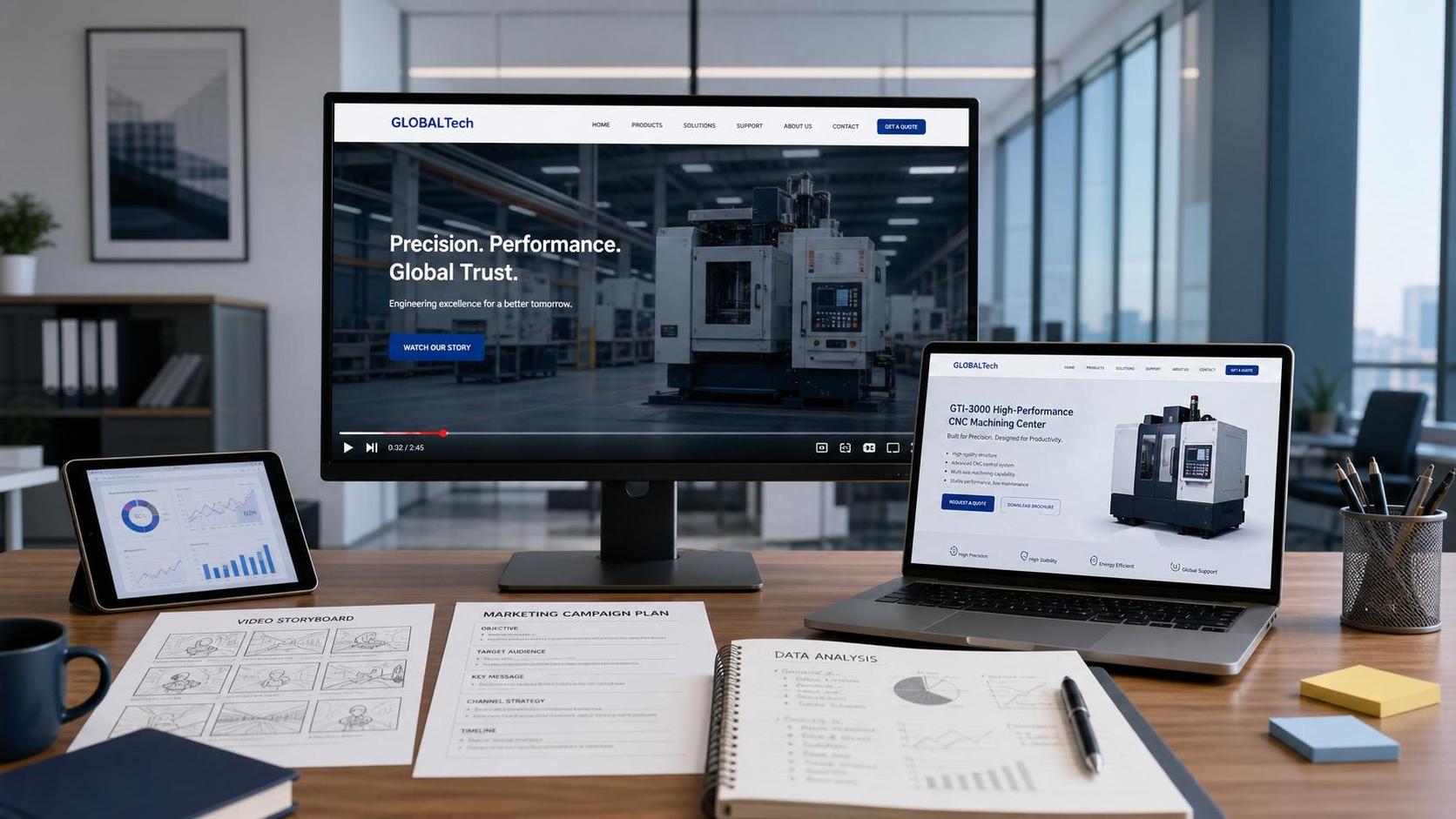

I. Definition and Core Value of Foreign Trade Marketing Videos
Foreign trade marketing videos are commercial content designed to support cross-border lead generation and purchasing decisions. Centered on products, processes, factories, application solutions, or customer issues, they deliver credible information through independent websites, search engines, social media, and advertising channels. Their goal is not simply to pursue views, but to reduce overseas buyers' costs of understanding and concerns about cooperation.
In B2B transactions, procurement personnel typically need to verify whether a supplier has the capabilities for production, quality control, delivery, and communication. Therefore, an effective foreign trade marketing video should present verifiable facts, such as equipment operation, raw material handling, inspection procedures, packaging processes, application results, and service responsiveness, rather than merely stacking promotional slogans.
The commercial value of videos also lies in extending website dwell time and providing explanatory support for inquiry forms, email, instant communication tools, and product catalogs. When a video aligns with the specifications, lead time, MOQ, and calls to action on the product page, visitors are more likely to move from initial understanding to the quotation or sample discussion stage.
II. Main Types and Content Alignment for Different Procurement Stages
By purpose, foreign trade marketing videos typically include brand and factory introductions, product demonstrations, production processes, installation and operation guides, industry solutions, frequently asked customer questions, and trade show footage. Industries with high unit values, such as machinery, chemicals, building materials, and new energy, should prioritize supplementing technical and delivery evidence rather than producing only corporate image videos.
At the awareness stage, short scenario-based videos are suitable for quickly explaining what problem a product solves. At the comparison stage, specifications, structure, performance differences, and application limits should be demonstrated. At the decision stage, content on factory audits, quality inspections, packaging, after-sales service, and case studies is needed. Materials for different stages should not simply use the same script with minor replacements.
Platforms also affect presentation methods. Videos on independent websites can provide complete explanations; short social media videos should clearly present the product and its application at the beginning; advertising videos need to remain consistent with the promises on the landing page; and YouTube is suitable for accumulating tutorial and product selection content. It is recommended to create long, short, and vertical versions for the same topic rather than repeatedly uploading the same file.
III. Website Content Layout and Technical Implementation Essentials
Videos on the website homepage should be placed after the core value proposition in the first screen to establish an initial layer of trust in the factory or brand. On product detail pages, demonstration videos should be placed close to product selling points, parameters, and inquiry entry points. For complex equipment, chapter indexes can be added to enable buyers to quickly jump to key content such as operation, maintenance, or test results.
Technically, mobile responsiveness, cover images, compression encoding, loading strategies, and subtitles should all be considered. Overseas users have widely varying network environments, and excessively large video files may slow down pages and lose visitors. Text summaries, parameter descriptions, and FAQs should be provided below videos to facilitate reading and make page information more complete.
Yiyingbao's responsive website-building capabilities can be used to centrally manage product pages, landing pages, and multilingual content, while improving overseas access experiences through global nodes. Companies can embed videos into marketing pages and configure communication entry points such as forms, WhatsApp, and email, ensuring a consistent path from viewing and understanding to making an inquiry after traffic reaches the website.
IV. Script Structure, Production Process, and Quality Control
Before production, the target country, procurement role, core product, and conversion action should first be determined. A script may follow the sequence of “customer pain point or application scenario, product solution, key evidence, and next step for cooperation.” Within the first few seconds, the product or its application site should appear directly to avoid losing target customers because of a lengthy opening sequence.
During filming, product models, parameter units, operating procedures, and on-screen objects must be consistent with actual delivery. When performance testing is involved, testing conditions should be explained to avoid exaggerated claims detached from the scenario. For industrial products, additional footage of details, interfaces, control panels, packaging, and quality inspection should be taken to provide materials for subsequent sales Q&A.
Post-production should provide subtitles and voice-overs that the target market can understand, while verifying terminology, units of measurement, and contact details. Before publication, mobile clarity, cover readability, link validity, and form usability can be checked. Yiyingbao's AI content capabilities can assist in generating script frameworks, page copy, and multilingual drafts, but professional terminology should still be reviewed by the company's technical personnel.
V. Who It Is Suitable For: Typical Industries and Application Scenarios
Manufacturing factories, OEM/ODM companies, foreign trade companies, industrial product suppliers, and brand globalization teams are all suitable for developing foreign trade marketing video assets. Videos can play a role in remote presentation and pre-sales communication, especially for businesses with complex product structures, customization requirements, long procurement cycles, or customers unable to conduct on-site factory inspections.
Industries such as laser engraving machines, steel, chemicals, heavy-duty trucks, machinery, new energy, agriculture, and healthcare can organize content around process capabilities, application results, quality control, and compliance documentation. When targeting distributors, product lines, delivery support, and marketing materials can be emphasized; when targeting end customers, application scenarios and product selection criteria should be explained in greater detail.
Yiyingbao serves multiple industries and publicly showcases service cases involving Haier, Aucma, Shandong Airlines, Yuanhe Power Station, Little Duck Group, and China National Heavy Duty Truck Group. When referencing cases, companies should focus on their own customers' decision-making paths and select reusable methods, such as using real factory footage together with multilingual product pages to receive overseas traffic, rather than copying creative formats from unrelated industries.
VI. Overseas Promotion Paths and Data Evaluation Methods
Foreign trade marketing videos should establish a content hub around an independent website and then be distributed through channels such as Google Ads, Facebook, LinkedIn, TikTok, and YouTube. Search traffic is more suitable for product selection, tutorial, and solution videos; social media is suitable for continuously demonstrating factory updates and brand credibility; and advertising is suitable for validating combinations of markets, products, and audiences.
Evaluation should not focus only on view counts. It should also examine effective viewing rate, page dwell time, product page views, form submissions, initiated instant communications, inquiry quality, and sales cycle length. Different countries, languages, product lines, and advertising channels need to be recorded separately to determine whether video content, traffic sources, or landing page elements are affecting conversion.
Yiyingbao can integrate multilingual independent websites, AI-powered SEO optimization, advertising, and overseas social media operations into one growth chain. For new websites, companies can first use advertising to test video topics and market feedback, then expand high-intent questions into product pages, articles, and Q&A content, gradually building a more stable foundation for organic traffic.
VII. Costs, Maintenance Cycles, and Future Trends
The total cost of ownership of foreign trade marketing videos includes planning, filming, editing, translation and voice-over, asset management, website deployment, advertising testing, and ongoing updates. Costs depend not only on filming specifications but also on whether content can be broken down and reused. If a complete factory shoot can produce a long official website video, short product videos, social media clips, and sales materials, the cost per content asset is generally more controllable.
Updates are recommended based on product iterations, changes in production processes, target market expansion, and data performance. Changes in parameters, certifications, packaging, or contact details should be synchronized promptly. For videos with low view rates but high click-through rates, the opening and cover can be optimized; when viewers watch sufficiently but inquiries remain low, it is necessary to check whether quotation information, trust pages, and communication entry points are properly aligned.
In the future, video will work more closely with multilingual content, structured Q&A, and generative search. Companies should accumulate authentic product knowledge, factory processes, and application evidence to improve content comprehensibility. Yiyingbao provides website operations, GEO, and data analysis services to help companies lacking overseas digital teams continuously update content and adjust investment priorities based on traffic and inquiry feedback.
