













I. Industry Definition: Too Few Inquiries Indicate a Failed Lead Generation Chain, Not a Single Website Issue
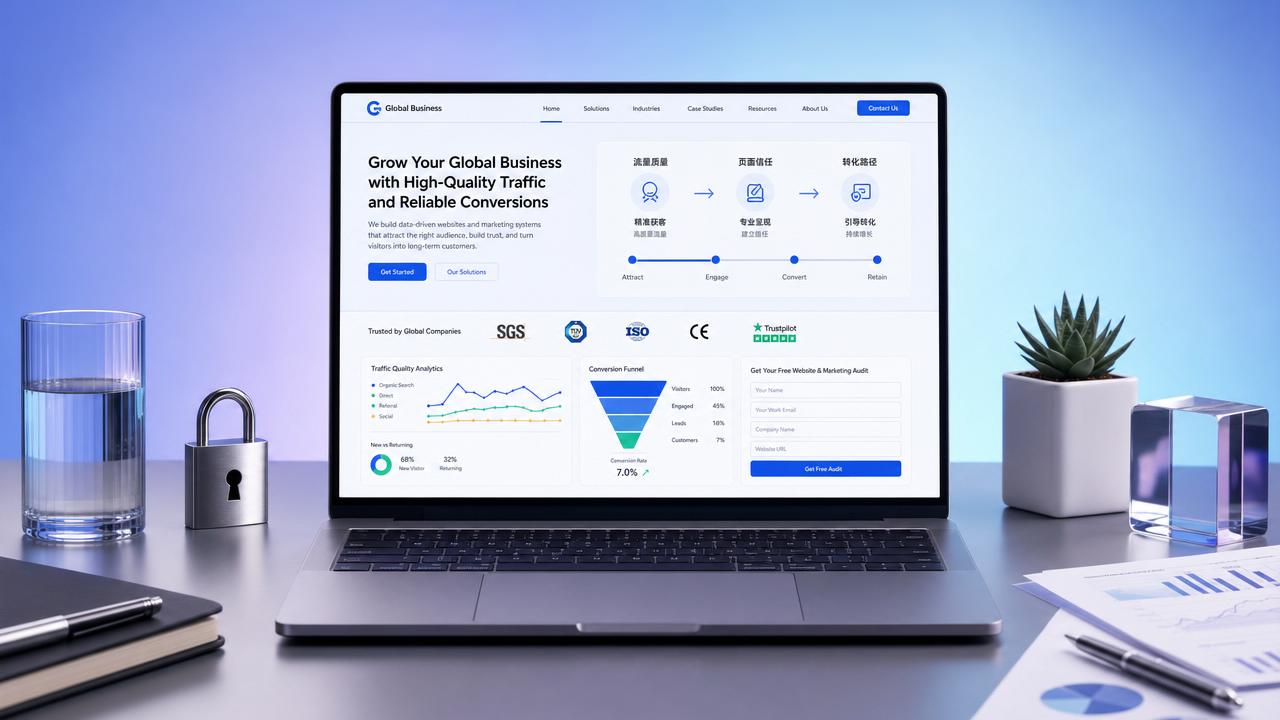
“What should I do if my foreign trade website receives too few inquiries?” is essentially a diagnostic question for export companies regarding the lead generation efficiency of their independent websites. Inquiry volume is jointly determined by effective traffic, the proportion of target buyers, page conversion rates, and sales response efficiency. Effectiveness cannot be judged solely by whether a website is online or whether its design is visually appealing.
B2B procurement cycles are long and involve multiple stakeholders. Visitors typically compare supplier capabilities, product specifications, certification documents, delivery terms, and communication reliability before proceeding. If a website only displays a company profile and a few images, it will be difficult to support customers in completing their initial screening and lead-submission decisions, even if it receives traffic.
The diagnosis should distinguish among four types of issues: “no traffic,” “inaccurate traffic,” “non-converting pages,” and “leads not handled promptly.” First review search impressions, traffic sources, time spent on key pages, and form submissions, then determine whether to increase traffic, adjust content, or restructure the inquiry path, avoiding blind redesigns or increased advertising spend.
II. Technical Principles: Search Visibility, Usable Visits, and Trackable Conversions
Search engines first crawl pages, then understand topics, entity relationships, and page value, and finally rank them based on relevance, user experience, and external signals. Product pages need to clearly state the category, application, material or specifications, capability scope, and purchasing action, rather than relying on repetitive keyword stuffing to gain long-term visibility.
At the technical level, websites should ensure crawlability, mobile readability, stable loading, and clear link hierarchy, while setting correct language and regional associations for multilingual pages. Overseas access speed, HTTPS, secure forms, and accessible image descriptions can also affect buyers’ browsing experience and search engines’ understanding.
Conversion tracking should cover organic search, advertising, social media, and direct visits, and record micro-conversions such as form submissions, email clicks, WhatsApp conversation initiations, and sample requests. Without event data, companies can only see traffic volume and cannot determine which link should be prioritized to address too few inquiries from their foreign trade websites.
III. Main Categories: Configure Content by Traffic Quality and Page Role
By traffic source, independent websites are generally categorized into organic search, paid advertising, social media traffic, and traffic from trade show or email follow-ups. Organic search is suitable for accumulating long-term demand, advertising is suitable for market validation and rapid lead generation, and social media is better suited for building ongoing engagement; different channels should lead to corresponding landing pages.
By page role, the homepage establishes positioning and trust, category pages capture category searches, product pages answer specification and procurement questions, solution pages explain application value, factory and case-study pages provide credibility, and article and Q&A pages address early-stage research needs. Confused page responsibilities dilute action goals.
Taking Yiyingbao’s multilingual independent websites and AI+SEO capabilities as an example, companies can organize content around products, industries, countries, and question keywords, while configuring entry points such as forms, email, and online customer service. For markets such as Russian, Japanese, or Spanish, priority should be given to core commercial pages that have undergone localized review, rather than mechanically replicated translations.
IV. Selection Criteria: Review Foreign Trade Marketing Websites from a Buyer’s Perspective
When choosing website development and operation services, foreign trade companies should first confirm whether the provider understands procurement information in their industry. Industrial product websites in particular need to present models, parameters, minimum order quantities, customization scope, lead times, quality control, packaging and transportation, and after-sales service boundaries, enabling visitors to determine whether further communication is worthwhile.
They should then assess content management, language expansion, data ownership, permission management, basic search configuration, and ongoing maintenance capabilities. Template launch speed is important, but more critical is whether products, articles, and landing pages can be continuously added, and whether the company can retain control of its domain name, content, form leads, and analytics data.
Services should also be accepted based on business objectives: agree on target countries, key categories, the definition of an inquiry, response time limits, and review cycles. Yiyingbao provides a combination of website development, SEO, advertising, social media, and operational services, which is suitable for companies lacking dedicated overseas digital teams; the actual solution should still be configured based on product complexity, market language, and budget.
V. Application Scenarios: Different Companies Should Adopt Different Paths for Inquiry Growth
Common issues for manufacturing factories include weak product pages and unverifiable factory capabilities. They can first supplement information on production equipment, inspection processes, customization capabilities, typical applications, and export experience, and create separate detail pages for high-intent products. Industries such as machinery, hardware, building materials, and chemicals especially need to reduce vague promotion and add verifiable information.
Foreign trade companies and traders, on the other hand, need to explain their supply chain integration, product selection capabilities, quality requirements, and service scope more clearly, avoiding pages that are identical to those of factories. Cross-border brands can strengthen use cases, product differentiation, review content, and purchase or inquiry processes, allowing advertising and social media visitors to receive coherent information on landing pages.
Yiyingbao has disclosed that its services cover multiple sectors, including laser engraving machines, steel, chemicals, heavy-duty trucks, machinery, and new energy, and that it has served companies such as Haier, Aucma, Shandong Airlines, and Little Duck Group. Case names alone cannot replace an assessment of a company’s solution; before a project begins, a diagnosis should still be completed based on the company’s own market, products, and existing data.
VI. Implementation Methods: Form a Closed Loop from Diagnosis and Page Building to Lead Operations
The first step is to establish a baseline: export search terms, channel visits, countries and regions, device types, key pages, and conversion records from the past three to six months to identify pages with impressions but no clicks, visits but no inquiries, or low-quality inquiries. New websites without historical data can begin by building a keyword database based on questions and product terms frequently searched by target customers.
The second step is to build a content matrix. Each core category should include at least a category page, product page, application page, capability page, and FAQ page, with internal links used to establish relationships among them. Product descriptions should be based on actual parameters and business processes. AI can improve first-draft efficiency, but technical data, commitment terms, and multilingual wording must be reviewed by business personnel.
The third step is to optimize lead capture and follow-up. Form fields should be sufficient to screen requirements without being excessively lengthy, while inquiry buttons should appear at decision points such as specifications, advantages, and case studies; instant notifications, tiered assignment, and response templates should be configured simultaneously. Website operations should review keywords, pages, channels, and qualified inquiries monthly, rather than focusing only on total submission numbers.
VII. Costs and Trends: Measure Long-Term Returns by Total Cost of Ownership
The total cost of ownership of an independent website includes not only website development costs, but also domain names, servers or acceleration services, security maintenance, content production, translation and proofreading, SEO, advertising testing, social media operations, and sales follow-up costs. Websites launched at a low price but lacking updating capabilities often incur higher costs later due to content rebuilding, technical fixes, and traffic dependence.
When evaluating returns, it is recommended to distinguish among raw inquiries, qualified inquiries, quotation opportunities, and sales opportunities, and calculate the acceptable customer acquisition cost based on product gross margin and the average sales cycle. For high-value industrial products, improving page screening mechanisms and sales response quality is usually of greater commercial value than simply pursuing more low-quality form submissions.
In the future, search results will increasingly feature Q&A summaries, videos, structured information, and multilingual content. Companies should continuously accumulate verifiable product knowledge, industry experience, and answers to customer questions, while also paying attention to brand visibility in generative search environments. When facing the issue of too few inquiries from foreign trade websites, the most reliable direction remains building the website into a continuously operated digital sales asset.
