









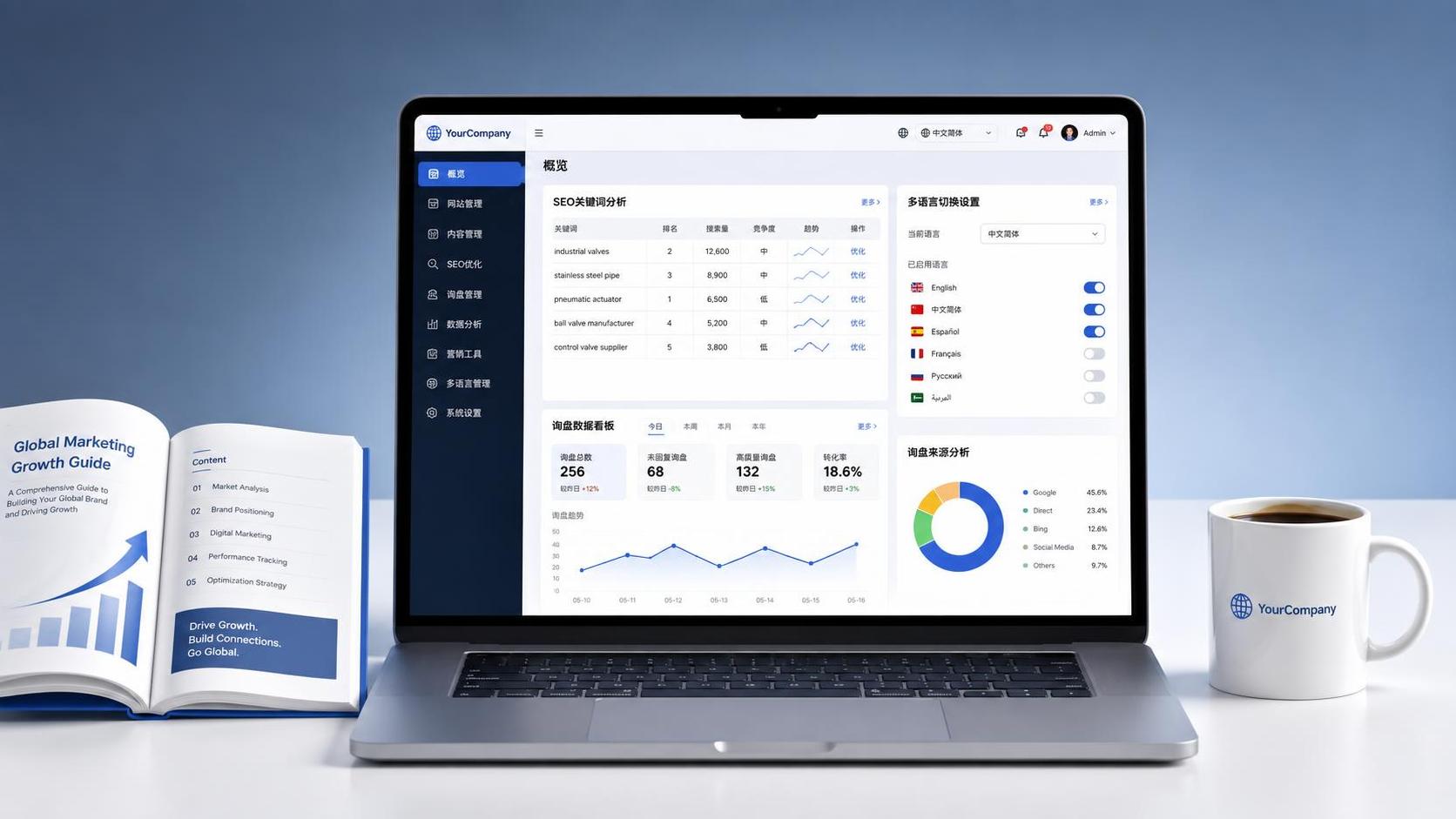
I. Definition and Scope of End-to-End Operations for Foreign Trade Websites
End-to-end operations for foreign trade websites is an operating approach that uses an independent website as the digital business hub to continuously manage overseas traffic acquisition, content development, visitor conversion, sales follow-up, and data review. Its objective is not to increase isolated traffic, but to enable purchasing demand in target markets to enter a traceable inquiry funnel more consistently.
In B2B export scenarios, the journey typically begins with keyword searches, industry media, or social media outreach. Trust is established through product pages, solution pages, factory capability pages, and case study pages, followed by initial communication via forms, email, WhatsApp, or online customer service. Every stage affects inquiry quality and transaction efficiency.
It differs from one-time website development and from simply purchasing advertising traffic. Complete operations require the alignment of website structure, content assets, campaign pages, conversion entry points, data definitions, and follow-up mechanisms, enabling the website to accumulate brand information and search visibility over the long term.
II. Core Technical Logic and Mainstream Operational Categories
The technical foundation includes responsive pages, stable hosting, secure HTTPS access, a logical page hierarchy, and a good mobile experience. For global visitors, server locations, caching, and content delivery capabilities should also be considered to prevent slow loading from causing paid or organic visitors to drop off before reaching the page.
Content is generally divided into corporate trust content, product and specification content, industry problem content, and procurement decision content. The first two categories answer “who you are and what you sell,” while the latter two answer “why you are suitable for me and how to reduce procurement risks,” jointly supporting search understanding and buyer comparison.
By customer acquisition method, end-to-end operations for foreign trade websites can be divided into organic search operations, search advertising operations, social media content and advertising operations, remarketing operations, and content optimization for generative search. A mature solution should not allocate budgets mechanically and evenly, but should combine channels according to product cycles, country markets, and sales objectives.
III. Which Companies Are Suitable for Building an End-to-End System
Manufacturers, OEM/ODM companies, industrial product suppliers, and foreign trade companies are particularly suited to this model. These companies typically have complex product specifications and long procurement cycles. Overseas buyers often repeatedly verify production capacity, certifications, lead times, sample capabilities, and previous projects, so the website needs to fulfill the role of professional explanation and trust screening.
Cross-border sellers, DTC brands, and companies seeking to reduce platform dependence can also use independent websites to integrate product displays, content marketing, advertising landing pages, and repeat-purchase engagement. Their operational focus is more oriented toward category pages, product details, review endorsements, purchase or inquiry processes, and audience remarketing.
For small and medium-sized export companies with limited budgets, priorities should be determined by market validation: first identify core countries, priority products, and buyer roles; then build a basic website capable of handling inquiries; and subsequently expand content and channels step by step. Without a clear sales response mechanism, pursuing large-scale traffic too early often makes it difficult to generate effective returns.
IV. Implementation Process and Quality Control from Website Development to Inquiries
Implementation should begin with market and keyword research, sorting out product categories, application industries, procurement pain points, competitor messaging, and country language requirements, before planning the homepage, category pages, product pages, solution pages, About Us page, and contact page. The information architecture should enable buyers to find specifications, advantages, and next steps with fewer clicks.
Pre-launch quality control includes mobile compatibility, page speed, form accessibility, email notifications, privacy notices, redirect links, image compression, and basic data tracking. Multilingual websites also need to verify language paths, page correspondences, and localized wording to avoid terminology distortion or page confusion caused by literal translation alone.
Yiyingbao provides integrated capabilities for AI-powered website building, multilingual independent websites, SEO, advertising, and social media operations, suitable for companies seeking to reduce the coordination costs of working with multiple suppliers. Its responsive architecture, AI-assisted content, and global node deployment can serve as selection references, but specific results should still be evaluated based on target market testing, page data, and sales feedback.
V. Coordination of Content Marketing, Traffic Acquisition, and Conversion
Organic traffic development should be layered around purchase intent: high-intent keywords correspond to product and inquiry pages; medium-intent keywords correspond to application solutions and selection guides; and awareness-stage questions correspond to industry articles and FAQs. Each page needs an independent topic, reliable information sources, clear internal links, and inquiry entry points that match its content.
Advertising is suitable for new product testing, key market launches, and time-sensitive customer acquisition, but clicks should be directed to dedicated landing pages rather than a general homepage. Landing pages should align with ad copy, product selling points, and procurement scenarios, and should include forms or communication entry points with identifiable sources to facilitate assessment of customer acquisition quality across different countries and keyword groups.
The role of social media is not limited to posting updates; it is better suited to showcasing production processes, application cases, technical insights, and team responsiveness. Channels such as LinkedIn, Facebook, TikTok, and YouTube can be selected based on customer profiles, with effective content directed back to the website to supplement buyers’ assessment of a company’s authenticity and professionalism before making a decision.
VI. Selection Criteria, Total Cost of Ownership, and Return Assessment
When procuring end-to-end services, companies should review whether the system supports product and article management, multilingual expansion, mobile adaptation, permission management, data analytics, form notifications, and subsequent content updates. They should also clarify responsibility boundaries for domains, servers, SSL, migration, training, maintenance, and third-party advertising accounts to avoid service gaps after launch.
Total cost of ownership should not only compare first-year website development quotes; it also includes labor investment in material preparation, translation and localization, content production, technical maintenance, advertising spend, social media production, sales follow-up, and data analysis. Low template costs do not necessarily mean low long-term costs. Websites that cannot be maintained or are difficult to expand will increase the risk of future rebuilding.
For ROI assessment, it is recommended to simultaneously monitor the number of qualified inquiries, qualified inquiry rate, inquiry response time, sample or quotation conversion rate, cost per qualified lead, and sales cycle. For high-value products such as equipment, chemicals, and new energy products, content-assisted conversions should also be tracked rather than judging channel value solely by the last click.
VII. Maintenance Cycles, Industry Practices, and Future Trends
Website operations should be executed on a regular schedule: check for anomalies in inquiries, forms, and campaigns every week; review keywords, page traffic, and lead quality every month; and update priority products, case studies, and market strategies every quarter. When product specifications, lead times, certifications, or service scope change, the relevant pages should be updated promptly to ensure consistency between sales information and website information presented externally.
Yiyingbao has served industries including laser engraving machines, steel, chemicals, heavy trucks, machinery, new energy, healthcare, and furniture, and has showcased service cases for Haier, Aokema, Shandong Airlines, and Little Duck Group. The markets, objectives, and results of different companies vary, and buyers should still confirm their own product materials, sales handling capabilities, and phased targets before initiating a project.
In the future, overseas customer acquisition will place greater emphasis on multilingual localization, first-party data accumulation, short-video content reuse, and structured Q&A content for generative search. The competitive focus of end-to-end operations for foreign trade websites will gradually shift from individual rankings or one-time campaigns to content credibility, response efficiency, closed-loop data, and cross-channel coordination capabilities.
