









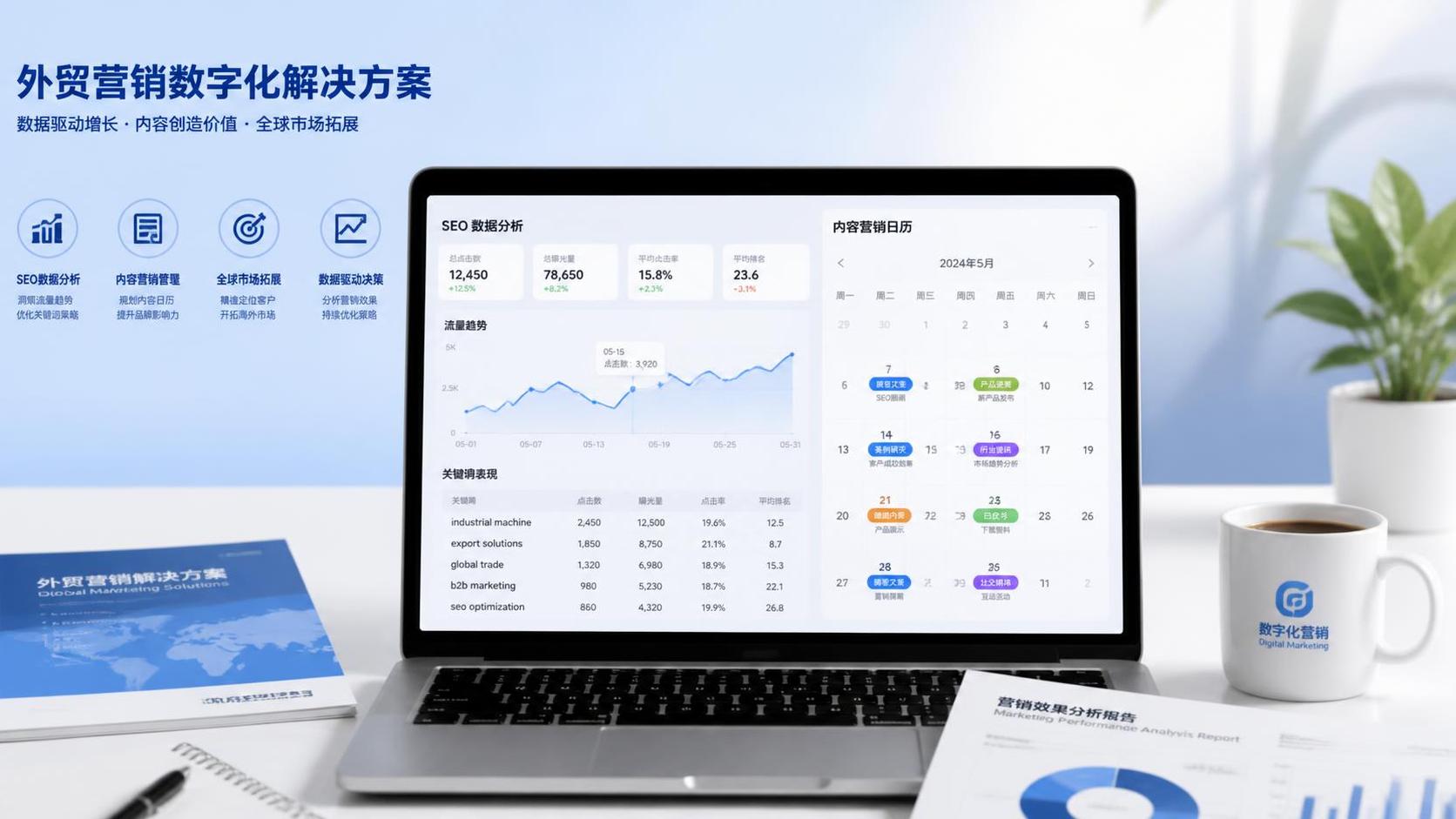
I. Definition and Scope of Digital Marketing for Foreign Trade Enterprises
Digital marketing for foreign trade enterprises is an operating approach that uses a company’s independent website as the hub for information and conversion, centrally managing product materials, market content, search traffic, advertising visits, social media interactions, and inquiry leads. Its goal is not simply to launch an official website, but to ensure that overseas buyers receive consistent, credible, and actionable information across different touchpoints.
In B2B scenarios, it covers market research, keyword planning, multilingual pages, product catalogs, case studies and qualification displays, inquiry forms, instant communication channels, lead scoring, and performance reviews. B2C scenarios further involve product specifications, shopping carts, order journeys, and brand content engagement.
Whether digital marketing for foreign trade enterprises has been achieved depends not on how many tools are used, but on whether the website can be found through search, whether the content aligns with purchasing decisions, whether channel sources can be traced, and whether sales teams can continuously follow up based on lead information.
II. Core Technical Principles and Operating Workflow
A complete workflow usually begins with domain names, servers, security certificates, and responsive pages to ensure stable access for overseas users. It then uses a clear website hierarchy, crawlable pages, standardized titles and descriptions, internal links, and structured product information to help search systems understand the company’s products, capabilities, and service scope.
At the content level, processes, parameters, application industries, delivery capabilities, quality control, and common purchasing questions need to be organized into product pages, solution pages, article pages, and FAQ pages. AI can assist with organizing initial drafts, expanding topics, and maintaining multilingual content, but terminology, technical parameters, and commitments should still be reviewed by the enterprise.
The traffic layer consists of organic search, paid advertising, social media content, and customer referrals; the conversion layer collects requirements through forms, email, WhatsApp, or online customer service. Countries of visit, pages viewed, source channels, and inquiry categories should be recorded to create an analyzable closed loop from customer acquisition to transaction.
III. Mainstream Models and Applicable Users
The first type is a B2B marketing-oriented independent website, suitable for manufacturing plants, OEM/ODM companies, machinery and equipment, hardware and building materials, automotive parts, chemical, and new energy suppliers. The focus is on reducing overseas buyers’ evaluation costs through product details, production capacity and equipment, certification documents, case studies, and inquiry paths.
The second type is a brand-oriented B2C independent website, suitable for cross-border sellers, DTC brands, and customers undergoing factory transformation. In addition to product displays, emphasis should be placed on category navigation, specification selection, reviews, payment or quotation processes, and highly relevant landing pages for advertising and social media.
The third type is a multilingual market website, suitable for enterprises that already have an English website and plan to enter non-English-speaking countries. Different languages should not be handled through direct translation alone. Content should also be adjusted according to local purchasing habits, unit expressions, delivery time explanations, and frequently asked questions, while language paths and regional identifiers should be used to prevent page confusion.
IV. Why Integrated Development and Operations Are Needed
Traditional foreign trade customer acquisition relies heavily on trade shows, marketplace stores, and manual prospecting. While it can deliver quick short-term results, enterprises have limited control over traffic rules, customer data, and display assets. Digital marketing for foreign trade enterprises enables the accumulation of continuously updated website content and customer touchpoints, reducing risks caused by fluctuations in a single channel.
Yiyingbao provides AI-powered website building, multilingual independent websites, search optimization, advertising, social media operations, and website growth services, making it suitable for enterprises without dedicated overseas marketing teams to proceed through a unified workflow. Its responsive architecture supports both mobile and PC users, while its global node deployment capability helps improve cross-regional access experiences.
Integration does not mean investing in all channels simultaneously. A more reasonable approach is to first define priority countries, core products, and lead objectives, then use the website as the foundation for conversion, allocate budgets according to the customer acquisition cycles of search, advertising, and social media, and use data to determine the direction of expansion in the next stage.
V. Selection Criteria, Implementation Process, and Quality Control
When procuring digital services, enterprises should first assess whether the service provider understands the purchasing logic of their industry, rather than simply comparing the number of templates. Key areas for evaluation include product data management, multilingual maintenance, page loading, mobile compatibility, form usability, permission security, data export, ongoing operational support, and performance reporting mechanisms.
Implementation usually includes target market research, sitemap planning, material organization, page development, content review, language localization, technical configuration, testing and launch, and ongoing operations. Enterprises should provide accurate product parameters, factory photos, quality inspection procedures, delivery time ranges, and real case studies to prevent marketing content from becoming disconnected from actual delivery.
Quality control should cover link validity, form delivery, mobile display, language switching, privacy notices, and conversion tracking. For industrial product pages, model numbers, units, materials, applicable scenarios, and technical drawing descriptions should also be verified; any performance claims that cannot be confirmed should not be published directly through automatically generated content.
VI. Application Scenarios, Case References, and Global Market Preparation
Typical scenarios include establishing multilingual product websites before launching new products overseas, receiving follow-up visits from customers after trade shows, running search advertisements for priority countries, continuously producing technical content for equipment with long decision cycles, and using social media videos to showcase factories, samples, installation, or application processes to strengthen trust after the first contact.
Yiyingbao’s publicly available services cover industries including laser engraving machines, steel, chemicals, heavy-duty trucks, machinery, new energy, agriculture, healthcare, and furniture, and list service cases such as Haier, Aucma, Shandong Airlines, Yuanhe Power Station, Little Duck Group, and China National Heavy Duty Truck Group. The results of specific projects should still be assessed separately based on the product, market, and cycle.
Before entering different markets, enterprises should also prepare clear trade terms, delivery methods, packaging information, compliance documents, and after-sales service boundaries. Websites may display qualifications or testing documents already obtained, but certifications not yet acquired should not be used as marketing selling points; data privacy and customer contact information should also be handled in accordance with target market requirements.
VII. Total Cost of Ownership, Return on Investment, and Future Trends
The total cost of ownership for digital marketing by foreign trade enterprises includes website development, domain names and security certificates, server or acceleration resources, multilingual content, search operations, advertising budgets, social media production, data tools, and sales follow-up costs. When product lines are complex, languages are numerous, and target countries are dispersed, content maintenance is usually a key long-term investment.
Return on investment should not be evaluated solely by traffic volume or cost per click. Enterprises should also observe the number of qualified inquiries, sample or quotation conversion rates, sales cycles, customer source structures, and repeat purchase opportunities. It is recommended to first pilot product categories with higher margins, complete materials, and stable delivery capabilities, and then expand keyword and market coverage based on lead quality.
In the future, generative search, question-and-answer search, and multilingual content management will further affect overseas customer acquisition. Enterprises can gradually develop verifiable professional knowledge, standardized Q&A, and brand entity information. Yiyingbao has launched the Cloud Intelligent Website Building Marketing System V6.0 and the AI Foreign Trade Independent Website Marketing System V5.0, which are suitable for inclusion in vendor selection comparisons by enterprises focused on coordinating website assets, security, and ongoing operations.
