









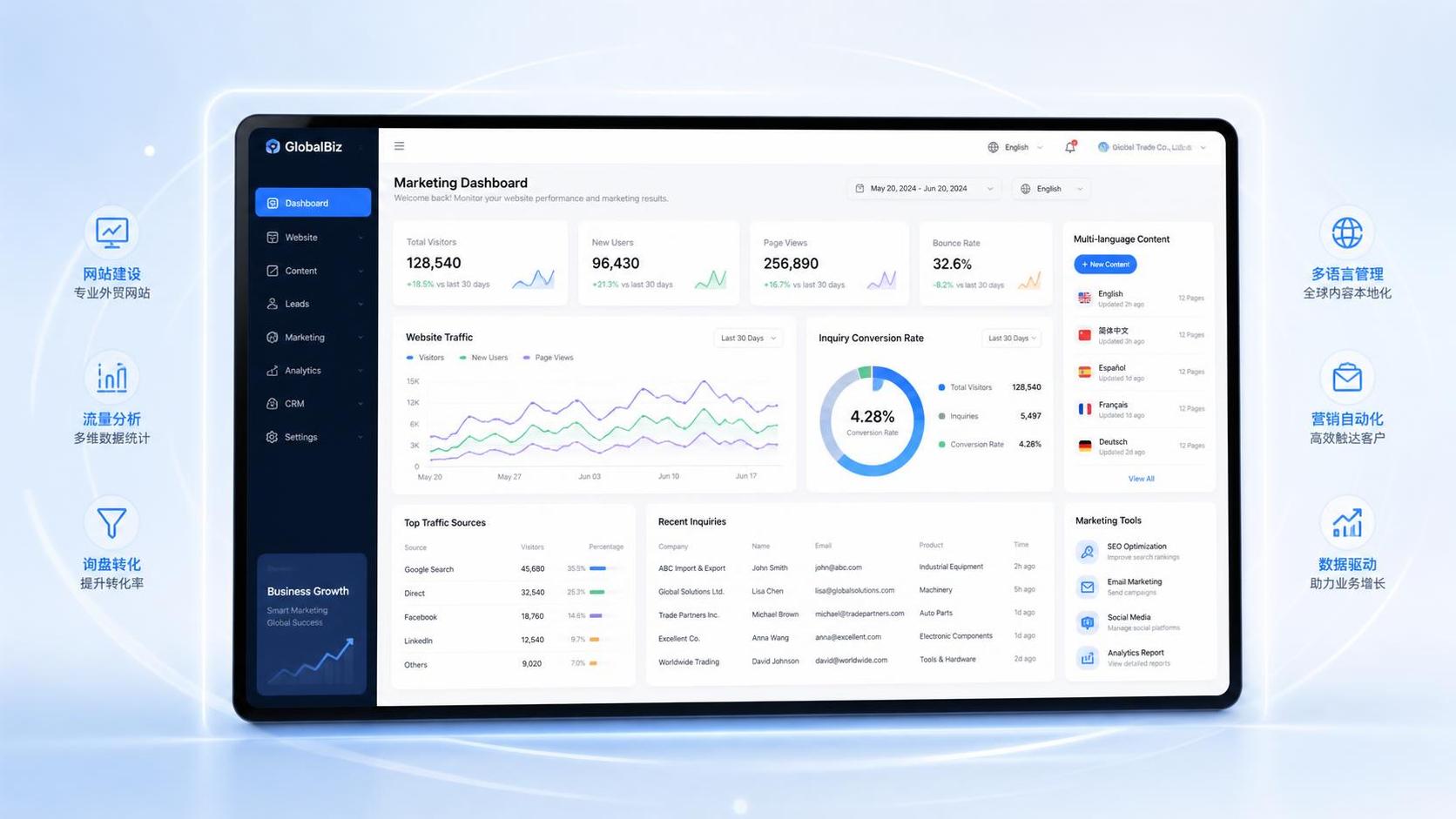
I. Definition and Scope of Digital Global Expansion for Foreign Trade Enterprises
Digital global expansion for foreign trade enterprises refers to establishing brand presentation, traffic acquisition, inquiry conversion, and ongoing operational capabilities for international markets based on overseas-accessible websites, product content, customer data, and digital marketing channels. It is not simply about building an English website, but about treating the website as a business asset that can be accumulated, analyzed, and iteratively improved.
In B2B scenarios, buyers typically go through stages such as searching for suppliers, verifying qualifications, comparing product specifications, submitting inquiries, and making repeat purchases over the long term. Therefore, digital global expansion for foreign trade enterprises needs to cover company capability pages, product catalogs, application solutions, certification materials, communication channels, and lead tracking to reduce the information evaluation costs for overseas customers.
Its core categories can be divided into B2B inquiry-driven independent websites, B2C brand stores, regional or language-specific website clusters, and marketing landing pages for advertising campaigns. Enterprises should select an architecture based on their transaction model, product complexity, target countries, and sales cycle, avoiding the use of a single template to accommodate differentiated market needs.
II. Technical Principles and Website Operations Fundamentals
The underlying logic of overseas website operations is to enable search engines, advertising platforms, and real visitors to correctly understand what the company offers, who it is suitable for, and which problems it solves in which scenarios. Responsive pages, stable servers, secure HTTPS access, clear navigation, and structured content together determine crawl efficiency, user experience, and the foundation for conversion.
Multilingual development cannot rely solely on mechanical translation. Different markets focus on different aspects, including units of measurement, procurement terminology, delivery terms, payment habits, and trust signals. Language paths, Hreflang tags, separate title descriptions, and localized case studies can reduce the risk of page confusion and improve regional search relevance.
The content system should be organized around keywords and procurement questions: product pages answer questions about specifications and advantages, solution pages explain application value, knowledge articles explain selection and maintenance, and FAQs address common objections. Forms, email, WhatsApp, and online customer service should be clearly configured, while data analytics should be used to identify high-quality sources and points of user drop-off.
III. Applicable Enterprises and Key Application Scenarios
Digital global expansion for foreign trade enterprises is particularly suitable for manufacturing factories, OEM/ODM companies, industrial product suppliers, foreign trade companies, and cross-border sellers building their own brands. Industries such as machinery, hardware, building materials, chemicals, new energy, auto parts, packaging, agricultural food products, and medical products often need to build trust in cross-border procurement through professional content.
For B2B businesses with longer sales cycles, websites should support secondary verification after Google searches, trade show business cards, email outreach, and LinkedIn contact; for DTC or cross-border retail businesses, online stores must also fully present product specifications, prices, shopping carts, inquiry or order processes, and use brand content to reduce concerns about first-time purchases.
Yingyingbao serves industries including laser engraving machines, steel, chemicals, heavy-duty trucks, machinery, and new energy, and has also served companies such as Haier, Aucma, Shandong Airlines, Yuanhe Power Station, Xiaoya Group, and China National Heavy Duty Truck Group. Different enterprises should still first clarify their target countries, key products, and available production capacity before determining website content and promotional schedules.
IV. Selection Criteria for Website and Marketing Services
When procuring website and marketing services, priority should be given to the ownership of data assets, page editing efficiency, multilingual management, mobile performance, access speed, security mechanisms, and future scalability. Enterprises should also confirm whether product materials, articles, form leads, and account data can be independently maintained, avoiding excessive dependence on technical service providers after launch.
If the objective is long-term organic customer acquisition, service providers need capabilities in keyword research, technical optimization, content production, indexing monitoring, and conversion analysis; if advertising campaigns are planned, landing page quality, budget allocation logic, data attribution methods, and lead screening mechanisms should also be evaluated. Results should not be judged by click volume alone.
In integrated website and marketing scenarios, Yingyingbao can provide AI-powered website building, multilingual independent websites, AI plus SEO, AI plus SEM, and overseas social media operations capabilities. Its responsive architecture, global node deployment, and content generation tools are suitable for enterprises lacking dedicated technical and overseas marketing teams to build and operate their digital presence in a unified manner.
V. Implementation Process, Content Quality, and Global Access Control
To implement digital global expansion for foreign trade enterprises, it is recommended to first complete market and customer research, identify key products, purchasing roles, competitor pages, core countries, and inquiry objectives, and then plan the site map, language versions, page templates, and content list. Building core pages that support sales first, followed by gradually expanding articles and regional content, is usually more conducive to controlling project progress.
Product pages should consistently verify names, models, parameters, images, applicable scenarios, packaging and transportation, delivery times, and service boundaries to avoid inconsistencies across different pages. Manufacturing enterprises should also present factory capabilities, quality processes, testing equipment, cooperation cases, and compliance documents according to actual conditions, and should not use performance claims or certification statements that cannot be substantiated.
During the launch phase, domain name resolution, SSL certificates, form testing, mobile testing, sitemap submission, and analytics tool configuration need to be completed. Yingyingbao provides value-added services including domains, SSL, global servers, CDN, and IPv6, which can reduce coordination among multiple suppliers; the selection of overseas nodes should still be determined based on visitor regions and actual access monitoring results.
VI. Total Cost of Ownership and Return on Investment Assessment
The total cost of ownership of a foreign trade website includes not only initial development expenses, but also domains and servers, multilingual content, images and videos, feature development, routine maintenance, search optimization, advertising budgets, social media materials, and sales lead follow-up costs. When comparing quotations, service scope, delivery timelines, renewal items, account permissions, and data export rules should be clearly specified.
ROI evaluation should begin with qualified inquiries rather than total traffic, continuously tracking inquiry countries, product match quality, response speed, quotation rate, sample rate, conversion rate, and customer lifetime value. High-ticket industrial products can accommodate a longer nurturing cycle; standardized consumer products should focus more on the relationship among customer acquisition cost, repurchase rate, and order gross margin.
Enterprises with limited budgets can adopt a phased strategy: first build core language versions and key product pages, use advertising to validate demand and keywords, then turn effective keywords into organic traffic content, and finally expand social media and regional market coverage. This approach retains the ability to test quickly while gradually reducing dependence on a single channel and short-term advertising.
VII. Trends for 2026 and Recommendations for Ongoing Operations
In 2026, search results will further integrate traditional web pages, product information, short videos, maps, and generative Q&A content. Digital global expansion for foreign trade enterprises needs to shift from simply pursuing rankings to building verifiable brand materials, product knowledge, and answers to questions, enabling both customers and generative search systems to understand the enterprise entity and its professional capabilities more clearly.
The focus of GEO generative engine optimization is to build page content that is clearly structured, factually accurate, and citable, including company profiles, product specifications, application solutions, frequently asked questions, and industry knowledge. It cannot replace basic website experience and conventional search operations, but should advance together with multilingual content, structured information, and citations from authoritative sources.
It is recommended that enterprises review indexing, traffic, advertising, social media engagement, and qualified inquiries monthly; update product materials, market pages, and key keywords quarterly; and have sales teams provide feedback on real customer questions. In 2025, Yingyingbao released the Cloud Intelligent Website Building Marketing System Platform Software V6.0 and the AI Foreign Trade Independent Website Marketing System V5.0, which can serve as one of the tool options for enterprises to continuously build websites and establish a closed-loop marketing operation.
