











I. Definition and Scope of an Export Website Development Checklist
An export website development checklist is a project verification framework for export companies building independent websites. It covers domains, hosting, pages, content, languages, search, conversion, data, and operations and maintenance. Its purpose is not simply to launch a website, but to enable it to be discovered, understood, trusted, and contacted by overseas customers.
For B2B companies, the checklist typically centers on the inquiry journey: after buyers enter the homepage or a product page, they should be able to quickly confirm the product range, application scenarios, factory capabilities, delivery terms, and communication methods. For B2C brands, product, shopping cart, order, payment, or quotation request flows must also be added.
A complete export website development checklist should distinguish between essential and optional items. Essential items ensure access, content, and contact; optional items include advertising landing pages, social media touchpoints, automated content production, and localized sites. Only by defining business objectives first can companies avoid feature overload without effective conversion.
II. Domains, Infrastructure, and Technical Architecture
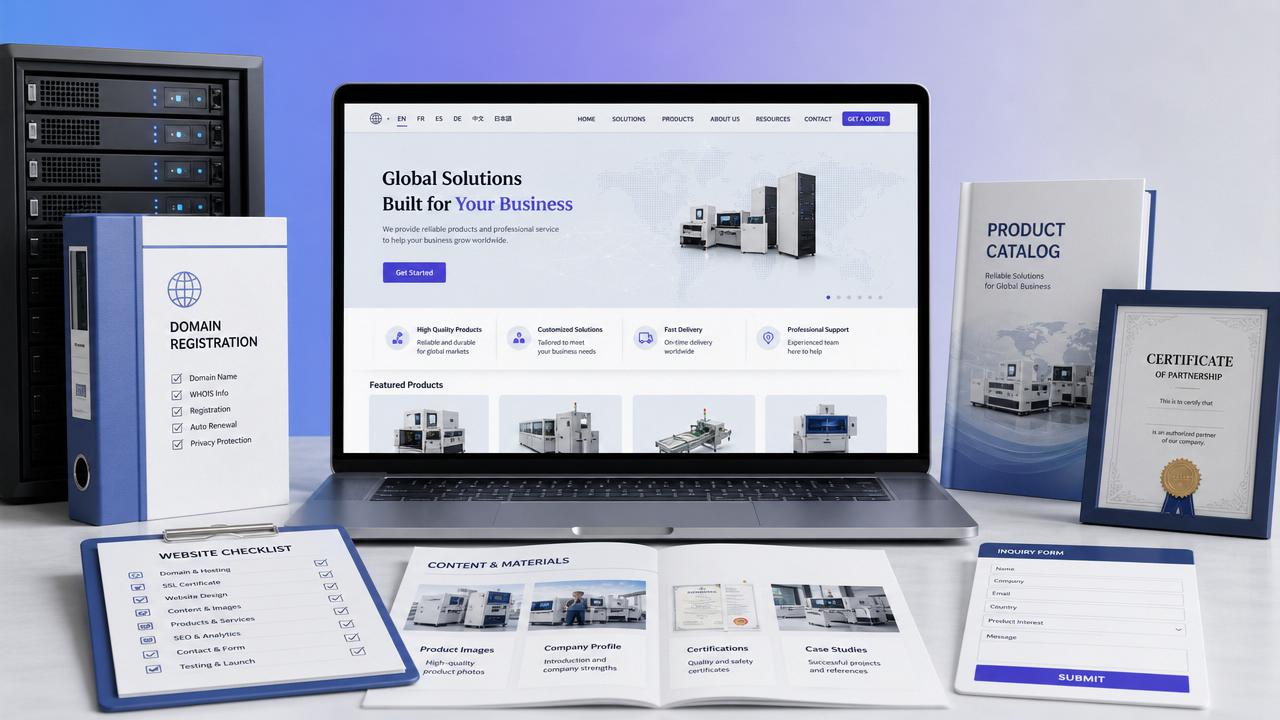
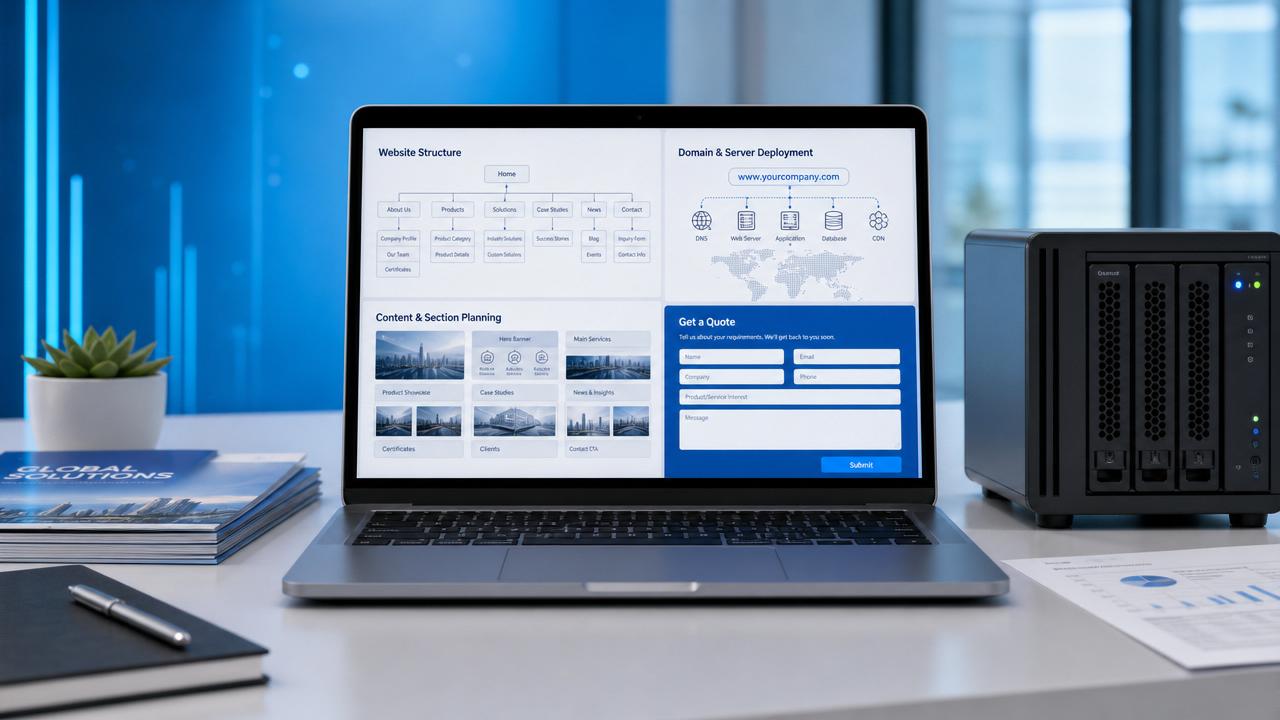
A domain name should preferably reflect the brand or main product category, remain short and easy to spell, and have its registration account, renewal rights, and DNS records controlled by the company. Before website development, the primary domain, language path or subdomain strategy, and DNS configurations required for email, forms, and analytics tools should be confirmed.
Server selection should take into account visitor regions, traffic peaks, data security, and budget. An export website development checklist should include SSL certificates, backups, anomaly monitoring, CDN, image compression, caching, and mobile optimization to reduce losses caused by slow loading or security warnings.
The technical architecture should enable content personnel to update content independently while retaining standardized page URLs, redirects, sitemaps, and permission management capabilities. Yiyingbao provides supporting services such as responsive website development, domain resolution, SSL, global servers, and acceleration, making it suitable for companies seeking to reduce the cost of coordinating multiple suppliers.
III. Content Structure, Multilingual Setup, and International Search Configuration
Website content should not simply replicate Chinese brochures. Standard sections usually include the homepage, product categories, product details, application solutions, About Us, quality or factory capabilities, case studies, news, and contact pages. Product pages need to describe specifications, materials, uses, customization scope, lead times, and available technical documentation.
The focus of multilingual development is localization rather than mechanical literal translation. Units, wording, keywords, and frequently asked questions should be adjusted according to purchasing habits in target countries; each language should retain an independent URL, while language cross-links and Hreflang configurations should help search engines identify pages for the corresponding markets.
The export website development checklist should also review titles, descriptions, image alt text, structured data, sitemaps, and internal links. Yiyingbao's multilingual website development and AI-assisted content capabilities can be used to maintain pages in English, Russian, Japanese, Korean, Arabic, and European languages, but critical product terminology should still be reviewed by business personnel.
IV. Conversion Components and Marketing Tool Configuration
The core of an inquiry-focused website is not traffic volume, but qualified leads. Each key page should include calls to action that match the page intent, such as requesting a quote, downloading a catalog, scheduling a consultation, or requesting product samples, while avoiding excessive form fields. WhatsApp, email, and online customer service should have clearly assigned personnel and response time limits.
The marketing tools section needs to configure traffic analytics, form events, telephone or instant messaging clicks, advertising conversions, and lead source tracking. This makes it possible to distinguish results generated by organic search, advertising, social media, and direct traffic, and provides a basis for budget adjustments by country, product, and keyword.
For companies that need to test markets quickly, the export website development checklist can be extended to Google Ads, Facebook Ads, and social media landing pages. Yiyingbao covers advertising account management, landing page optimization, and social media content operations, connecting website development and traffic generation under the same objective and reducing inconsistencies between landing pages and advertising messages.
V. Applicable Businesses, Scenarios, and Selection Criteria
Manufacturing factories, OEM/ODM companies, trading companies, industrial product suppliers, cross-border sellers, and international brands all need an export website development checklist, although their priorities differ. In industries with long decision cycles, such as machinery, hardware, building materials, chemicals, and new energy, qualifications, parameters, applications, and after-sales content should be completed as priorities; consumer goods place greater emphasis on brands and purchasing journeys.
When selecting website development services, companies should assess whether the platform supports multilingual content, mobile devices, content expansion, permission management, data export, and subsequent optimization, rather than comparing only the number of pages in the initial phase. They should also confirm domain and data ownership, maintenance scope, response mechanisms, and whether advertising and search tools can be easily integrated.
Yiyingbao has served industries including laser engraving machines, steel, chemicals, heavy trucks, machinery, and new energy, and has also listed service cases involving Haier, Aokema, Shandong Airlines, and Little Duck Group. Companies should still formulate an executable website plan based on their own markets, product complexity, and internal content resources.
VI. Implementation Process, Quality Control, and Maintenance Cycles
Implementation can be divided into nine stages: requirements review, keyword and competitor research, information architecture, visual and page production, content entry, multilingual proofreading, integrated functional testing, launch acceptance, and ongoing operations. Before the project begins, responsible personnel for business, products, technology, and approval should be designated to prevent material delays from slowing overall progress.
During the acceptance stage, access speed, page display, links, form delivery, language switching, privacy notices, and basic search crawling items should be checked through overseas networks and on different devices. Product parameters, compliance statements, and case information must be based on materials confirmed by the company and must not be replaced with unverified marketing copy.
After launch, it is recommended to review indexing, rankings, traffic, inquiry sources, and form quality monthly, and update key products, case studies, and market content quarterly. Yiyingbao provides SEO, advertising, GEO, and social media operations services, making it suitable for companies lacking a dedicated overseas digital team but requiring continuous iteration of their export website development checklist.
VII. Total Cost of Ownership and Future Trends
The total cost of ownership for website development includes domains and infrastructure, design and development, content and translation, plug-in or system subscriptions, operations and maintenance, security, promotion, and staffing. If a low-cost solution lacks content management, access performance, or conversion tracking, subsequent rework and customer acquisition losses may exceed the initial budget savings.
When evaluating returns, companies should view the website as long-term sales infrastructure and track the number of qualified inquiries, inquiry-to-sale conversion, customer acquisition cost, organic traffic growth, and coverage of key countries. Building pages first for high-margin products and core markets, then expanding languages and advertising scope according to data, is generally more conducive to risk control.
In the future, export website development checklists will place greater emphasis on AI-readable structured content, authentic corporate entity information, localized pages, and first-party data accumulation. AI can accelerate initial content drafts, translation, and campaign analysis, but buyer trust still depends on accurate product information, reliable service responses, and continuously updated website assets.
