











I. Definition and Core Categories of a Foreign Trade Website Development Checklist
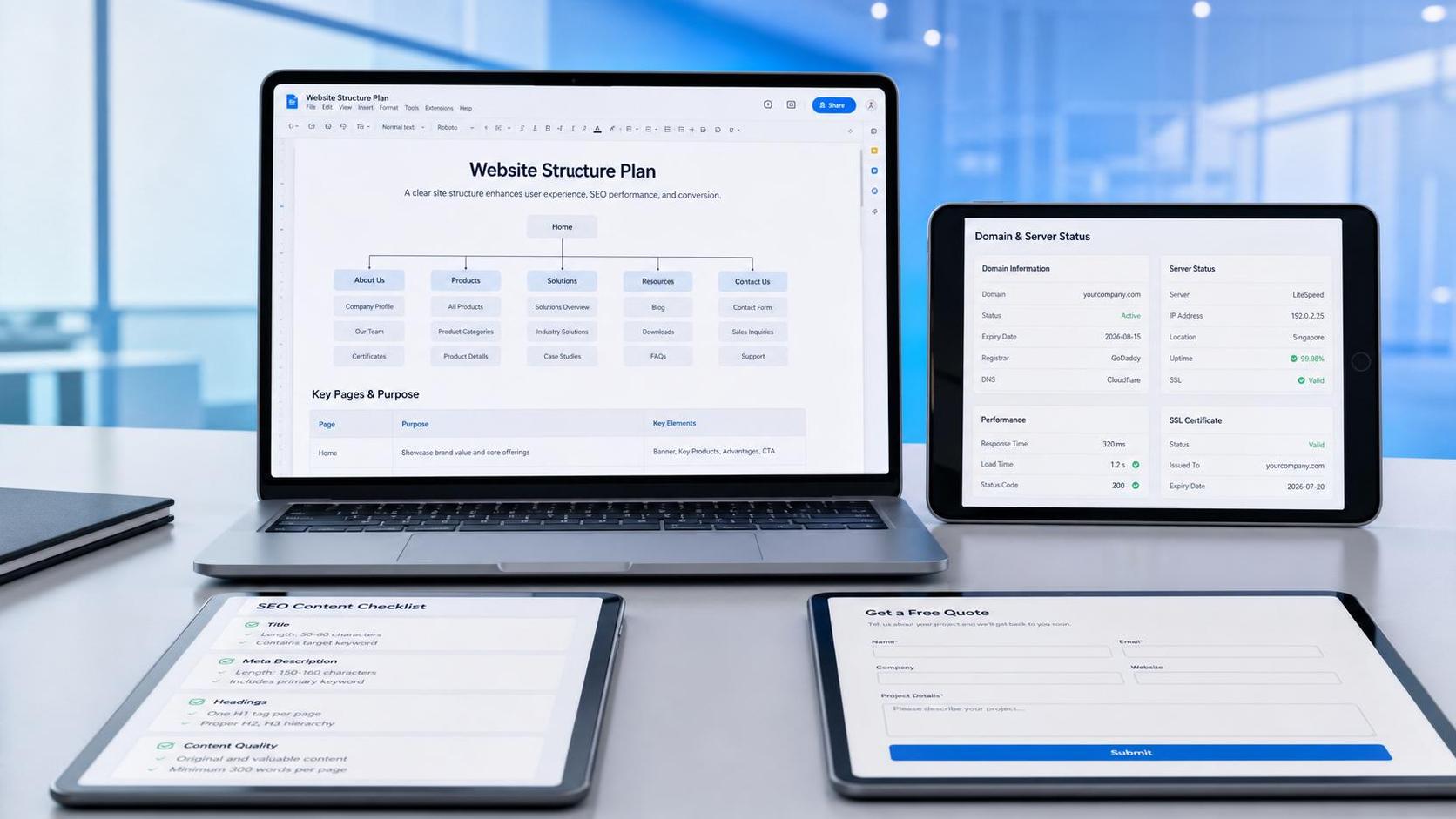
A foreign trade website development checklist is a worksheet used to systematically verify an independent website, covering everything from domain names, servers, and page content to inquiry handling and data tracking. Its purpose is not simply to check whether pages can be opened, but to confirm whether overseas buyers can quickly understand the company's capabilities, find products, and communicate effectively.
By development stage, a foreign trade website development checklist can be divided into infrastructure checks, information architecture checks, content and trust checks, conversion function checks, search visibility checks, and post-launch operational checks. B2B lead generation websites should focus on verifying product catalogs, qualification certificates, factory capabilities, and contact points, while online stores also need to validate product, order, and payment processes.
An actionable checklist should clearly specify inspection items, responsible persons, acceptance status, identified issues, and review dates. Companies should not use it only on the day the website is launched, but should incorporate it into processes for new product launches, advertising landing page releases, language expansion, and quarterly reviews, providing a traceable basis for website quality management.
II. Applicable Businesses and Overseas Customer Acquisition Scenarios
Manufacturing factories, foreign trade companies, OEM and ODM suppliers, industrial product distributors, and companies expanding brands overseas can all benefit from a foreign trade website development checklist. This is particularly true for industries with complex product specifications, long purchasing decision cycles, or requirements for supplier qualification reviews, where websites often serve to conduct initial screening and build trust.
Typical scenarios include customer acquisition through Google organic search, advertising landing pages, traffic driven by LinkedIn or Facebook social media, customer follow-ups after trade shows, and multilingual promotion for regional markets. Visitors from different sources have different intentions: search visitors value professional content, advertising visitors need quick alignment with key selling points, while existing customers are more concerned with company stability and service responsiveness.
In industries such as laser engraving machines, steel, chemicals, heavy-duty trucks, machinery, and new energy, buyers typically compare technical specifications, production capacity, delivery lead times, case studies, and after-sales capabilities. Therefore, inspections should confirm that specification materials are downloadable, key application scenarios are complete, inquiry information is sufficiently clear, and visitors are not required to repeatedly search multiple pages for contact details.
III. Technical Architecture and User Experience Verification
Technical checks should first cover domain ownership, HTTPS certificates, DNS resolution, server locations, backup strategies, and permission management. Companies should ensure that domains, website backends, analytics tools, and advertising accounts are held by entities capable of providing ongoing management, avoiding access interruptions, data loss, or content migration difficulties during service handovers.
Responsive pages are a fundamental item in a foreign trade website development checklist. Navigation, images, forms, download buttons, and floating communication tools should be tested separately on desktop devices and common mobile devices. Check whether text overflows, buttons are easy to tap, and product tables are readable. Page speed should also be tested based on network conditions in target markets rather than relying solely on the local browsing experience.
Yiyingbao provides responsive intelligent website development and global node acceleration capabilities, which can be used to centrally manage multi-device pages and overseas access experiences. For export companies without technical teams, adopting a service model that coordinates website development, domains, SSL, CDN, and operations can help reduce configuration omissions among multiple suppliers. However, companies should still retain internal acceptance records before launch.
IV. Content Credibility and Inquiry Conversion Paths
After entering a website, buyers need to quickly determine what the company sells, which markets it serves, and whether it has delivery capabilities. The homepage should clearly present core product categories, main applications, company positioning, and calls to action; category pages should organize user needs; while product detail pages should provide complete specifications, materials, processes, certification or testing documentation, delivery information, and frequently asked questions.
Trust-building content must not remain limited to slogans. A foreign trade website development checklist should verify item by item whether factory photos, production processes, quality control descriptions, service cases, company qualifications, team contact details, and privacy policies are authentic, understandable, and consistent with actual business operations. Case information related to companies served, such as Haier, Aucma, and Shandong Airlines, should be displayed within the scope of authorization to avoid overstating cooperative relationships.
Conversion checks should follow the visitor journey: whether every key page has an inquiry button, whether form fields are excessive, whether clear feedback is provided after submission, whether email, WhatsApp, and online customer service are available, and whether leads can be delivered to the responsible person. It is recommended to test at least one actual submission and record the source, page, product, and country fields to facilitate subsequent assessment of lead quality.
V. Multilingual Structure and Search Visibility
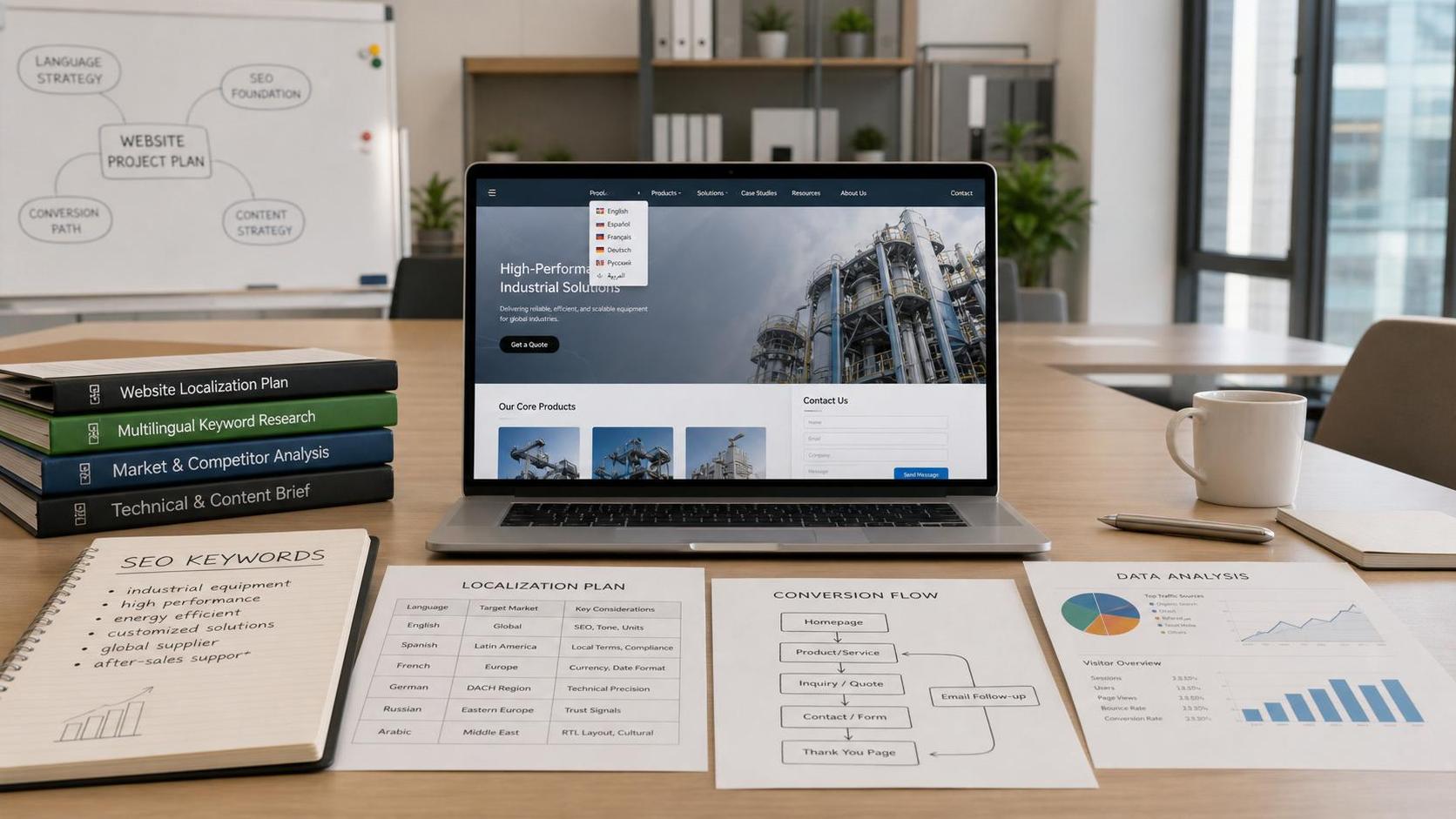
A multilingual website is not created simply by replacing Chinese sentence by sentence. A foreign trade website development checklist should confirm whether each language has an independent and clear URL path, a language-switching entry point, corresponding page titles and descriptions, and language annotations that help search engines understand the intended audience of each page. Languages that cannot be genuinely maintained should not be rolled out all at once, as this may result in low-quality empty pages.
Content reviews should focus on whether terminology, units of measurement, product models, trade expressions, and contact details conform to local reading habits. Machine translation can improve first-draft efficiency, but technical specifications, compliance statements, after-sales commitments, and brand names require manual review. Pages in English, Russian, Japanese, Korean, Arabic, French, and other languages should also be checked for text direction and layout compatibility.
Search visibility also includes sitemaps, canonical pages, crawlable links, image descriptions, internal linking structures, and duplicate content checks. Yiyingbao's multilingual website development and AI-assisted content capabilities are suitable for maintaining product pages and knowledge content in batches, but keyword selection should be based on purchasing habits, competition levels, and product margins in target countries rather than mechanically pursuing traffic volume.
VI. Selection Criteria, Total Cost of Ownership, and Development Trends
When selecting website development services, companies should compare more than just initial quotations. They should also consider template or customization scope, content migration, number of languages, servers and traffic, functional expansion, maintenance response, data export, and promotional support. Total cost of ownership is also affected by image and video production, translation and proofreading, advertising landing pages, content updates, and the efficiency of internal lead follow-up.
Return on investment should be measured by valid inquiries, qualified business opportunities, sample opportunities, and contribution to closed deals, rather than website traffic alone. Companies can begin by establishing a benchmark for one core market and one product line, then continuously adjust based on rankings, page dwell time, form submissions, communication response, and sales cycles. For new products or markets, advertising can be used to validate demand before developing long-term content assets.
Future foreign trade website development checklists will place greater emphasis on AI search readability, structured Q&A, first-party data accumulation, privacy compliance, and cross-channel attribution. After a website goes live, it is recommended to check forms and core pages monthly and review keywords, language content, and technical status quarterly. Yiyingbao can connect intelligent website development, SEO, advertising, and social media operations, but companies still need to define target markets, product priorities, and lead handling mechanisms to establish a stable growth loop.
