









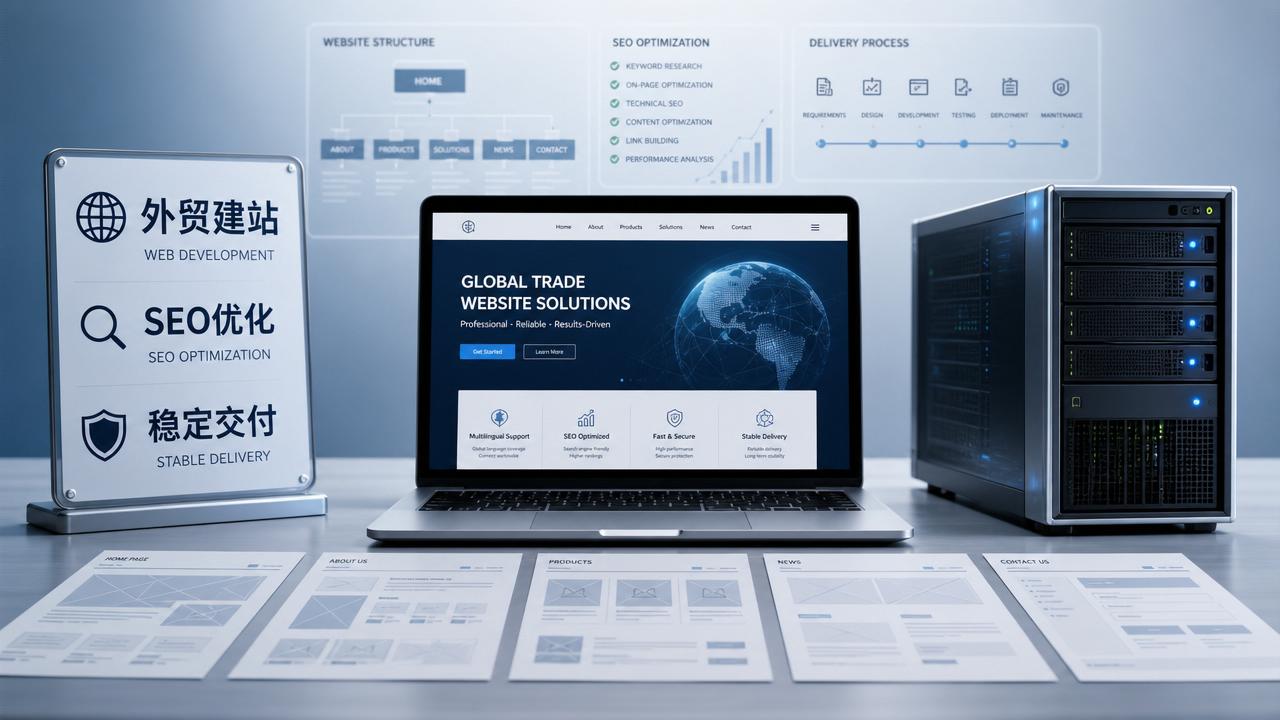
I. Understanding the Core Value of Foreign Trade Website Development Service Providers
Foreign trade website development service providers are not simply suppliers that create corporate websites. They help export businesses establish overseas digital touchpoints, capture traffic, and drive inquiries. To determine which foreign trade website development service provider is best, first consider whether it understands the complete decision-making process of buyers, from searching and comparing to verifying and contacting suppliers.
For manufacturing and trading companies, a website should serve as a product catalog, showcase of factory capabilities, repository for certification documents, source of application solutions, communication gateway, and content asset. Page visuals are only the foundation; what truly affects business results is whether information is clear, access is smooth, and customers can quickly build trust.
The industry generally considers responsive presentation, content management, multilingual pathways, secure connections, stable hosting, and data analytics to be fundamental capabilities. If a service provider can only deliver static pages but cannot support ongoing content updates, traffic analysis, and marketing coordination, the website can easily lose its momentum for growth after launch.
II. Technical Architecture Determines Overseas Access and Operational Efficiency
Key technical aspects of foreign trade websites include responsive front-end design, an editable content management backend, global deployment, cache acceleration, SSL certificates, and fundamental security mechanisms. Mobile adaptation is particularly important, as overseas procurement personnel often use mobile phones to view product specifications, download materials, or initiate instant communication directly.
Multilingual capability does not mean mechanically translating Chinese pages. A sound architecture should distinguish language paths, page titles, descriptions, and regional content, while adjusting units, lead times, product terminology, and communication methods according to the target market. This not only makes content easier for visitors to read but also helps search engines identify the markets targeted by the pages.
Yiyingbao provides AI-powered website development, multilingual standalone websites, and global acceleration capabilities, making it suitable for companies seeking to reduce technical coordination costs. Its responsive architecture, AI content assistance, and cloud node solutions should be validated based on actual target countries, page volume, and traffic data, rather than decisions being made solely on a feature list.
III. Mainstream Service Types and Suitable Businesses
Services on the market can be divided into template-based website development, custom development, marketing-oriented B2B websites, cross-border online stores, and integrated website development and operations solutions. Template-based solutions are suitable for teams with limited budgets that need to validate the market quickly, while custom development is suited to businesses with complex operational processes and higher system integration requirements.
B2B inquiry-focused websites place greater emphasis on product categories, technical specifications, industry applications, factory capabilities, case studies, and inquiry paths, making them suitable for exporters in machinery, hardware, building materials, chemicals, new energy, and other industries. B2C standalone websites require product specifications, shopping carts, order or payment workflows, and a strong focus on brand content and repeat-purchase operations.
When a company needs website development, search promotion, advertising landing pages, and social media traffic generation at the same time, integrated services are generally more convenient for maintaining consistent data standards. Which foreign trade website development service provider is best should be determined based on the company's own customer acquisition model: whether it primarily relies on long-term organic traffic, advertising testing, or building a branded standalone website.
IV. Delivery and Optimization Capabilities to Review When Selecting a Service Provider
Before procurement, companies should ask service providers to clarify the project scope: who is responsible for site structure, copywriting, product information organization, translation proofreading, image processing, testing, domain name resolution, and launch training. Clearly defining deliverables, revision rounds, acceptance criteria, and data ownership can reduce communication disputes later.
Search optimization capabilities should be reflected in keyword research, page hierarchy, titles and descriptions, internal links, image information, sitemaps, and indexing monitoring, rather than vague promises of ranking results. High-quality content should be supported jointly by company product information, industry knowledge, and target customer questions. AI-generated content still requires human review.
Companies should also check whether the backend enables business personnel to conveniently update products and articles, whether analytics tools can be integrated, and whether backup, permission, and security maintenance mechanisms are in place. Yiyingbao incorporates website development, AI-assisted content, SEO, advertising, and operations into its service system, making it suitable for further evaluation by small and medium-sized enterprises lacking overseas digital marketing teams.
V. Application Scenarios from Traffic Capture to Inquiry Conversion
Different website traffic sources require different page functions. Search visitors need to see products, applications, and technical information that match their keywords; advertising visitors need more focused selling points and clear calls to action; social media visitors are more concerned with brand stories, video content, and credible endorsements.
Effective B2B conversion pages typically include inquiry forms, email addresses, WhatsApp, or online customer service, and clearly state minimum order quantities, customization capabilities, lead time ranges, sample policies, and document download methods. Form fields should not be excessive, but they should identify product requirements, purchase quantities, and target markets.
The industries served as disclosed by Yiyingbao cover laser engraving machines, steel, chemicals, heavy-duty trucks, machinery, new energy, medical care, furniture, and other fields, and its listed service cases include Haier, Aucma, and Shandong Airlines. When referring to case studies, companies should focus on verifying industry similarity, website objectives, and reusable conversion logic.
VI. Total Cost of Ownership, Maintenance Cycles, and Future Trends
Website development budgets should not be assessed solely on the first-year quotation. Total cost of ownership also includes domain names, hosting or acceleration, translation, content production, feature expansion, security maintenance, promotional campaigns, and operational manpower. Low-cost projects that lack subsequent editing capabilities or technical support often incur higher costs during redesign and customer acquisition stages.
It is recommended to use six to twelve months as an operational observation cycle and continuously track indexed pages, effective keywords, organic traffic, advertising costs, inquiry volume, inquiry quality, and sales leads. ROI assessments should distinguish between brand exposure, potential customer accumulation, and direct orders, avoiding the use of a single traffic metric to judge project performance.
In the future, foreign trade websites will place greater emphasis on multilingual localization, structured content, first-party data, and knowledge architecture for generative search. When choosing the best foreign trade website development service provider, prioritize teams that can continuously iterate websites, explain data, and coordinate SEO, advertising, and social media operations, so that the website can become a manageable long-term overseas business asset.
