



I. Definition and Core Categories of Foreign Trade Customer Acquisition
Foreign trade customer acquisition refers to the ongoing marketing activities organized by enterprises for overseas markets, involving websites, content, advertising, social media, and sales follow-up, with the goal of obtaining qualified leads, inquiries, sample requests, quotation opportunities, or orders. It is not equivalent to a one-time campaign, but rather a growth mechanism covering traffic, trust, conversion, and repeat purchases.
By traffic source, foreign trade customer acquisition is generally divided into organic search, paid search, social media, trade shows and industry platforms, email outreach, and referrals. By customer acquisition pace, it can also be divided into advertising-driven acquisition that delivers short-term results and content-, brand-, and search-driven acquisition that accumulates value over the long term. The two types of channels should be coordinated according to the product cycle.
B2B companies in particular should distinguish between website traffic and qualified business opportunities. Industrial products, equipment, and components often involve long purchasing decision cycles. A website needs to address specifications, production capacity, quality control, delivery, and service. Foreign trade customer acquisition only has real commercial value when visitor behavior is converted into identifiable inquiry information.
II. How Overseas Marketing Customer Acquisition Works
Overseas buyers typically reach a company page through search, social media recommendations, industry content, or advertisements, and then assess whether a supplier is trustworthy through product information, case studies, qualifications, and contact channels. The key to a marketing system is ensuring that information at every step matches purchasing intent and reduces the effort required for visitors to find answers and contact the company.
Search-based foreign trade customer acquisition relies on keywords, page structure, content quality, and technical accessibility. Advertising-based acquisition relies on keyword or audience matching, budget control, and landing page conversion. Social media-based acquisition places greater emphasis on ongoing content, brand reach, and remarketing. All three share the same website assets and data foundation.
Effective conversion requires clear action paths, such as inquiry forms, corporate email addresses, instant messaging channels, sample requests, or catalog downloads, along with records of the visitor's country of origin, pages visited, and conversion actions. Only by conducting tiered follow-up based on this information can the sales team determine which channels truly generate high-quality purchasing opportunities.
III. Suitable Businesses and Typical Application Scenarios
Foreign trade customer acquisition is suitable for manufacturing factories, trading companies, OEM and ODM enterprises, industrial product suppliers, cross-border sellers, and small and medium-sized enterprises building overseas brands. For companies that rely on trade shows, platforms, or sales representatives for customer development, independent websites and digital channels can supplement their ability to maintain ongoing engagement outside exhibition periods.
In industries such as machinery and equipment, hardware and building materials, auto parts, chemicals, new energy, packaging, and agricultural food products, customers often need to compare technical parameters, customization capabilities, and lead times. These industries are well suited to meeting search demand through product pages, solution pages, and factory capability pages. Consumer product brands, by contrast, place greater emphasis on the online store experience, content-driven product discovery, and social media interaction.
Yiyingbao's services cover sectors including laser engraving machines, steel, chemicals, heavy trucks, machinery, and new energy, and it cites service cases involving Haier, Aucma, Shandong Airlines, and Xiaoya Group. When entering different markets, companies should also verify local product compliance, language usage, privacy regulations, and payment or logistics requirements.
IV. Selection Criteria for Foreign Trade Customer Acquisition Solutions
Solution selection should first begin with business objectives. Advertising can be prioritized for testing new products and driving traffic before trade shows. Companies with complex product lines and higher average order values should invest in search content over the long term. Companies that need to build brand awareness should increase social media and video content. Channel selection should not be separated from target countries, product margins, and sales cycles.
The website is central to evaluating service capabilities. Buyers should check whether it supports responsive display, multilingual content management, product catalogs, inquiry forms, instant communication, site speed, content updates, and data analytics. Page launch speed is important, but more importantly, whether product and marketing pages can be continuously expanded afterward.
Yiyingbao provides integrated services including intelligent website building, multilingual independent websites, search optimization, advertising, social media operations, and website operations, making it suitable for companies seeking to manage website building and promotion workflows in a unified manner. Its public materials mention global cloud nodes and a responsive architecture; actual access performance should still be tested and accepted based on the target market.
V. Implementation and Quality Control from Website Building to Inquiries
Implementing foreign trade customer acquisition should begin with market and keyword research to identify priority countries, core products, customer roles, and competitive differences, followed by website section planning. B2B websites generally require company profiles, product categories, product details, application scenarios, capability evidence, resource content, and contact pages, rather than merely displaying corporate promotional information.
For content development, business personnel should provide actual specifications, production processes, testing methods, delivery scope, and frequently asked questions. The marketing team can then transform this information into page language that buyers can easily understand. Multilingual pages should not pursue literal translation alone; units, terminology, contact information, and localized expressions should also be checked to avoid undermining professional trust.
Before launch, mobile pages, form submissions, email notifications, link redirects, language switching, page loading, and analytics code should be checked. After launch, indexing, rankings, advertising search terms, inquiry sources, and sales feedback should be reviewed monthly. Yiyingbao's AI-assisted content and operational capabilities can improve update efficiency, but key technical materials should still be reviewed and confirmed by the company.
VI. Total Cost of Ownership and Return on Investment Assessment
The total cost of ownership for foreign trade customer acquisition includes not only website-building and advertising fees, but also domain names, servers, content production, translation, localization, account management, data analysis, sales response, and ongoing optimization costs. Ignoring subsequent operational investment can easily lead to websites being left unmaintained after launch and traffic dropping to zero once advertising stops.
When assessing return on investment, it is recommended to track impressions, clicks, visits, qualified inquiries, qualified opportunities, quotations, and closed deals in tiers, and compare them by product line and country. High-ticket equipment should not be assessed solely by cost per inquiry; analysis should also consider the sales cycle, gross margin, repeat purchases, and customer lifetime value.
Companies with limited budgets can first focus on one key market and a small number of high-value products, using advertising to validate search demand while building product and content pages that can accumulate value. As data accumulates, they can then expand into additional languages, countries, and social media channels, reducing the management and trial-and-error costs of entering multiple markets all at once.
VII. Industry Trends and Directions for Continuous Optimization
In the future, foreign trade customer acquisition will shift from competition through individual channels to data coordination. Organic search, advertising, social media, email, and sales systems need to share lead tags and conversion feedback, enabling companies to identify the actual contribution of different countries, products, and content to opportunity quality and allocate budgets to verifiable growth areas.
Generative search and question-answering tools are changing how customers obtain information. Companies need to continuously build clear product descriptions, scenario-based answers, company entity information, and frequently asked questions, while keeping content verifiable and structurally complete. The GEO operational direction proposed by Yiyingbao can serve as a supplementary initiative for companies monitoring AI search visibility.
A sustainable overseas marketing system ultimately depends on genuine supply capabilities, consistent content updates, and rapid sales response. It is recommended to review target markets, keyword coverage, page conversion, customer acquisition costs, and transaction results every quarter, promptly discontinue inefficient campaigns, and turn customers' frequently asked questions into new content and page assets.
 How to Evaluate a Multilingual Content Management Quote?How Are Translation、Review、and Publishing Costs Calculated SeparatelyHow to evaluate a multilingual content management quote?This article breaks down translation、review、publishing and maintenance costs,teaches you how to understand the quotation structure、avoid hidden surcharges,and helps enterprises make more accurate budgets,improve the efficiency and conversion of websites going global。
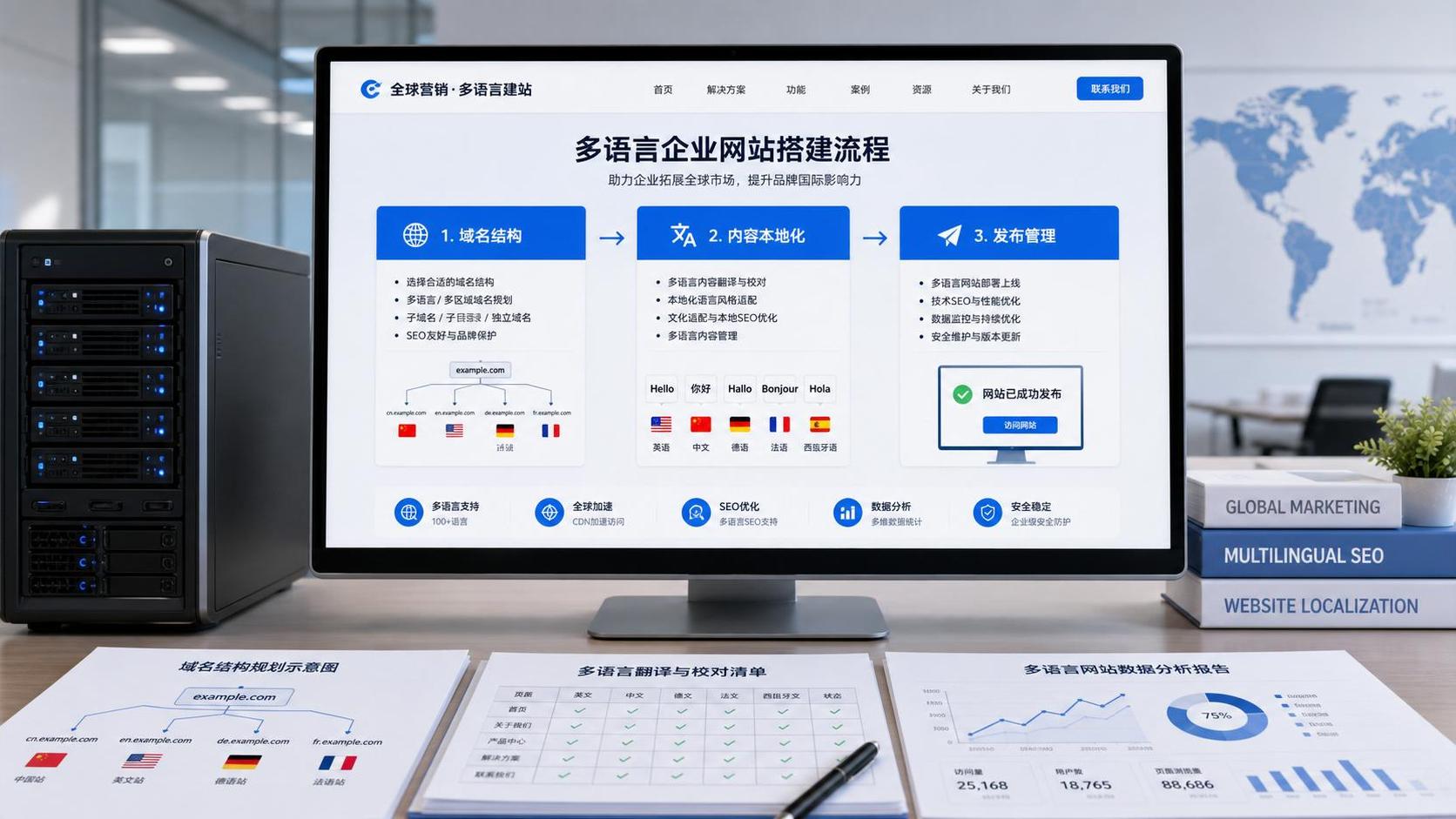
 What are the processes for building a multilingual website?Key steps from domain structure to translation and publishingBuilding a multilingual website is not completed through translation alone,domain structure、SEO tags、technical deployment and localized publishing all affect indexing and conversion。This article outlines the key steps from planning to launch,helping enterprises avoid detours and improve the effectiveness of overseas customer acquisition。
 What are the core modules of a digital marketing SaaS system?A feature checklist suitable for small and medium-sized teamsWhat are the core modules of a digital marketing SaaS system?This article focuses on the feature checklist commonly used by small and medium-sized teams,analyzing the key points of website building,SEO,advertising,conversion,and data collaboration,helping you quickly determine whether an integrated platform is truly suitable for business growth。
 Using AI to boost brand voice and exposure for quick results,which channels are most suitable for initial investment?Using AI to boost brand voice and exposure for quick results,the key is not investing in more channels,but the sequence of priorities。This article analyzes priority strategies for new websites、SEO、advertising and social media,helping you identify high-conversion entry points,avoid detours and amplify brand growth faster。
 How to develop an inquiry quality improvement plan?Key actions from traffic filtering to sales follow-upHow to build an inquiry quality improvement plan?This article focuses on traffic filtering、page conversion、lead grading and sales follow-up,breaking down the key actions in an integrated website + marketing services scenario to help you increase the proportion of qualified inquiries and deal-closing efficiency。
 Which websites are suitable to prioritize generative engine optimization?Consider content scale and brand exposure needsIs it too early to do generative engine optimization now?Do not rush to a conclusion yet。This article starts from content scale,update capabilities,and brand exposure needs,and analyzes which websites are more suitable for prioritizing GEO deployment,helping enterprises determine the timing of investment and seize early opportunities for overseas growth。
 Can website building tools provide customized solutions? First assess template boundaries and development depthDo website building tools provide customized solutions? Do not just look at template demos; more importantly, assess template boundaries、API openness and development depth。 This article helps you identify the real capabilities of website and marketing integrated platforms, avoiding limitations on later-stage expansion。
 How to conduct website development selection evaluation?A decision checklist from business goals to later maintenanceHow to conduct website development selection evaluation?This article reviews a practical decision checklist from business goals、budget cycle、marketing collaboration to later maintenance,helping enterprises avoid the risks of rebuilding and inefficient promotion,and choose a website solution more suitable for long-term growth。