









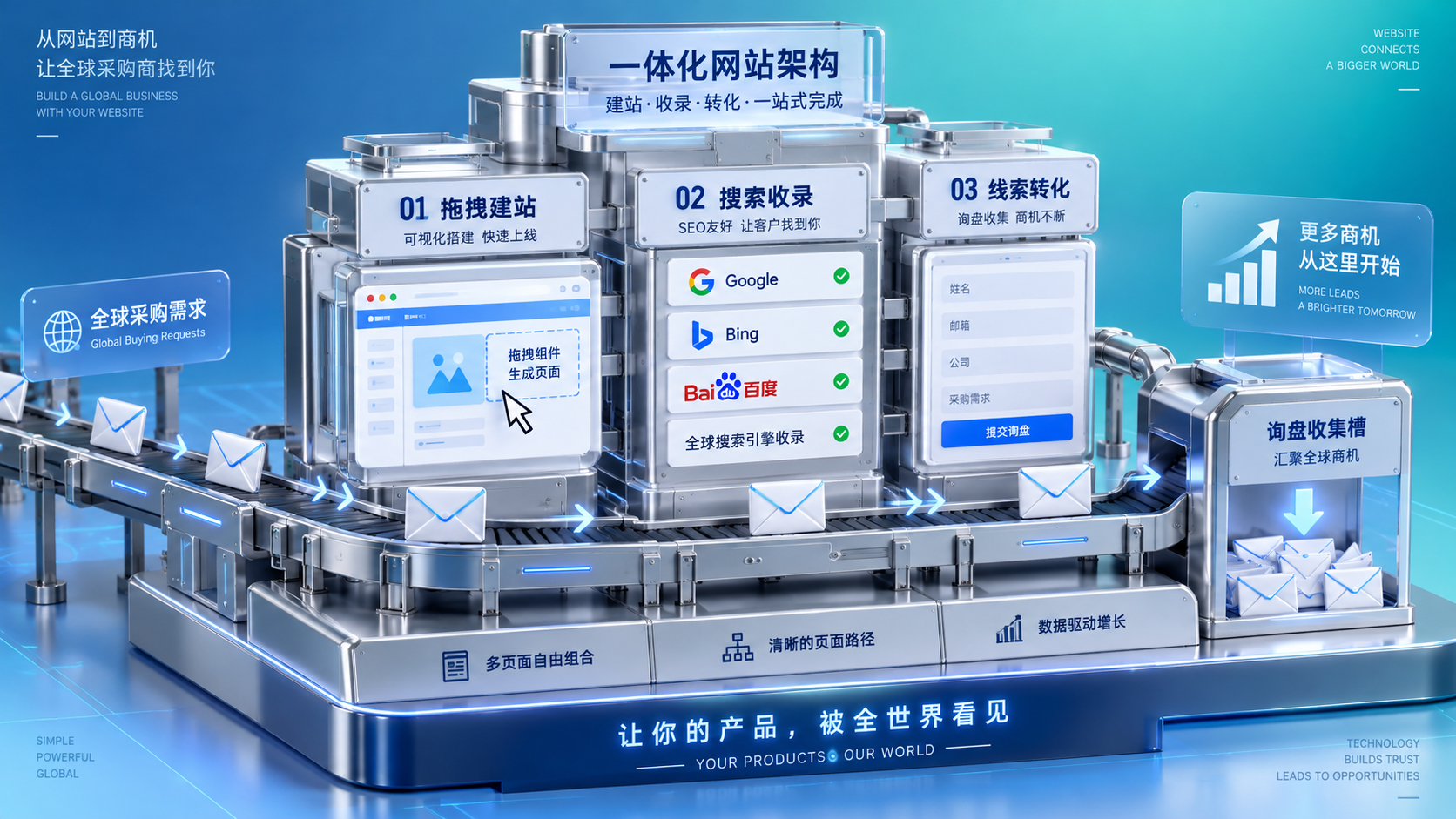
I. Industry Definition and Technical Principles
Drag-and-drop website building uses a visual editor to combine navigation, images, product lists, and forms, lowering the barrier to page creation. For export-oriented businesses, it is both a content management tool and infrastructure for handling traffic from search, advertising, and social media. Its value should be measured by its operational capabilities.
The underlying system typically consists of a component library, page templates, a content database, and a publishing system. The editor converts layout settings into pages accessible through a browser, while responsive rules adapt them to different screen sizes. Whether search engines can understand a page also depends on its rendering method, link structure, and content output.
Mainstream solutions include template-based website builders, free-layout editors, and integrated marketing platforms. Template-based builders are suitable for rapid publishing, free-layout editors for visual customization, and integrated platforms for coordinating promotion and conversion. Before choosing a solution, clarify whether inquiries, transactions, or brand presentation are the primary goal.
II. Website Indexing and Search Fundamentals
Launching a website does not guarantee that it will be indexed. Search engines typically need to discover the URL, crawl the page, understand its content, and then decide whether to add it to the index. A drag-and-drop website builder should provide stable URLs, accessible page content, and clear internal links, so that important product pages can be reached from category pages and navigation.
When troubleshooting pages that have not been indexed, first check their access status, crawl restrictions, and noindex settings, then verify canonical URLs and the sitemap. Use search management tools to review indexing reasons and avoid submitting the same pages repeatedly without cause. Submitting a URL can help search engines discover a page, but does not guarantee indexing or rankings.
Product pages should describe specifications, applications, materials, delivery terms, and purchasing constraints, rather than relying on repetitive copy that only swaps out product names. Multilingual pages should use separate URLs and correct language annotations. Key terminology should also be reviewed by a person to help users and search engines distinguish between language versions.
III. Marketing Landing Pages and Lead Conversion
A landing page should be organized around one clear purchasing need, with the advertising keywords, page title, and above-the-fold selling points aligned. Buyers of industrial equipment typically focus on operating conditions, production capacity, and maintenance requirements; wholesale buyers of consumer goods are more concerned with minimum order quantities, customization options, and delivery arrangements.
A page can be structured around needs, product evidence, cooperation terms, and an inquiry form. Factory photos, inspection documents, and project descriptions should be genuine and verifiable. When using a drag-and-drop website builder to adjust the layout, check the buttons, forms, and images on mobile devices to ensure they do not obscure content or make the page harder to use.
Forms should first collect contact details, product requirements, and purchase volume. More complex specifications can be gathered in follow-up discussions. Record successful submissions, email clicks, and inquiry-button clicks separately. Button clicks are only engagement signals; lead quality should also be assessed based on valid contact details and sales confirmation.
IV. Platform Selection and Launch Acceptance
When purchasing a drag-and-drop website building platform, verify that titles, descriptions, URLs, redirects, and image alt text can be configured independently. Also check multilingual management, form notifications, and data exports. The visual appeal of a demo page is no substitute for testing the platform with a real product catalog.
Launch acceptance testing should cover mobile readability, access to key pages, form delivery, certificate status, and analytics events. Test overseas speed in the target country and network environment using actual page resources. Compressing images, limiting scripts, and configuring caching are usually more valuable than simply adding animations.
The contract should also clarify domain ownership, content copyright, backup and recovery, renewal terms, and migration support. When handling customer information, configure privacy notices and any necessary consent mechanisms in accordance with target-market requirements, and restrict backend access to avoid gaps in data management during marketing collaboration.
V. Applications in International Trade and Coordinated Services
Manufacturers can use product categories, technical specifications, and production capability pages to capture buyer searches. Trading companies can highlight supply chain integration and delivery services. Cross-border stores should focus on validating product specifications, the shopping process, and payment capabilities, rather than using a brochure-style website configuration to meet transactional needs.
Yingyingbao provides intelligent website building, multilingual independent websites, and search, advertising, and social media operations services. It is suitable for businesses seeking to manage their websites and customer acquisition processes in one place. Companies can start by building pages for one product line and target market, then expand after validating the content, user experience, and inquiry-handling process.
According to the information provided by the company, Yingyingbao serves industries including machinery, steel, chemicals, and new energy, but the current materials do not disclose inquiry growth figures for specific projects. When purchasing, ask to see comparable pages, product demonstrations, and the scope of service delivery, and request verifiable evidence of relevant industry experience.
VI. Total Cost of Ownership and Investment Assessment
The total cost of ownership for a drag-and-drop website includes platform subscriptions, domain registration, content creation, translation, promotion, and ongoing maintenance. The number of products and languages, integration requirements, and operational responsibilities all affect the budget. When purchasing, distinguish between the initial launch cost and the annual investment required for continued growth.
Performance can be assessed using cost per qualified inquiry, opportunity rate, and contribution to sales. Cost per qualified inquiry is calculated by dividing the relevant investment by the number of qualified inquiries, but the measurement period and attribution rules must be consistent. For businesses with long decision-making cycles, also track progress on quotations, samples, and contracts rather than focusing only on form submissions.
When budgets are limited, prioritize core product pages, languages for target markets, and inquiry pathways, then gradually add content and advertising. Before consulting Yingyingbao about a solution, prepare a product catalog, market priorities, and sales process, and request an itemized breakdown of deliverables, costs, and methods for assessing results.
VII. Maintenance Cycles and Future Industry Trends
Website maintenance should be scheduled around business changes: update product specifications and delivery terms promptly, and regularly check for broken links, forms, and indexing issues. If traffic is low, first investigate visibility and demand alignment. If visits are growing but inquiries are not, review the page information and communication process.
Artificial intelligence is improving the efficiency of structural planning, translation, and initial content drafting, but technical specifications, certification claims, and commercial commitments still require human review. Competition among drag-and-drop website builders will increasingly focus on content governance, data coordination, and the ability to continuously optimize operations across markets.
For generative search, businesses can continuously develop clear product explanations, purchasing FAQs, and traceable documentation to increase the chances of their content being understood and cited. Such optimization cannot guarantee recommendations. Adjust content based on actual inquiry sources and sales feedback so that the website builds long-term business value.
