












I. Definition and Scope of Social Media Marketing Automation
Social media marketing automation is an operational approach that uses software, rule engines, and human review mechanisms to connect content creation, asset scheduling, account publishing, interaction routing, lead recording, and performance analysis. Its goal is not to post content mechanically in bulk, but to improve the efficiency of reaching overseas audiences on social media while maintaining compliance.
In foreign trade B2B scenarios, social media marketing automation typically covers channels such as Facebook, LinkedIn, TikTok, and YouTube, guiding visitors to product pages, case study pages, inquiry pages, or WhatsApp communication entry points. Social media is responsible for building awareness and maintaining ongoing reach, while an independent website supports trust-building and conversion.
It is important to distinguish that automation is suitable for repetitive processes; it does not mean automatically sending private messages, buying engagement, or bypassing platform rules. Communications with high-value buyers, technical Q&A, quotation confirmation, and dispute handling should still be completed by sales personnel to safeguard brand credibility and customer experience.
II. Technical Principles and Key Workflows
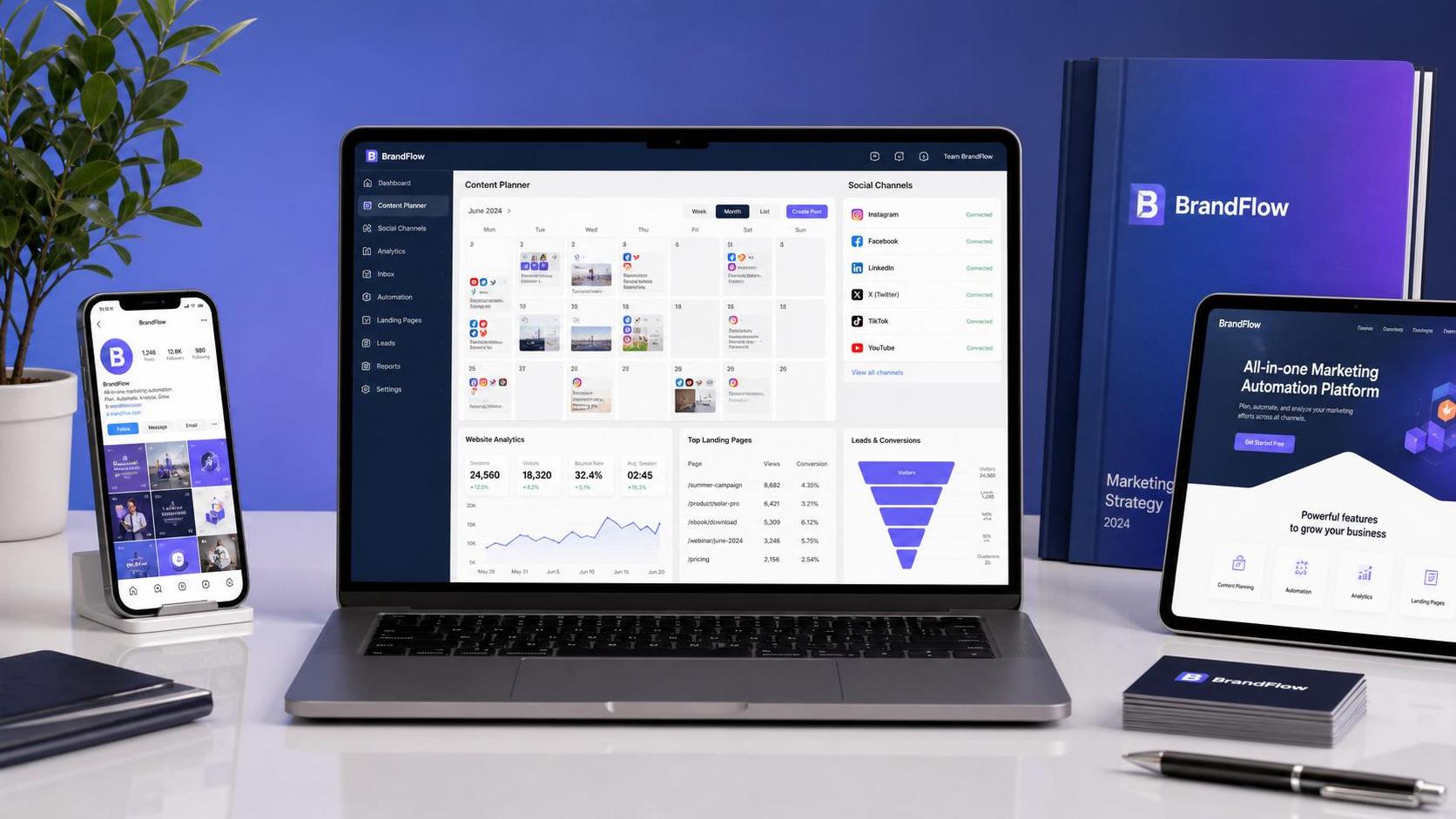
An effective social media marketing automation system typically consists of a content library, account authorization, publishing calendar, asset adaptation, link tracking, interaction reminders, and data dashboards. The content library accumulates product selling points, application scenarios, factory capabilities, frequently asked questions, and customer cases, preventing operations from starting from scratch each time.
Before publishing, the system generates content for review based on platform dimensions, hashtag conventions, the language of target regions, and publishing time windows. After publishing, parameterized links are used to identify traffic sources and attribute form submissions, emails, online customer service inquiries, or instant messaging consultations to specific content and channels.
The focus of technical implementation is permission control and human verification. Enterprises should use platform-approved authorization methods and set approval permissions for different accounts, markets, and product lines; automatically generated copy, translations, image descriptions, and external links should be reviewed item by item to avoid factual errors, cultural misunderstandings, and duplicate publishing.
III. Main Types and Suitable Users
By application objective, social media marketing automation can be divided into content distribution, brand cultivation, advertising coordination, lead operations, and data analysis. Content distribution focuses on multi-platform scheduling, brand cultivation emphasizes the consistent delivery of professional content, and lead operations focus on inquiry response, customer classification, and sales follow-up.
Manufacturing factories are well suited to distributing content around production processes, quality control, equipment capabilities, certification documents, and application cases; foreign trade companies can highlight supply chain integration, product selection capabilities, and delivery experience; cross-border brands should further combine short videos, review content, and product landing pages to increase repeat visits and conversion opportunities.
Industries such as laser engraving machines, steel, chemicals, heavy trucks, machinery, new energy, automobiles, agriculture, and healthcare typically involve longer decision-making cycles. Social media content should not only publish promotional information, but should continuously address buyers' concerns regarding specifications, delivery times, customization, after-sales service, and compliance.
IV. Platform Compliance, Selection Criteria, and Industry Practices
When selecting a solution, priority should be given to reviewing the scope of platform authorization, account security policies, content review mechanisms, data export capabilities, and permission management, rather than merely comparing the number of accounts that can be connected. For companies concerned about risk control, reasonable frequency, original content, normal interaction, and traceable operational records are more important than aggressive automation features.
International market operations should also consider language localization, privacy protection, advertising asset restrictions, and sensitive industry expressions. Content involving chemicals, healthcare, food, or equipment performance should be confirmed by personnel familiar with the products regarding parameters, applicable conditions, and the boundaries of claims, avoiding comparative statements that cannot be substantiated.
Yiyingbao's AI+SNS overseas social media marketing capabilities can be deployed in coordination with multilingual independent websites, SEO content, advertising landing pages, and inquiry entry points. For companies lacking dedicated overseas operations teams, this integrated website and marketing service model helps reduce information gaps between channels while retaining analyzable website data assets.
V. Implementation Methods from Content Publishing to Lead Generation and Conversion
Before implementing social media marketing automation, companies should first clarify their target country markets, buyer roles, key products, and conversion actions. For example, technical parameters and project cases can be used to direct engineering procurement personnel to download or inquiry pages; for distributors, product portfolios, supply capabilities, and cooperation policies can be presented.
The second step is to establish a content matrix: product content answers “what is being sold,” capability content demonstrates “whether it can be done,” case content explains “how well it has been done,” knowledge content reduces procurement concerns, and brand content reinforces long-term memory. Each type of content should be equipped with a corresponding landing page, avoiding directing all visitors to the homepage.
The third step is to set weekly schedules and response rules. Automated scheduling can ensure consistent updates, but responsible personnel and response time limits need to be established for comments, private messages, and inquiries. Review impressions, valid visits, form submissions, qualified opportunities, and contribution to closed deals monthly; eliminate low-quality topics and continue expanding high-intent content.
VI. Operations Maintenance, Quality Control, and Trend Assessment
Social media marketing automation is not a one-time deployment project. It is recommended to check publishing success rates, link validity, pending comments, and account anomalies weekly; update product materials, image assets, hashtag libraries, and key market topics monthly; and adjust content proportions, advertising coordination strategies, and landing page conversion paths quarterly based on sales feedback.
Quality control should cover four areas: factual accuracy, language localization, visual consistency, and conversion usability. In particular, AI-assisted content generation requires verification of models, parameters, delivery times, and industry terminology. Videos, images, and customer cases should also be confirmed to have appropriate usage authorization.
In the future, social media operations will place greater emphasis on content reuse, short-video search, first-party data accumulation, and generative search visibility. Companies can expand highly engaging social media topics into independent website articles, frequently asked questions, and solution pages, then use GEO structured content to improve the opportunities for their brands to be understood and cited in AI Q&A environments.
VII. Total Cost of Ownership and Return on Investment Assessment
The total cost of ownership for social media marketing automation typically includes system subscription or service fees, account and asset development, copywriting and video production, multilingual review, advertising budgets, website landing page optimization, data analysis, and sales follow-up labor. When purchasing, companies should clarify which functions, content production capacity, and operational services are included to avoid subsequent budget overruns.
ROI assessment should not focus only on follower counts or the impressions of individual content pieces, but should combine target market traffic, qualified inquiry rates, sales follow-up rates, opportunity value, and sales cycles. For industrial products with high average order values and long decision-making cycles, brand search growth, repeat visits, and remarketing audience accumulation can also be monitored.
Yiyingbao can connect intelligent website building, multilingual content, SEO, advertising placement, social media operations, and subsequent website operations into a unified workflow. Before purchasing, companies can first review their existing websites, target countries, content assets, and lead processes, validate the results of investment through phased objectives, and then gradually expand account coverage and market scope.
 Will social media automation marketing tools trigger platform risk controlsWill social media automation marketing tools trigger platform risk controls? Yes, but the key lies in how they are used. This article analyzes common trigger points, frequency control, and compliance strategies to help businesses safely improve social media lead generation efficiency and reduce the risk of traffic restrictions and account bans.
 How to Choose the Right Social Media Automation Marketing ToolsHow to choose the right social media automation marketing tools? Don’t just focus on scheduled posting; pay more attention to lead conversion, data tracking, and website integration. This article starts from enterprise use cases to help you quickly identify suitable tools and an integrated growth solution.
 Comparison of Overseas Social Media Automation Marketing Tools: Scheduling, Private Messaging, and Lead Management Solutions Suitable for B2B TeamsHow to Choose Comparison of Overseas Social Media Automation Marketing Tools? This article focuses on the scheduling, private messaging, and lead management that B2B teams care about most, analyzes the website + marketing integrated closed-loop approach, and helps you improve lead quality and overseas customer conversion efficiency.
 What are the pitfalls of outsourcing social media automation marketing? Check these 5 areas firstWhat pitfalls should you watch out for when outsourcing automated social media marketing? This article focuses on five key issues that must be investigated before a business evaluation, helping you identify risks such as inflated data, disconnected processes, and unclear lead attribution, avoid budget waste, and improve lead generation and conversion efficiency.
