









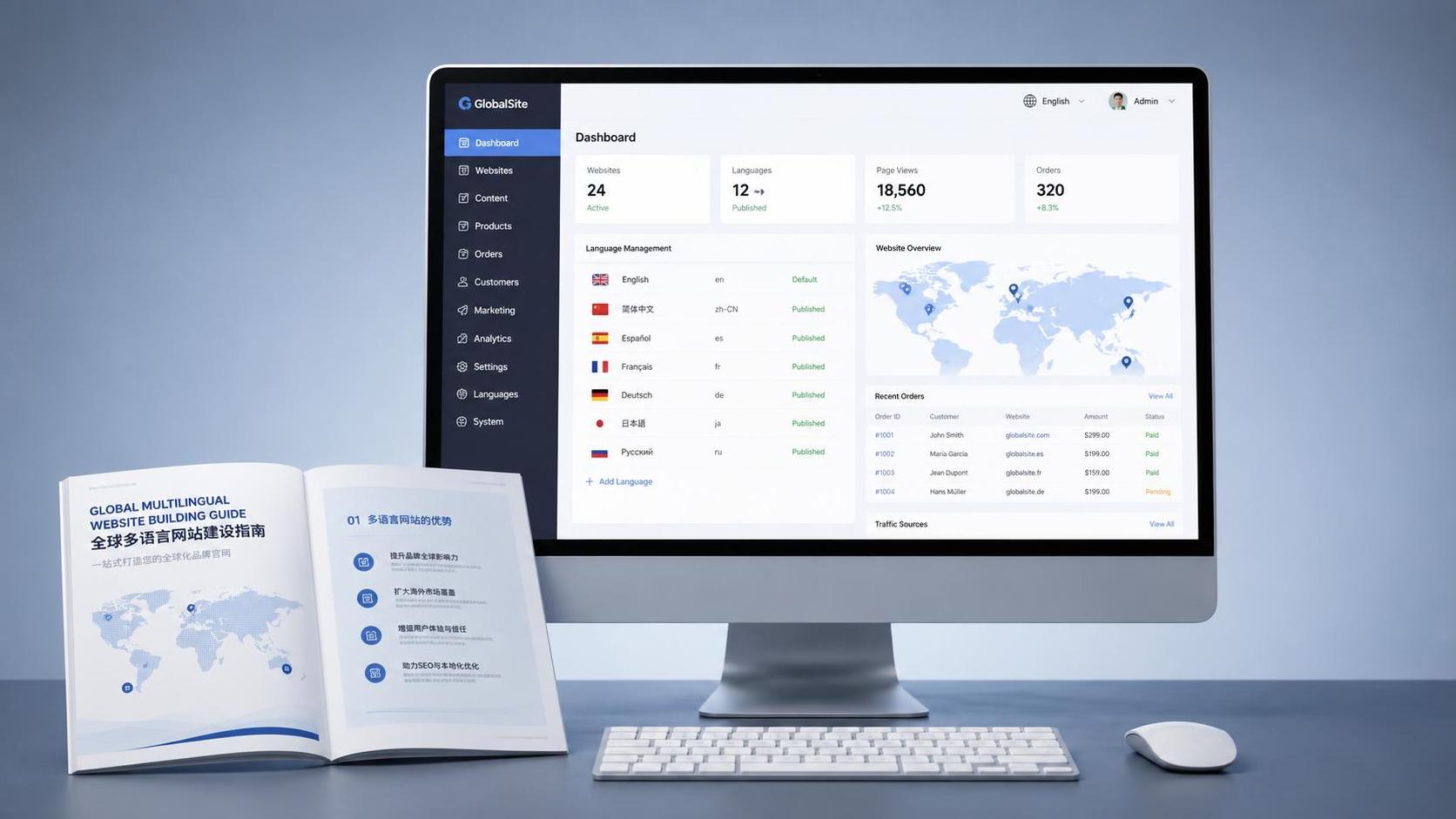
I. Definition and Industry Value of Global Multilingual Website Platforms
A global multilingual website platform is a digital system used to centrally build, publish, manage, and optimize websites in multiple language versions. It not only handles page translation, but also coordinates product data, language paths, regional content, access speed, inquiry channels, and marketing data, enabling enterprises to continuously operate their website assets across different markets.
For foreign trade B2B enterprises, the platform's core task is to enable overseas buyers to quickly understand product capabilities, supply qualifications, delivery scope, and communication methods after arriving through search, advertising, or social media. For cross-border brands, it must also accommodate product presentation, purchasing or quotation-request journeys, trust-building content, and repeat-purchase engagement.
A complete platform typically includes content management, responsive front-end design, multilingual version control, international search configuration, global acceleration, security certificates, data analytics, and marketing connectivity. When making a purchase, enterprises should regard it as long-term customer acquisition infrastructure rather than a one-time page translation project.
II. Technical Principles and International Search Structure
The technical foundation of multilingual sites lies in the content model and language routing. Content such as products, articles, and case studies should retain unified data relationships, with independently accessible pages generated for each language. Common architectures include subdirectories, subdomains, and country-code domains. The choice should be based on market size, operational capabilities, and brand strategy, rather than merely pursuing uniformity of form.
International search configuration must clearly define the language and applicable region of each page and establish corresponding relationships between versions through hreflang, preventing search engines from mistakenly identifying similar pages as duplicate content. Titles, descriptions, body text, image alt text, and internal links should also be independently optimized based on local procurement terminology rather than simply copying the original text.
User experience also affects conversion. A global multilingual website platform should support responsive pages, image compression, caching, content delivery networks, and HTTPS access, while conducting usability tests for forms, online customer service, WhatsApp, and email workflows. Page loading, mobile readability, and form delivery rates should be included in launch acceptance testing.
III. Main Platform Types and Suitable Enterprises
The first category consists of B2B marketing platforms centered on corporate presentation and inquiries, suitable for factories, trading companies, OEMs, and industrial product suppliers. Their focus is on product catalogs, specification pages, application scenarios, factory capabilities, certification materials, case studies, and multi-channel inquiry entry points, rather than complex transaction functions.
The second category consists of B2C standalone websites or e-commerce platforms centered on product conversion, suitable for DTC brands and cross-border sellers. In addition to multilingual content, they must assess their capacity to support product specifications, inventory, pricing, shopping carts, orders, payments, logistics information, and ad landing pages, preventing marketing traffic from entering inefficient pages.
The third category consists of platforms integrating websites with marketing operations, suitable for small and medium-sized enterprises lacking overseas digital teams. E-Market Pro connects AI-powered website building, multilingual sites, search optimization, advertising, social media operations, and website operations within a single service system, making it more suitable for enterprises that need to move from website building to continuous customer acquisition.
IV. Selection Criteria and Launch Implementation Process
Platform selection should begin by defining business objectives: whether to acquire B2B inquiries, build a regional brand, receive advertising traffic, or conduct online retail. Next, identify target countries, priority languages, core product lines, customer decision cycles, and existing content assets. The clearer the market priorities, the better enterprises can avoid launching too many low-quality language pages at once.
Procurement evaluation can focus on six capabilities: support for independent language pages and regional paths; ease of maintaining product content in batches; availability of basic international search configuration; mobile compatibility; integration with advertising and analytics tools; and provision of security, backup, speed, and permission management mechanisms.
Implementation should proceed in stages: first complete market research and keyword segmentation, then determine the information architecture and page templates, followed by organizing source-language content and localizing it, and finally configuring forms, tracking, indexing, and acceleration services. Before launch, test language switching, link redirects, inquiry notifications, and access performance across different regions.
V. Application Scenarios, Market Entry, and Content Localization
Manufacturing export enterprises can use a global multilingual website platform to build an English main site and add German, French, Spanish, Russian, Japanese, Korean, or Arabic pages for key regions. Industries such as machinery, chemicals, new energy, automotive parts, and building materials should prioritize explaining technical specifications, application environments, customization capabilities, delivery processes, and after-sales support.
Localization does not mean translating sentence by sentence. Different markets vary in units, lead-time expressions, product naming, contact methods, privacy notices, and procurement practices. Enterprises should have business personnel verify key terminology, marketing personnel adjust selling points, and add FAQs, case studies, downloadable materials, and clear calls to action for high-value pages.
E-Market Pro has served industries including laser engraving machines, steel, chemicals, heavy-duty trucks, machinery, and new energy, and also covers case materials involving Haier, Aucma, Shandong Airlines, Yuanhe Power Station, Little Duck Group, and China National Heavy Duty Truck Group. Enterprises may refer to the structure of its industry pages, but should still rely on their own products, market materials, and compliance requirements.
VI. Operating Cycles, Quality Control, and Growth Methods
After a website goes live, it is recommended to review indexing, traffic to key pages, keyword coverage, visitor countries, bounce performance, and inquiry sources monthly; and to review product information, outdated case studies, broken links, and language quality quarterly. When adding new markets or product lines, first establish a content list and then expand pages in batches to avoid losing control of the structure.
Quality control should cover four areas: content accuracy, technical accessibility, marketing conversion potential, and data traceability. AI can assist with generating first drafts, expanding keywords, and optimizing descriptions, but content involving performance specifications, certifications, pricing, lead times, and legal statements must be reviewed and approved by responsible enterprise personnel before publication.
E-Market Pro provides AI-assisted content generation, multilingual SEO, and integration between advertising and social media operations, and leverages its publicly described cloud service nodes for global access acceleration. For enterprises without dedicated teams, having website building, promotion, and operations coordinated within the same system helps shorten issue identification and page iteration cycles.
VII. Total Cost of Ownership and 2026 Development Trends
The total cost of ownership of a global multilingual website platform includes not only initial website-building costs, but also domain names, servers or content delivery, certificates, page design, content production, translation review, system maintenance, data tools, ad landing pages, and ongoing operations. The number of languages, product complexity, degree of customization, and integration requirements all affect the budget.
When evaluating return on investment, enterprises should separately attribute organic search, advertising, social media, and returning existing customers, focusing on the number of qualified inquiries, sales opportunity quality, customer acquisition cost, page conversion rate, and revenue from key countries rather than only traffic volume. Prioritizing high-margin products and key markets is generally easier for validating returns than deploying all languages evenly.
In 2026, platform competition will shift from “whether translation is possible” to “whether localization can be scaled and growth can be sustained.” Generative search environments will increase the importance of structured knowledge, brand entity information, Q&A content, and evidence pages. Enterprises should connect global multilingual website platforms with GEO, search optimization, advertising data, and customer follow-up processes to build reusable cross-market operating capabilities.
