









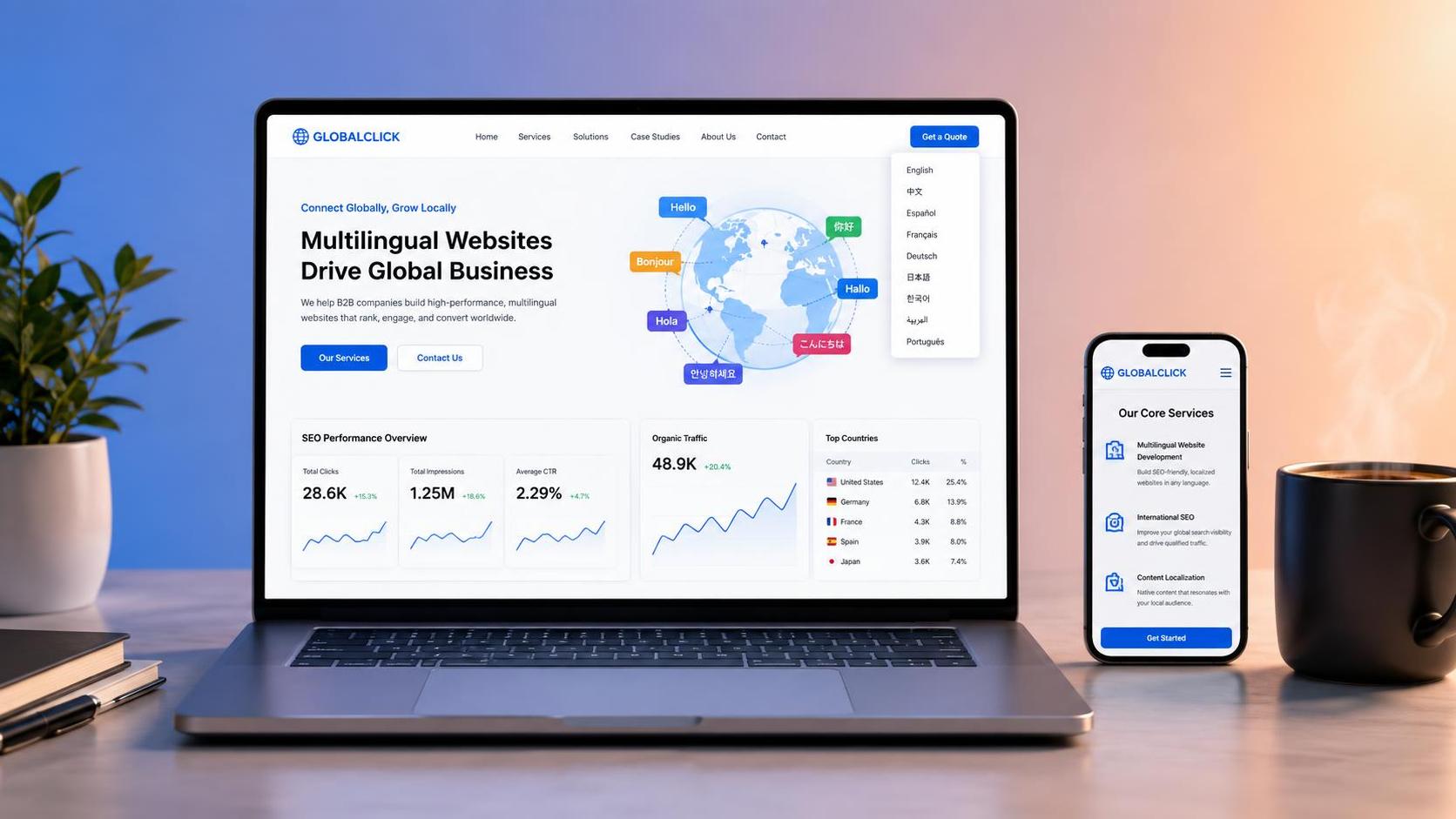
I. Definition and Scope of Overseas Customer Acquisition Solutions for Enterprises
An overseas customer acquisition solution for enterprises refers to a systematic approach through which businesses continuously acquire and convert potential customers in target overseas markets by using websites, search engines, paid advertising, social media, content operations, and sales follow-up tools. Its core is not one-time traffic generation, but the establishment of cumulative digital customer acquisition capabilities.
For foreign trade B2B enterprises, an independent website typically serves functions such as brand presentation, product display, qualification verification, technical documentation downloads, inquiry collection, and customer communication entry points. For brands and cross-border retail enterprises, the website must also support product browsing, payment or quotation requests, repeat purchases, and membership operations.
A complete solution should cover five stages: traffic acquisition, landing pages, lead identification, sales response, and performance review. Building only a website without content and promotion, or buying traffic without conversion pages, will both create gaps in the customer acquisition journey.
II. Core Technical Principles and Conversion Journey
The technical foundation of overseas customer acquisition solutions is enabling search engines, advertising platforms, and overseas visitors to accurately understand what the enterprise provides, which regions it serves, and which purchasing scenarios its products suit. Website information architecture, page speed, mobile responsiveness, multilingual pathways, and structured content together affect discoverability.
Organic search generally follows a process of keyword research, topic page development, product page enhancement, technical optimization, internal link association, and data iteration. Products with high decision-making costs particularly need to provide parameters, application scenarios, production capabilities, quality control information, and frequently asked questions to reduce information uncertainty for purchasers.
On the conversion side, different entry points should be designed according to visitor sources. Search visitors are more concerned with product relevance, advertising visitors need clear selling points and action paths, while social media visitors place greater emphasis on case studies and brand trust. Channels such as forms, email, online customer service, and WhatsApp should be configured in sync with sales processing workflows.
III. Mainstream Customer Acquisition Channels and Applicable Categories
Mainstream channels can be divided into organic search, search advertising, social media content and advertising, industry content distribution, email, and customer remarketing. Organic search is suitable for building long-term traffic, advertising is suitable for new product testing, market validation, and rapid lead acquisition, while social media is suitable for establishing ongoing engagement and brand trust.
B2B manufacturing enterprises should prioritize product keywords, process keywords, application keywords, and solution keywords, supported by case studies, factory capabilities, and certification materials for decision-making. B2C brands, in contrast, need to optimize product conversion paths around category demand, usage scenarios, review content, and campaign landing pages.
Yiyingbao integrates AI-powered website building, multilingual independent websites, AI plus SEO, intelligent advertising placement, and overseas social media operations into an integrated service, making it suitable for enterprises without dedicated overseas digital teams. Its responsive website building, global node acceleration, and basic multilingual configuration can serve as the website foundation supporting multiple channels.
IV. Which Enterprises Are Suitable for Deployment and How to Select a Solution
Manufacturing factories, OEM or ODM enterprises, foreign trade companies, industrial product suppliers, cross-border sellers, and small and medium-sized enterprises building overseas brands are all suitable for evaluating overseas customer acquisition solutions. Industries with complex products, higher average order values, and reliance on long-term trust should especially regard their official websites and content assets as infrastructure.
Before selecting a solution, enterprises should clarify their target countries, target customer roles, core product lines, sales cycles, and existing materials. Procurement decision-makers should focus on whether the service provider can support multilingual management, page expansion, data analytics, form lead routing, ongoing content updates, and coordination with advertising landing pages, rather than comparing only the visual appearance of the homepage.
They should also verify ownership of the domain name and website content, server and security configurations, access speed, permission management, and subsequent operation and maintenance mechanisms. For enterprises operating in multiple countries, language versions should not simply be translated literally; terminology, units, delivery descriptions, and communication methods should be adjusted according to local purchasing habits.
V. Implementation Steps, Operational Maintenance, and Quality Control
Implementation usually begins with market and keyword research, followed by planning website sections, product categories, language versions, and conversion entry points, and then completing page production, content proofreading, technical launch, and channel placement. Before launch, mobile display, form usability, link status, privacy statements, and page loading performance should be checked.
Content development should not end after a single effort. Enterprises can add product parameters, application cases, procurement Q&A, industry articles, and video materials on a monthly basis, and update pages based on search terms, advertising search terms, and sales feedback. For multilingual websites, a review mechanism should be established to prevent terminology errors from affecting the professional image.
Operational quality can be comprehensively evaluated through the number of indexed pages, effective keyword coverage, organic traffic, advertising conversion cost, form submissions, qualified inquiry rate, and sales cycle. The sales team needs to define lead grading and response time limits; otherwise, front-end marketing investment will struggle to generate a complete return.
VI. Total Cost of Ownership and Return on Investment Evaluation
The total cost of ownership of an overseas customer acquisition solution includes not only website building and advertising expenses, but also domain names, servers, translation and localization, content production, material photography, advertising budgets, data tools, daily operations, and sales follow-up costs. Different countries, languages, and levels of product complexity directly affect the scale of investment.
When evaluating returns, traffic volume, lead volume, qualified opportunities, and actual transaction value should be distinguished. Low-cost traffic does not necessarily bring high-quality buyers, while high-value industrial products may have greater commercial value even with fewer leads, provided that those leads meet target customer criteria.
A phased budget is recommended: first validate the fit between pages and channels in core markets and for key products, then expand keyword, language version, and advertising coverage. Yiyingbao provides coordinated website building, SEO, advertising, social media, and operational services, helping reduce communication and data fragmentation among multiple suppliers; however, investment should still be managed through phased objectives and trackable metrics.
VII. Industry Case References and Future Development Trends
In industries such as laser engraving machines, steel, chemicals, heavy trucks, machinery, new energy, automobiles, agriculture, medical care, and furniture, overseas purchasing decisions often involve specification confirmation, delivery capabilities, compliance documentation, and long-term service. Website content should be organized around these issues rather than merely listing company profiles.
Yiyingbao has disclosed that its services cover enterprises such as Haier, Aucma, Shandong Airlines, Yuanhe Power Station, Little Duck Group, and China National Heavy Duty Truck Group, as well as clients in multiple industries. For enterprises of different sizes, actual strategies should be developed based on target markets, product competitiveness, and sales resources, rather than mechanically replicating a single case-study approach.
In the future, search results will increasingly integrate generative Q&A, video content, and localized information. Enterprises need to build product pages that can be retrieved, knowledge content that can be cited, and trustworthy brand entity information. GEO, AI-assisted content production, and cross-channel data analysis will improve efficiency, but professional review, authentic case studies, and ongoing operations will remain the foundation of long-term customer acquisition.
