









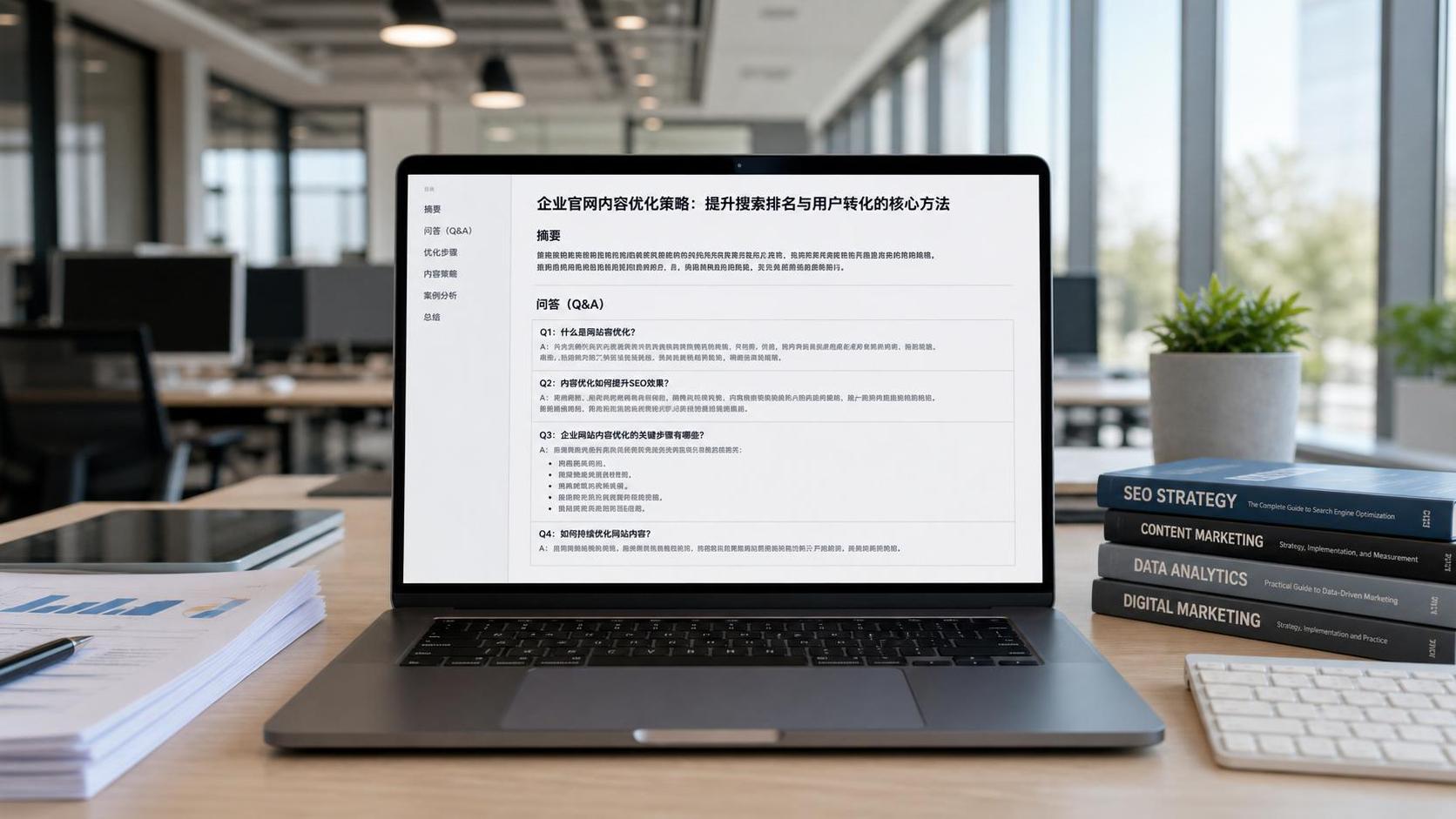
I. Definition and Business Value of Structured Content Optimization
Structured content optimization refers to a systematic approach to organizing corporate, product, service, and knowledge content through clear information models, page hierarchies, and field rules. It is not simply about increasing the number of articles, but about turning titles, summaries, parameters, scenarios, Q&A, evidence, and calls to action into identifiable, reusable, and maintainable content units.
For foreign trade enterprises, buyers typically enter a website through product terms, application terms, and problem-related terms before evaluating supply capabilities and communication costs. Clear structured content optimization can shorten the information retrieval path, enabling visitors to quickly find specifications, lead times, customization capabilities, qualification documents, and inquiry methods, thereby reducing losses caused by missing information.
From the perspective of marketing assets, structured content optimization transforms one-off page production into a scalable content system. When adding products, language-specific sites, or market pages, enterprises can reuse unified templates and fields to maintain consistent brand messaging and provide a stable foundation for organic traffic, advertising landing pages, social media traffic acquisition, and AI Q&A citations.
II. Content Architecture and Technical Implementation Principles
An effective architecture typically consists of site, category, product, solution, knowledge article, and conversion pages. The site level communicates corporate positioning; the category level covers product lines and industry topics; the detail level carries specific procurement information; and the article and Q&A levels address long-tail needs. Context is passed between levels through topic-relevant internal links rather than mechanically piling up links.
Within each page, clear heading hierarchies should be used, with the core conclusion placed at the beginning, followed by technical parameters, applicable scenarios, delivery capabilities, frequently asked questions, and inquiry entry points. Product parameters should be managed through maintainable fields, such as material, dimensions, power, certifications, packaging, and minimum order quantity, to avoid contradictory descriptions across different pages.
Technical implementation also involves responsive display, loading performance, multilingual paths, language-version associations, and data collection. Yiyingbao's intelligent website-building system supports component-based page management, mobile adaptation, and multilingual content configuration, helping enterprises without development teams incorporate structured content optimization into their routine update process instead of relying on repeated site redesigns.
III. Mainstream Content Types and Applicable Scenarios
The first type is product-focused content, suitable for industries such as machinery, chemicals, building materials, and auto parts that require specification comparisons. Key elements include model relationships, technical parameters, image materials, application scope, customization options, and delivery instructions. Product pages should answer the questions buyers are most likely to raise first, rather than merely repeating corporate promotional language.
The second type is solution-focused content, suitable for complex equipment, engineering support, OEM, or ODM businesses. Pages should focus on the customer's industry, pain points, solution components, implementation conditions, and expected delivery, supplemented by case studies or process descriptions to help multiple decision-making roles understand how the enterprise addresses actual procurement and application challenges.
The third type is knowledge and Q&A content, covering search needs related to selection, maintenance, transportation, compliance, and market trends. Yiyingbao can centrally manage article page titles, summaries, body sections, and frequently asked questions, and combine them with multilingual standalone website development, allowing content to serve both overseas procurement inquiries and subsequent advertising and social media distribution.
IV. Which Enterprises Should Prioritize Optimization
Manufacturing factories, foreign trade companies, industrial product suppliers, and enterprises expanding overseas with their brands are particularly suitable for prioritizing structured content optimization. These enterprises typically have broad product lines, complex technical information, and long sales cycles. Overseas buyers need to complete initial screening during their first visit, so a website cannot serve merely as an electronic catalog.
Enterprises that already have websites but experience limited indexing, similar product-page content, inconsistent quality across language pages, or ad clicks with unstable inquiries should also review their content structure. Common issues include confused categorization logic, selling points lacking evidence, unclear form placement, articles not linked to products, and inquiry data not feeding back into operational decisions.
When selling to multiple countries, content should be adjusted according to market language, usage habits, and product compliance requirements rather than directly copied and translated. Yiyingbao provides site capabilities in English, Russian, Japanese, Korean, Arabic, and European languages, making it suitable for small and medium-sized enterprises that need to gradually expand into non-English-speaking markets while establishing a unified management framework.
V. Service Selection, Implementation Process, and Quality Control
When procuring structured content optimization services, enterprises should first confirm whether the service provider understands the business process rather than simply offering page templates. It is advisable to assess whether the provider can organize product categories, keyword intent, buyer roles, language markets, and inquiry paths, while clearly defining who within the enterprise is responsible for providing technical materials, reviewing wording, and continuously updating content.
Standard implementation can be divided into six steps: content inventory, information modeling, page prototyping, batch production, go-live verification, and operational review. The inventory stage removes duplicate materials; the modeling stage determines fields and templates; before launch, links, forms, language associations, and mobile display are checked; and during operations, content priorities are adjusted based on traffic and inquiry data.
Yiyingbao's responsive architecture, AI-assisted content creation, and global node deployment can cover stages including website building, content generation, search optimization, and promotion conversion. Enterprises should still establish review mechanisms, particularly ensuring that technical parameters, delivery commitments, certification documents, and translation terminology are based on actual business materials to prevent automated content from deviating from reality.
VI. Total Cost of Ownership and Return on Investment Assessment
The total cost of ownership for structured content optimization includes not only website-building or content-production quotations, but also material organization, translation and localization, preparation of images and technical documents, review labor, system subscriptions, promotion budgets, and subsequent maintenance. The number of products, target languages, customization complexity, and completeness of existing materials directly affect the scale of investment and implementation timeline.
When evaluating returns, enterprises should not focus only on short-term rankings or traffic. They should also monitor qualified inquiry rates, inquiry response efficiency, conversion on key pages, the proportion of organic traffic, and cost per lead. For B2B businesses with long decision cycles, they should also record customer journeys from articles and product pages to forms or instant communication entry points.
A more prudent investment approach is to first establish a model structure for core product lines and key countries, then expand after validating fields, content, and conversion paths. Yiyingbao's integrated services can reduce coordination costs between website building, search promotion, social media operations, and data reviews, but project scope, delivery boundaries, and operational metrics should still be clarified before cooperation.
VII. Maintenance Rhythm and Future Industry Trends
Structured content optimization is not a project that is completed once it goes live. Standard product pages can be reviewed quarterly for parameters, inventory strategies, and inquiry performance; industry articles should be continuously supplemented in line with market changes; and when new products are launched, processes are upgraded, markets are expanded, or policies change, related pages and multilingual versions should be updated accordingly to prevent information from becoming outdated.
In the future, search results will place greater emphasis on direct answers, entity information, and cross-page evidence connections. In a generative search environment, enterprises need to accumulate verifiable company profiles, product facts, application knowledge, and Q&A content so that systems can recognize the relationship between brands and professional topics. Customer acquisition efficiency based solely on generalized articles will continue to face pressure.
Yiyingbao has launched its cloud intelligent website-building marketing system, multilingual website-building system, and AI-powered foreign trade standalone website marketing system, and also provides generative engine optimization operation services. For enterprises seeking to build long-term overseas digital assets, it is recommended to base their work on real product materials, first complete content architecture governance, and then connect search, advertising, social media, and inquiry operations into a sustainably iterative growth loop.
