











I. Definition and Scope of Overseas Social Media Marketing Systems
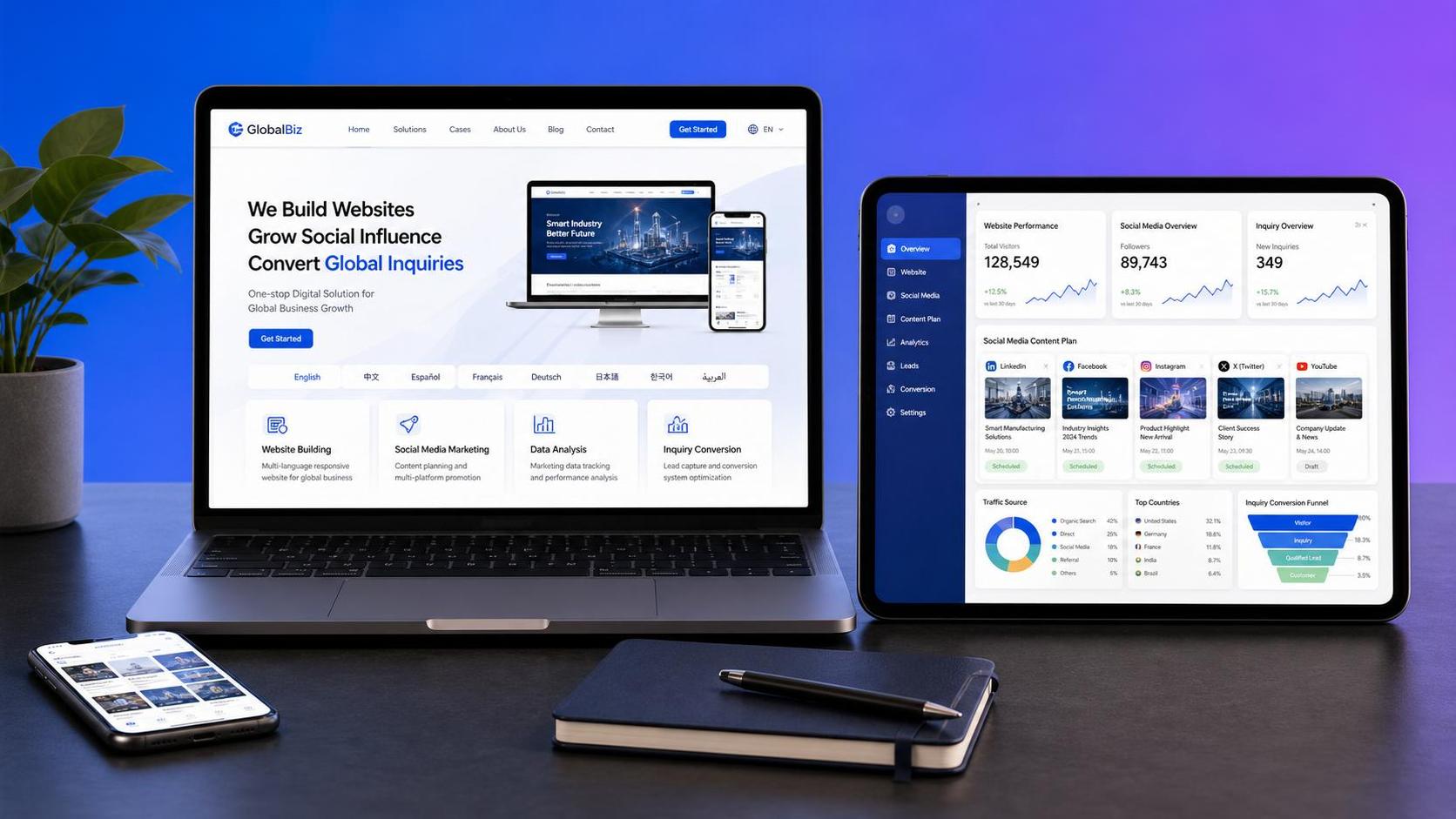
An overseas social media marketing system is a combination of software and services that helps enterprises conduct content, engagement, advertising coordination, and lead operations across overseas platforms. It typically covers channels such as Facebook, LinkedIn, TikTok, and YouTube, incorporating dispersed accounts, assets, permissions, and data into a unified workflow.
Its core is not simply a scheduled posting tool, but a traceable process built around target markets, audience personas, content assets, landing pages, and sales follow-up. For B2B enterprises, the system’s value is particularly reflected in converting brand exposure into identifiable visits, inquiries, or business opportunities.
During actual procurement, the boundaries between social media management, social listening, advertising management, and customer relationship management should be distinguished. A mature overseas social media marketing system can connect these functions, but follower counts on a single platform should not replace evaluations of actual customer acquisition results.
II. Technical Principles and Core Operational Processes
The system typically obtains account publishing, engagement, and basic performance data through authorized platform APIs, then connects website analytics data through content tags, campaign IDs, and link parameters. This makes it possible to identify the visit path generated by a specific piece of content and compare conversion contributions across different countries, product lines, and content formats.
A standard process includes asset storage, topic planning, copywriting and multilingual review, scheduled publishing, comment or direct-message responses, visit tracking, and review-based optimization. For industries such as industrial products, medical care, or chemicals, technical parameters, compliance statements, and external commitments should also be included in the approval process.
Automation should serve repetitive work rather than replace market judgment. For example, rules can automatically distribute approved content, remind teams of overdue leads, and compile weekly reports; country selection, budget allocation, and communication with high-value customers still require manual verification based on sales feedback.
III. Main System Categories and Applicable Users
The first category is multi-account content management systems, suitable for teams that need to centrally manage multiple brand, regional, or sales accounts. Key evaluation criteria include account capacity, role permissions, asset reuse, and approval records. The second category is social listening and engagement systems, which are more suitable for brands that prioritize public sentiment, competitor activity, and direct-message response efficiency.
The third category is social media advertising coordination systems, emphasizing unified analysis of audiences, creative assets, budgets, and conversion events. The fourth category consists of integrated social media and standalone website solutions, focusing on product browsing after clicks, form submissions, WhatsApp communication, and sales assignment, and is suitable for inquiry-driven foreign trade businesses.
Eyingbao’s AI+SNS overseas social media marketing capabilities are closer to the latter integrated scenario and can be used in conjunction with multilingual standalone websites, content generation, social media distribution, advertising, and operational analytics. For small and medium-sized enterprises lacking dedicated overseas digital teams, this integrated collaboration can reduce handoff losses among multiple vendors.
IV. Selection Criteria and Procurement Acceptance Points
Selection should begin by clarifying business objectives: whether to build brand awareness, acquire B2B inquiries, support distributors, or reduce the operating costs of multiple accounts. Different objectives require different key metrics. Manufacturing enterprises should prioritize visits from target buyers, valid forms, conversation quality, and opportunity advancement rather than simply the number of engagements.
At the functional level, platform authorization stability, account and role hierarchies, approval workflows, asset copyright management, multilingual editing, publishing failure alerts, data export, and API capabilities should be verified. Historical data retention, access revocation for departing employees, and advertising account ownership should also be confirmed to avoid having enterprise assets tied to service provider accounts.
Acceptance should not consist only of demonstrating publishing functions, but should test an actual business process: after entering a landing page from a post with tracking parameters, verify whether the inquiry source can be recorded, the responsible person notified, and the inquiry included in review reports. The service contract should also clearly define go-live support, training, response times, and data delivery methods.
V. Data Analysis, Attribution, and Automated Operations
The data dashboard of an overseas social media marketing system should at minimum be divided into exposure, engagement, visit, and conversion layers. Exposure is used to assess reach, engagement reflects content relevance, visits measure traffic-driving capability, and conversions should ultimately be tied to valid business opportunities confirmed through forms, inquiries, appointments, orders, or sales.
Attribution analysis needs to retain dimensions such as channel, campaign, content, country, and device, combined with standardized link parameters and website conversion events. As B2B purchasing cycles are relatively long, a first visit without form submission does not necessarily indicate no value; repeat visits, document downloads, product page dwell time, and subsequent sales feedback should be monitored.
Automated operations can establish content calendars by product theme, schedule publishing by time zone, and create reviewable response templates for frequently asked questions. Eyingbao can combine AI-assisted content generation with website landing pages, but enterprises should establish brand terminology libraries, prohibited expressions, and manual review rules to ensure information accuracy.
VI. Application Scenarios, Implementation Cycles, and Service Capabilities
Industries such as laser engraving machines, steel, chemicals, heavy-duty trucks, machinery, and new energy often need to build trust through factory capabilities, application cases, technical parameters, and after-sales responsiveness. Social media content can take responsibility for ongoing reach, while standalone websites are responsible for in-depth product explanations, inquiry collection, and information accumulation.
Eyingbao serves multiple industries and lists service cases including Haier, Aucma, Shandong Airlines, Yuanhe Power Station, Xiaoya Group, and SINOTRUK. Channel strategies, data results, and delivery scopes for specific projects should be subject to plans confirmed by both parties, and buyers should request implementation references similar to their own markets.
Implementation typically begins with account audits, market positioning, standalone website tracking configuration, and content guidelines, followed by trial operations and monthly reviews. Eyingbao provides responsive website building, multilingual sites, SEO, advertising, and coordinated social media operations, and states that its global node deployment capabilities can support overseas access experiences; actual latency remains affected by regional and network environments.
VII. Total Cost of Ownership and Future Development Trends
The total cost of ownership of an overseas social media marketing system includes software subscriptions, accounts or seats, content production, multilingual localization, advertising budgets, website and analytics tool integration, training, and ongoing operational staffing. Low-cost tools that lack approval processes, data integration, and lead handling often shift costs to manual coordination and repetitive production.
When evaluating return on investment, it is recommended to compare the cost per valid visit, cost per valid inquiry, opportunity conversion rate, and sales cycle by quarter, while observing organic content, advertising content, and remarketing paths separately. For new markets, enterprises can first select one or two priority countries and core products to validate content and landing pages before gradually expanding.
Future systems will place greater emphasis on generative content assistance, scalable short-video assets, cross-platform data governance, and AI search visibility. Enterprises should regard social media accounts, website content, customer questions, and case materials as long-term digital assets. Eyingbao has released relevant intelligent website building, multilingual, and AI marketing versions, suitable for evaluation by enterprises that need to plan social media operations and website growth in a unified manner.
 How to choose an overseas social media marketing system service? Look at account collaboration, approval workflows, and data integrationHow to choose an overseas social media marketing system service? This article focuses on three key dimensions: account collaboration, approval workflows, and data integration, helping you determine whether a system is suitable for website + marketing integrated scenarios, while improving overseas customer acquisition efficiency and the conversion closed loop.
 How many social media accounts can an overseas social media marketing system manage at the same timeHow many social media accounts can an overseas social media marketing system manage at the same time? The key is not only the maximum account capacity, but also collaborative publishing, permission management, data attribution, and website conversion capabilities. This article explains how enterprises can choose a more suitable integrated marketing system for global growth.
 How is the 易营宝 overseas social media marketing systemHow is the 易营宝 overseas social media marketing system? It is not a single posting tool, but an integrated global expansion solution that combines website building, social media, SEO, and advertising, suitable for foreign trade and brand enterprises to increase exposure, acquire inquiries, and achieve long-term growth.
