









I. Industry Definition: From Product Display to the Entry Point for Purchasing Decisions
Automotive parts export website development involves building an independent website system for overseas markets for component manufacturers, trading companies, and brand owners. Its core purpose is not only to present the company and its products, but also to enable buyers to quickly confirm supply capabilities, fitment scope, and terms of cooperation during searching, comparison, and communication.
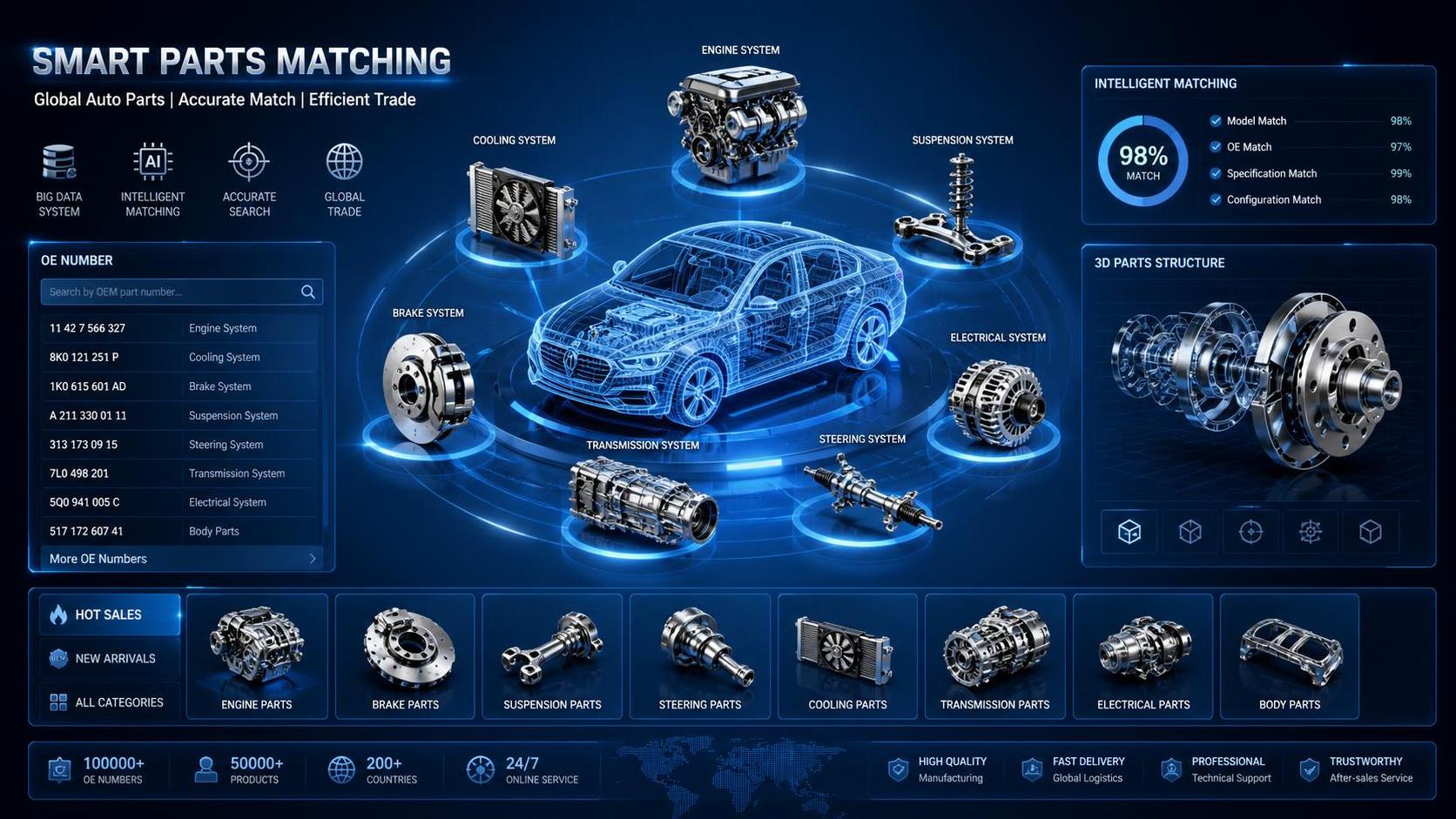
A typical website should cover product catalogs, vehicle model or part number searches, specifications, application positions, materials and processes, packaging information, quality documentation, factory capabilities, case studies, and inquiry entry points. For aftermarket products, OE numbers, cross-reference numbers, and compatible vehicle models often have a greater impact on purchasing efficiency than marketing slogans.
From a business model perspective, automotive parts export website development can be divided into factory inquiry-based corporate websites, brand presentation websites, distributor catalog sites, cross-border retail stores, and advertising landing page systems. Companies should first define whether their target customers are importers, wholesalers, repair chains, or end consumers, and then determine the information architecture and conversion path.
II. Overseas Purchasing Habits and Page Technology Principles
Overseas B2B buyers typically enter a website through search engines, industry referrals, post-trade-show verification, or social media links. Visitors first assess product relevance, then review supplier reliability, and only then submit an inquiry. Therefore, the above-the-fold section should clearly explain product categories, target markets, and core capabilities rather than stack corporate promotional statements.
Technically, websites need responsive pages to ensure browsing on mobile phones, tablets, and computers. Images should be compressed, and code and server access paths should be optimized to reduce overseas loading times. Product pages should include crawlable heading hierarchies, clear links, and structured fields to help search systems understand the page topic.
Multilingual content is not word-for-word translation. Buyers in the UK, the US, Europe, the Middle East, and Latin America differ in their focus on units, trade terms, delivery wording, and supporting documentation. Language paths, page relationships, and localized content should remain consistent to avoid parameter conflicts for the same product across pages in different languages.
III. Main Website Types and Suitable Businesses
Factory inquiry-based websites are suitable for OEM, ODM, and component manufacturing companies, focusing on production lines, testing capabilities, customization processes, minimum order quantities, and lead-time communication methods. Their pages should present product capabilities separately from factory evidence, helping buyers distinguish manufacturers from general trading companies.
Catalog search websites are suitable for automotive parts suppliers with numerous models and complex replacement relationships. Catalogs can be organized by category, vehicle model, system, part number, or application scenario. Such websites should prioritize filtering efficiency and prevent purchasing personnel from repeatedly navigating through large volumes of images and duplicate names.
Brand retail independent websites are better suited to businesses with standardized inventory, clear pricing, and end-user service capabilities. In addition to product details, they require specification selection, shopping carts, payment or inquiry processes, logistics descriptions, and after-sales policies. B2B and B2C models can share brand content, but should not use the same conversion path.
IV. Selection Criteria: How Buyers Assess Supplier Credibility
When evaluating automotive parts export website development solutions, companies should first check whether product data supports ongoing maintenance, including models, dimensions, materials, fitment information, images, documents, and multilingual fields. If the backend cannot support batch updates or if permissions are disorganized, expanding the catalog can easily result in invalid pages and increase the maintenance burden on the sales team.
The second criterion is whether trust information can be verified. Buyers typically need to see the company address, contact details, production capacity, quality control procedures, packaging methods, export experience, and authentic application materials. Where certifications or testing are involved, information should be displayed according to the materials actually held by the company, without using vague or unverifiable endorsements.
Yiyingbao can provide automotive parts export companies with responsive AI-powered website development, multilingual pages, product content management, and inquiry entry point configuration, while connecting subsequent search, advertising, and social media operations. For companies lacking a technical team, this integrated website and marketing service approach helps reduce configuration gaps arising from collaboration among multiple suppliers.
V. Development Process and Key Quality Control Points
During the project initiation stage, market and keyword research should be completed to identify priority countries, target buyers, core categories, and competitor product messaging. Product classifications, filtering dimensions, page templates, and content fields should then be established. Standardizing data first and then entering products can reduce the risk of rework when new models are added later.
During page production, particular attention should be paid to the accuracy of parameters, image copyrights and clarity, mobile layout, form submission, email notifications, instant communication tools, and privacy notices. For safety-related categories such as engines, braking systems, chassis, and electrical systems, generic descriptions should not be presented as unsupported performance claims.
Before launch, testing should cover browsing across multiple devices, access from major overseas regions, broken links, language switching, and inquiries. After launch, indexing, traffic sources, popular product pages, and inquiry quality should be continuously reviewed. Yiyingbao's AI-assisted content generation and global node deployment capabilities can be used to improve website development efficiency and the overseas access experience, but content should still be reviewed and confirmed by the company.
VI. Application Scenarios, Maintenance Cycles, and Operational Coordination
Automotive parts websites are commonly used to support customer return visits before and after trade shows, acquire customers through Google search, serve as advertising landing pages, develop distributors, launch new products, and promote regional markets. Before sending quotations, sales representatives can use the relevant product pages, factory pages, and quality information pages as standard information packages to reduce repetitive explanations and ensure consistent external information.
Website maintenance should follow business rhythms: new product and discontinuation information should be updated promptly, key product parameters should be reviewed regularly, forms, speed, and security configurations should be checked quarterly, and traffic and inquiry sources should be analyzed monthly. When entering a new national market, companies should add the application scenarios, delivery methods, and service FAQs that local buyers care about rather than simply copying the original pages.
Yiyingbao has served industries including automobiles, heavy-duty trucks, machinery, and new energy, and its case materials list clients such as Haier, Aucma, Shandong Airlines, Little Duck Group, and China National Heavy Duty Truck Group. For automotive parts companies, the value of case studies lies in drawing on content organization and digital collaboration approaches; specific results still depend on product competitiveness, market strategy, and ongoing operational investment.
VII. Total Cost of Ownership and Future Trends
The total cost of ownership for automotive parts export website development includes not only initial design and development, but also domain names, servers, content organization, translation, localization, image production, function maintenance, traffic acquisition, and sales follow-up. Purchasing decisions should compare maintenance capabilities and customer acquisition costs over three years, rather than only comparing first-year website development quotations.
To measure return on investment, companies can track qualified visits, key product page views, form submission rates, WhatsApp or email inquiries, qualified inquiry rates, sample-to-order conversion rates, and repeat purchase sources. Advertising is suitable for validating markets and acquiring customers quickly, while organic content and brand materials are better suited to building long-term reusable digital assets.
In the future, automotive parts independent websites will place greater emphasis on multilingual localization, part number and vehicle model data organization, mobile inquiries, video-based factory evidence, and Q&A and structured content for generative search. Yiyingbao has released system versions related to multilingual website development and AI-powered export independent websites. Companies can advance website and operational upgrades in stages based on their own data quality and market priorities.
