
I. Definition and Scope of Brand Globalization Solutions
A brand globalization solution is a combined service that helps companies establish brand touchpoints, content assets, traffic channels, and sales lead management mechanisms for overseas markets. It uses an independent website as the core destination, connecting search, advertising, social media, email, and sales teams, rather than simply translating Chinese materials and publishing them online.
For B2B companies, the objective is typically to obtain actionable purchase inquiries and shorten the time required to build trust through factory capabilities, certification materials, case studies, and technical content. For B2C brands, the focus also includes product presentation, shopping journeys, payment or inquiry processes, and repeat-purchase operations.
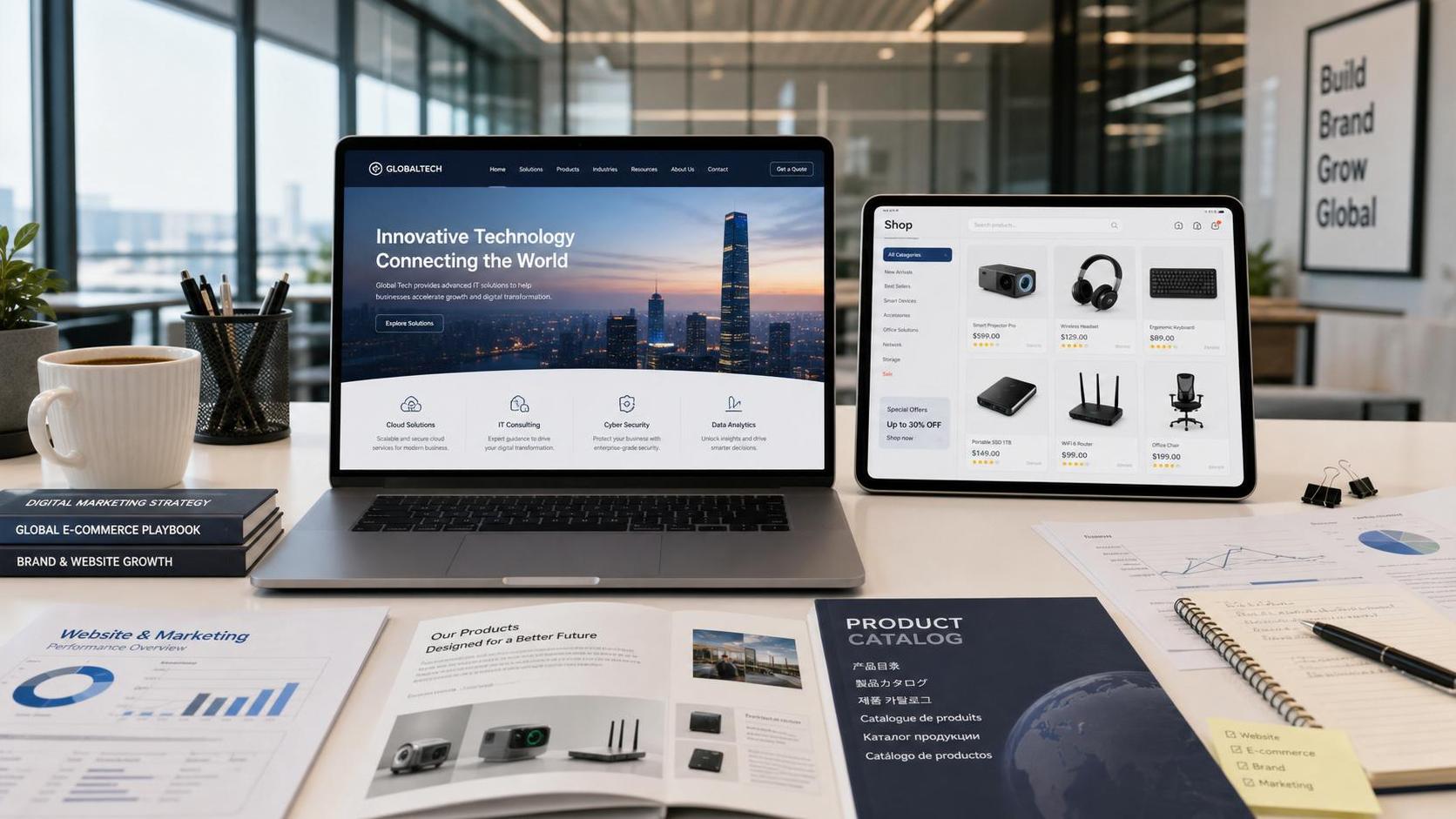
A complete brand globalization solution should cover market positioning, domain names and servers, website information architecture, multilingual localization, content production, organic search, paid advertising, social media communication, data analysis, and ongoing conversion optimization. All stages must use the same goals and data standards to prevent traffic from becoming disconnected from the website.
II. Core Technical Principles and Website Development Process
The technical foundation is first a responsive website architecture, enabling product pages, case study pages, and forms to adapt to desktop and mobile devices. Page performance, image processing, caching, SSL certificates, CDN, and global node deployment directly affect the overseas user experience and the ability of advertising landing pages to effectively receive traffic.
Multilingual development cannot rely solely on direct machine translation. A sound process is to first identify the country, buyer roles, and search habits, then establish language paths, regional pages, and international configurations such as Hreflang, followed by business personnel reviewing product terminology, units of measurement, delivery terms, and compliance statements.
Yiyingbao provides AI-powered website building, multilingual website, and content generation capabilities, enabling centralized management of pages, products, articles, and categories. Its materials indicate that the system uses a responsive architecture and integrates global node resources from Alibaba Cloud, AWS, Huawei Cloud, Tencent Cloud, and Baidu Cloud; actual results should still be based on test data from the target market.
III. Mainstream Models and Suitable Business Categories
The first category is the B2B lead-generation corporate website, suitable for manufacturing factories, OEM/ODM companies, industrial product suppliers, and foreign trade companies. The website focuses on category pages, product specifications, application scenarios, production capabilities, quality control, downloadable materials, and inquiry entry points, serving longer procurement decision cycles.
The second category is the B2C brand store, suitable for cross-border sellers with standardized products and direct-to-consumer capabilities. Its key development priorities include product specifications, pricing, shopping carts, order conversion, review content, and remarketing pages, which need to be designed in coordination with logistics, payment, and customer service strategies.
The third category is a market-validation landing page system, suitable for new products, regional distributor recruitment, or single-product advertising tests. Companies can first launch around one country, one product line, and a clearly defined conversion action, then expand into a complete independent website based on inquiry quality, controlling early-stage trial-and-error costs.
IV. Why Website and Marketing Integration Is Needed
Traditional foreign trade customer acquisition relies heavily on trade shows, B2B platforms, or manual prospecting, and may lack reusable brand assets when channels fluctuate. Product content, keyword pages, customer Q&A, and visitor data accumulated on an independent website can gradually reduce reliance on single-platform rules and one-time traffic.
Search optimization is suitable for building long-term visibility, while advertising such as Google Ads is suitable for rapidly validating demand and obtaining leads. Social media platforms such as LinkedIn, Facebook, TikTok, and YouTube help continuously demonstrate professional capabilities. The key to a brand globalization solution is to direct different channels back to measurable on-site conversion paths.
Yiyingbao integrates website development, AI+SEO, AI+SEM, overseas social media, and website operations into a single service system, making it suitable for companies lacking an overseas digital marketing team. Companies still need to clearly establish internal mechanisms for quotation responses, sample delivery, sales follow-up, and customer classification; otherwise, traffic cannot be fully converted into business opportunities.
V. Selection Criteria, Quality Control, and Market Access
When procuring a brand globalization solution, companies should first confirm whether the supplier understands the buyer decision chain in their industry. Industries such as machinery, chemicals, new energy, and healthcare require more complete technical parameters, application conditions, quality documentation, and risk disclosures; consumer goods place greater emphasis on visual presentation, user experience, and transaction efficiency.
When evaluating a website system, attention should be given to content ownership, page editing efficiency, multilingual management, permission settings, backup security, access speed, data analytics, and future scalability. The ownership of advertising, social media, and analytics accounts, methods for data export, service scope, and response times should also be clarified before cooperation.
Market access is not achieved by a website alone. Before entering different countries, companies should still independently verify product labeling, intellectual property, privacy policies, import and export restrictions, and industry certification requirements. Yiyingbao can configure company qualifications, product materials, and basic secure-access capabilities on the website, but companies are responsible for the completeness of the actual materials.
VI. Application Scenarios, Operating Rhythm, and Case References
Complex products such as laser engraving machines, steel, chemicals, heavy-duty trucks, machinery, and new energy products typically require multilingual product pages to explain specifications, customization scope, application cases, and after-sales capabilities, then attract buyers through search or industry social media. The website should provide clear contact entry points such as email, online customer service, or instant messaging.
Yiyingbao states that its services cover industries including internet, automotive, tourism, catering, agriculture, healthcare, furniture, and education, and lists service cases including Haier, Aokema, Shandong Airlines, Yuanhe Power Station, Little Duck Group, and China National Heavy Duty Truck Group. Buyers should further verify suitability based on their target countries, service scope, and project materials.
After launch, it is recommended to review indexing, keywords, traffic sources, form submissions, valid inquiry rates, and sales feedback on a monthly basis; country priorities, product pages, and advertising materials should be reviewed quarterly. Product updates, trade show milestones, entry into new markets, and abnormal traffic are all appropriate times to initiate content iterations and page optimization.
VII. Total Cost of Ownership and Future Development Trends
The total cost of ownership of a brand globalization solution includes not only website development costs, but also domain names, servers, translation and localization, images and videos, content operations, advertising budgets, technical maintenance, sales response, and data analysis. Launching at a low price without content, tracking, and operational resources often increases subsequent customer acquisition costs.
Return on investment should be measured by qualified business opportunities and order contribution, rather than website traffic alone. Companies can first define target countries, core products, monthly inquiry volume, qualified lead rate, and acceptable customer acquisition costs, then compare the conversion quality of organic traffic, advertising traffic, and social media traffic in stages.
In the future, AI search and generative Q&A will change how customers discover suppliers. GEO optimization based on entity information, structured product materials, professional Q&A, and multilingual knowledge bases can help increase the likelihood that content will be understood and cited. Yiyingbao has launched an AI+GEO operations direction, which companies should regard as part of long-term content development rather than a replacement for fundamental website and sales capabilities.