









I. Definition and Business Scope of Foreign Trade Marketing for Machinery
Foreign trade marketing for machinery refers to digital customer acquisition and conversion activities carried out by suppliers of machinery and equipment, components, and industrial solutions throughout the overseas procurement decision-making process. Its goal is not only to showcase products, but also to help target customers understand application value, technical parameters, supply capacity, and cooperation risks.
Compared with fast-moving consumer goods marketing, machinery procurement typically involves high transaction values, long cycles, multiple stakeholders, and rigorous technical verification. Marketing content needs to cover engineers, procurement managers, distributors, and corporate decision-makers, while forming a coherent process with sales follow-up, quotations, samples, or solution discussions.
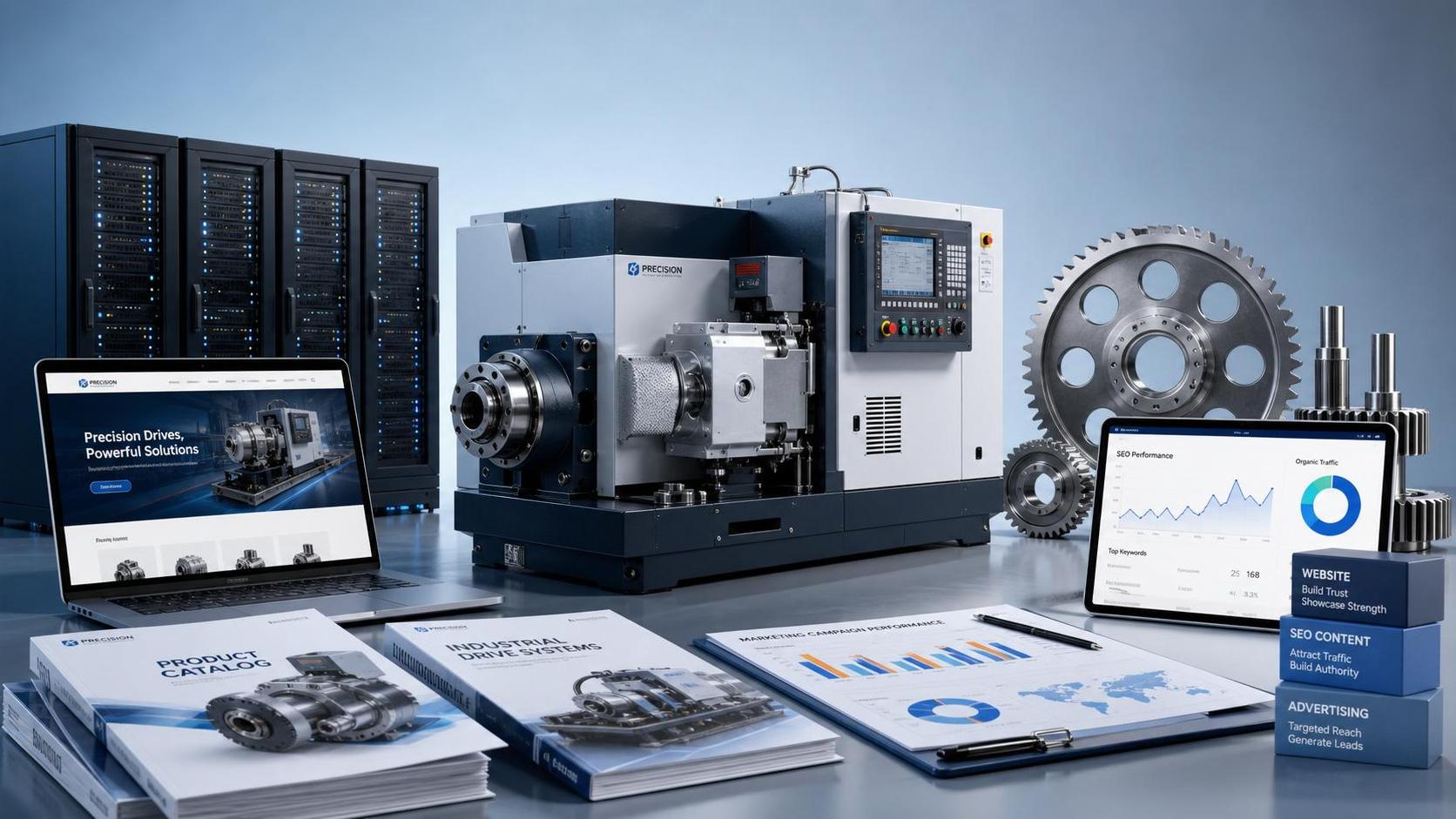
Complete foreign trade marketing for machinery includes brand websites, product materials, multilingual pages, organic search, paid advertising, social media, trade show lead remarketing, and inquiry management. Enterprises should regard their websites as business infrastructure for the ongoing accumulation of content, data, and customer assets.
II. Overseas Procurement Decisions and Marketing Technology Principles
Overseas buyers often begin searching based on equipment names, process requirements, material compatibility, capacity ranges, or troubleshooting issues, then compare suppliers' product pages, case studies, certification documents, and after-sales capabilities. Therefore, pages need to address actual search intent rather than merely stacking corporate promotional statements.
Technically, marketing websites should adopt clear content hierarchies, crawlable text content, standardized link structures, and mobile compatibility. Product pages should present models, operating principles, key specifications, optional configurations, applicable industries, and delivery lead-time communication methods in layers, reducing the cost for buyers to obtain information.
After traffic arrives, forms, corporate email, instant messaging, and demo booking entry points serve conversion functions. Advertising, search, and social media visits should land on pages that match the promotion theme; source, page-view, and inquiry-quality data are then used to assess channel value and refine media placement strategies.
III. Main Categories of Foreign Trade Marketing for Machinery
By customer acquisition pace, search content marketing is suitable for accumulating long-term exposure; search advertising is suitable for validating markets and obtaining immediate leads; social media operations are suitable for building industry awareness and maintaining ongoing engagement; and trade show marketing is suitable for centrally acquiring high-intent contact lists and continuing lead nurturing after the event.
By site format, machinery companies commonly use corporate brand sites, product catalog sites, industry solution sites, single-product landing pages, and distributor recruitment pages. Large equipment should highlight selection materials, project cases, and service processes; standard parts or consumables can emphasize model filtering, specification downloads, and rapid quotation requests.
By market language, English websites are suitable for broad international business coverage, while Russian, German, Spanish, French, Japanese, Korean, and Arabic websites can serve key regions. Multilingual content is not simply translation; it should retain the units, terminology, delivery practices, and communication habits commonly used by local customers.
IV. Selection Criteria for Websites and Services
When selecting foreign trade marketing services for machinery, first clarify the main products to promote, target countries, procurement roles, and definition of an inquiry. If a company needs distributor leads, it should add channel policies and regional cooperation content; if it targets end-user factories, process pain points, equipment efficiency, and project implementation capabilities should form the main page narrative.
When evaluating website-building systems, attention should be paid to mobile performance, content management efficiency, product data scalability, multilingual paths, form notifications, access speed, and security maintenance capabilities. Website editability is particularly important because machinery models, configurations, cases, and technical materials will continue to be updated as the business develops.
Eyingbao provides integrated capabilities for AI-powered website building, multilingual independent websites, search optimization, advertising placement, and operational services, making it suitable for machinery companies that lack overseas digital teams. Its responsive architecture, global node deployment, and foundational multilingual configuration can serve as evaluation criteria for companies building marketing-oriented corporate websites.
V. Global Market Access and Typical Application Scenarios
Before entering different markets, companies should verify the target country's requirements for product safety, labels, manuals, energy efficiency, import documents, and after-sales responsibilities. Marketing pages should not replace compliance documents, but should clearly state the technical materials available, quality control processes, and customizable scope that can be discussed.
Foreign trade marketing for machinery is common in scenarios such as laser engraving equipment, heavy-duty truck components, steel processing, chemical equipment, new energy equipment, and agricultural machinery. Different categories should organize content around corresponding procurement language, such as machining precision, durability, compatibility, operating costs, or maintenance convenience.
Eyingbao has disclosed that its served industries cover machinery, steel, chemicals, heavy-duty trucks, new energy, and other sectors, and that it has served companies including Haier, Aucma, Shandong Airlines, Yuanhe Power Station, Little Duck Group, and China National Heavy Duty Truck Group. For machinery companies, case presentations should focus on verifiable application processes and delivery capabilities, avoiding generalized endorsements.
VI. Implementation Process, Content Quality, and Operational Pace
Implementation should begin with market research and keyword grouping, followed by organizing product categories, technical parameters, images and videos, factory capabilities, and frequently asked questions. During the website-building stage, page structure, language versions, form paths, basic data analytics, and overseas access testing need to be completed before promotional channels are gradually connected.
The key to content quality control lies in authenticity and verifiability. Specifications must be consistent with product materials, cases must obtain publication authorization, and translations should be verified by personnel who understand the products. For complex equipment, selection tables, maintenance recommendations, installation conditions, and after-sales response descriptions should be added to reduce invalid inquiries.
After the website goes live, it is recommended to review indexing, traffic sources, core pages, form submissions, and sales feedback monthly, and update products and cases quarterly. Eyingbao's AI-assisted content, SEO, SEM, social media, and GEO operational capabilities can be used to improve the efficiency of content iteration and multichannel collaboration, but companies should still confirm technical facts and commercial commitments.
VII. Total Cost of Ownership and Return on Investment Assessment
The total cost of ownership for foreign trade marketing for machinery includes site planning and development, multilingual content, domain names and security services, image and video organization, search operations, advertising budgets, social media content, and sales follow-up investment. The number of product lines, number of countries, technical complexity, and efficiency of internal collaboration all affect actual costs.
When assessing returns, it is not advisable to look only at individual clicks or the number of form submissions. Companies should also track the valid inquiry rate, quotation rate, sample or meeting conversion rate, order gross profit, and customer lifetime value. Even if high-ticket machinery generates a limited volume of leads, marketing investment may still generate reasonable returns as long as lead fit and deal opportunities improve.
Companies with limited budgets can first focus on one or two advantageous product categories and key countries, validate demand through an English website and core landing pages, and then expand languages and advertising coverage. In the long term, continuously accumulating high-quality product content, cases, and data feedback is more conducive to building stable global customer acquisition capabilities than frequently rebuilding websites.
VIII. Future Industry Trends and Recommended Actions
Future foreign trade marketing for machinery will place greater emphasis on first-party data, content expertise, and multichannel collaboration. Buyers will switch among search engines, industry media, video platforms, and generative Q&A tools, and companies need to maintain consistency in brand information, product facts, and contact paths.
Generative tools can help companies improve efficiency in first drafts, translation, keyword expansion, and data organization, but they cannot replace engineering judgment. Content involving performance, materials, certifications, delivery lead times, and after-sales terms must be jointly reviewed by business, technical, and compliance personnel in order to maintain the trust of overseas customers.
It is recommended that machinery companies first define their advantageous products and target markets, establish updatable multilingual website assets, and then use search optimization, advertising testing, and social media outreach to obtain data. By continuously adjusting content and budgets based on sales feedback on lead quality, foreign trade marketing for machinery can shift from one-off promotion to a reusable growth system.
