










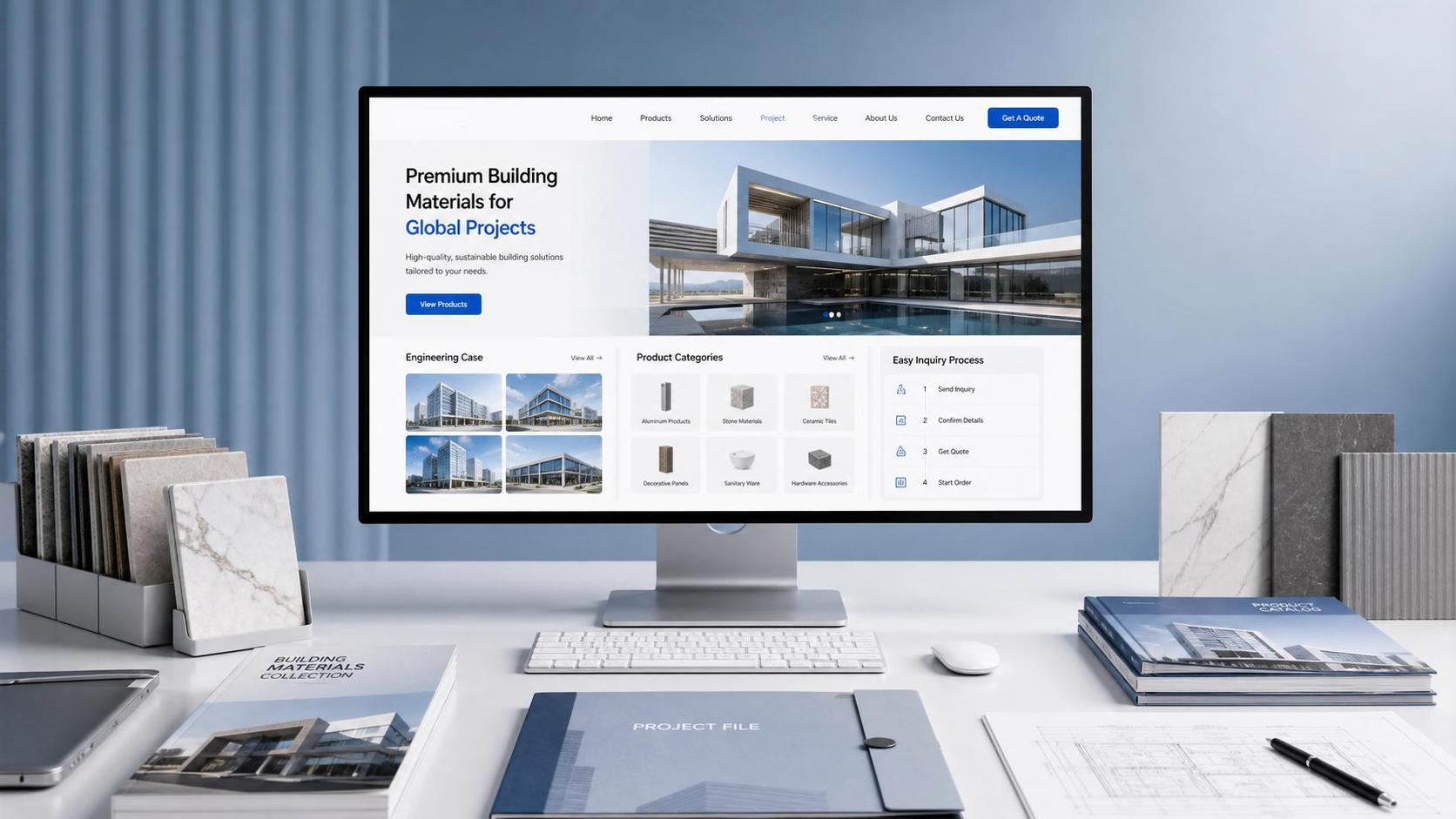


I. Definition and Core Categories of Building Materials Export Websites
A building materials export website is a corporate digital portal designed for overseas buyers, contractors, distributors, design firms, and project owners. Its value lies not only in showcasing the company and its products, but also in converting overseas search, advertising, and social media traffic into trackable inquiries, sample requests, quotation requests, or project communications.
By business model, common types include factory-brand official websites, product catalog inquiry websites, engineering project solution websites, regional distributor support websites, and cross-border online stores for retail customers. Tiles, sanitary ware, doors and windows, panels, hardware, insulation materials, and prefabricated building materials have different requirements for page structure and conversion paths.
By market language, building materials export websites can use an English primary site supplemented by regional-language sites, or establish independent language paths by country. For products with complex specifications and long procurement cycles, the website should serve as a sales resource library, clearly providing models, dimensions, materials, packaging, application environments, downloadable files, and contact channels.
II. Decision-Making Logic of Overseas Buyers and Suitable Businesses
Building materials procurement typically involves performance verification, project suitability, delivery capability, compliance requirements, and after-sales risk assessment. After entering a website, buyers often first confirm whether the products are suitable, then evaluate factory capabilities, quality control, and supply experience, and only then submit an inquiry. Therefore, page information must be organized according to the decision-making sequence.
Manufacturing factories, foreign trade companies, OEM/ODM suppliers, engineering material exporters, and building materials companies seeking to establish their own brands are all suitable for developing building materials export websites. In particular, businesses that rely on trade shows, platform inquiries, or sales prospecting can use websites to accumulate reusable product content and overseas traffic entry points.
Different conversion actions should be configured for different roles. Distributors are more concerned with regional cooperation, minimum order quantities, and product line completeness; engineering customers focus more on technical parameters and project cases; retail customers pay greater attention to prices, delivery times, and usage results. A single unified form cannot cover all requirements, so inquiry fields should be configured according to page scenarios.
III. Website Architecture, Technical Principles, and Key Functions
A building materials export website designed for lead generation typically includes a homepage, product category pages, product detail pages, application solution pages, project case pages, factory and certification pages, knowledge content pages, and a contact page. Navigation should support entry by product, application, material, or industry to reduce buyers' search costs.
Product detail pages should present visual selling points and procurement information in layers: the first screen should explain product uses and core advantages, followed by specifications, performance, colors or surface finishes, packaging, production capacity, instructions for use, and frequently asked questions. For engineering materials, downloadable technical documentation and a clear sample communication path are particularly important.
Technically, responsive pages should be adopted to ensure a consistent browsing and inquiry experience on both desktop and mobile devices; image compression, caching, content delivery networks, and security certificates should be used to improve access stability. Multilingual pages require language paths, page correspondence, and localized titles and descriptions, rather than simply publishing Chinese content after direct machine translation.
IV. Selection Criteria and Marketing Configuration for Building Materials Export Websites
When selecting a service provider, priority should be given to assessing whether it understands the classification logic, specification fields, project-based inquiries, and multilingual maintenance requirements of building materials, rather than looking only at visual templates. Companies should also verify whether the backend makes it easy to update products, articles, materials, and regional pages, avoiding reliance on developers for every content adjustment.
Building materials export websites should reserve capabilities for search, advertising, and social media traffic conversion, including page title and description management, form source tracking, online communication channels, landing page creation, traffic data analysis, and permission management. Product pages and case pages should form internal links, enabling buyers to continue reviewing the corresponding materials and service capabilities based on their application needs.
Yiyingbao provides AI-powered website building, multilingual independent websites, overseas marketing lead generation, and operational growth services, suitable for export companies seeking to centrally manage website development, content, and promotion. Its responsive website-building capabilities, AI-assisted content generation, and global node deployment can serve as reference directions for companies evaluating the coordination of technology and operations for building materials export websites.
V. Post-Launch Operating Cycle, Quality Control, and Future Trends
Website launch is not the end of a project. Companies are advised to check access speed, form availability, indexing status, inquiry sources, and high-traffic pages on a monthly basis; key products, cases, technical articles, and market-language content should be updated quarterly. When launching new products, adjusting specifications, changing packaging, or entering new countries, relevant pages should be revised accordingly.
Content quality control should be completed collaboratively by sales, product, and marketing teams. Sales personnel should add frequently asked customer questions, product personnel should confirm technical parameters, and marketing personnel should standardize wording and page structure. Performance claims relating to fire resistance, waterproofing, weather resistance, and environmental protection should be based on documentation the company can provide, avoiding claims that cannot be substantiated.
In the future, building materials export websites will place greater emphasis on multilingual localization, the integration of short videos and project cases, first-party data accumulation, and Q&A content for generative search. Yiyingbao has launched systems related to multilingual website building and AI-powered foreign trade independent websites. Companies can continuously structure their product knowledge, application solutions, and service processes to enhance the long-term value of content assets.
VI. Total Cost of Ownership, Return on Investment, and Case References
The total cost of ownership of a building materials export website typically consists of planning and design, content organization, multilingual processing, domain names and servers, security maintenance, function expansion, advertising, and ongoing operations. A low-cost launch without product architecture, content maintenance, and data tracking often increases rework and customer acquisition costs during subsequent promotion stages.
When evaluating return on investment, companies should not only measure website traffic, but also focus on the number of qualified inquiries, target-country coverage, cost per inquiry, post-quotation conversion rate, and repeat purchasing opportunities. Companies can first select core categories and key countries to validate the effectiveness of pages and channels, then gradually expand language sites, product lines, and advertising budgets.
Yiyingbao serves industries including machinery, new energy, chemicals, agriculture, healthcare, and furniture, and cites service cases involving Haier, Aucma, Shandong Airlines, and Little Duck Group. For building materials companies, the key value of these cases should lie in content organization, inquiry conversion, and operating mechanisms, rather than simply copying page formats; the final solution must still match their own product categories, markets, and sales processes.
