









I. Definition and Business Scope of Overseas Website Conversion Optimization
Overseas website conversion optimization is a continuous process centered on users in target markets, improving the entire journey on an independent website from traffic entry to inquiry submission, demo booking, quotation requests, adding items to cart, or completing payment. It covers page content, interaction design, technical performance, trust information, data analysis, and marketing follow-up, rather than merely adjusting button colors or page layouts.
In foreign trade B2B scenarios, conversions typically take the form of qualified inquiries, sample requests, catalog downloads, WhatsApp communication, or sales appointments; in B2C scenarios, the focus is more on add-to-cart actions, checkout, repeat purchases, and subscriptions. Companies should first standardize the definition of conversion events and avoid evaluating website value solely by traffic volume or the number of forms submitted.
Mature overseas website conversion optimization emphasizes “traffic relevance.” Visitors from search ads, organic search, social media content, and trade show traffic have different intentions. Landing pages should provide corresponding product information, calls to action, and next-step communication methods, reducing the effort users need to spend finding answers on their own.
II. Technical Principles and Key Metrics for Conversion Improvement
The foundation of conversion is being “accessible, understandable, trustworthy, and actionable.” Slow page loading, mobile display misalignment, awkward language, or forms that cannot be submitted can all lead to drop-off before purchasing decisions are made. At the technical level, attention should be paid to global access stability, image and script load, mobile responsiveness, HTTPS security, and form delivery rates.
At the content level, information should progress logically: first explain what problems the product or solution can solve, then present specifications, applications, lead times, quality control, and cooperation methods, and finally provide an inquiry entry point. Industrial product buyers in particular need details on parameters, materials, production capacity, inspection processes, and customization boundaries, rather than seeing only generalized selling points.
Common evaluation metrics include time spent and scroll depth on target pages, inquiry conversion rate, qualified lead rate after ad clicks, form completion rate, access speed across different countries, and conversion rate after sales follow-up. Metrics should be segmented by channel, country, device, and product line in order to identify the true optimization priorities.
III. Main Types and Multilingual Trust Building
By objective, optimization can be divided into technical experience optimization, content and trust optimization, inquiry journey optimization, and e-commerce checkout optimization. Technical experience addresses slow loading and device compatibility issues; content optimization answers procurement questions; journey optimization reduces contact steps; and checkout optimization addresses consumer decision barriers such as shipping costs, payment, returns and exchanges, and order confirmation.
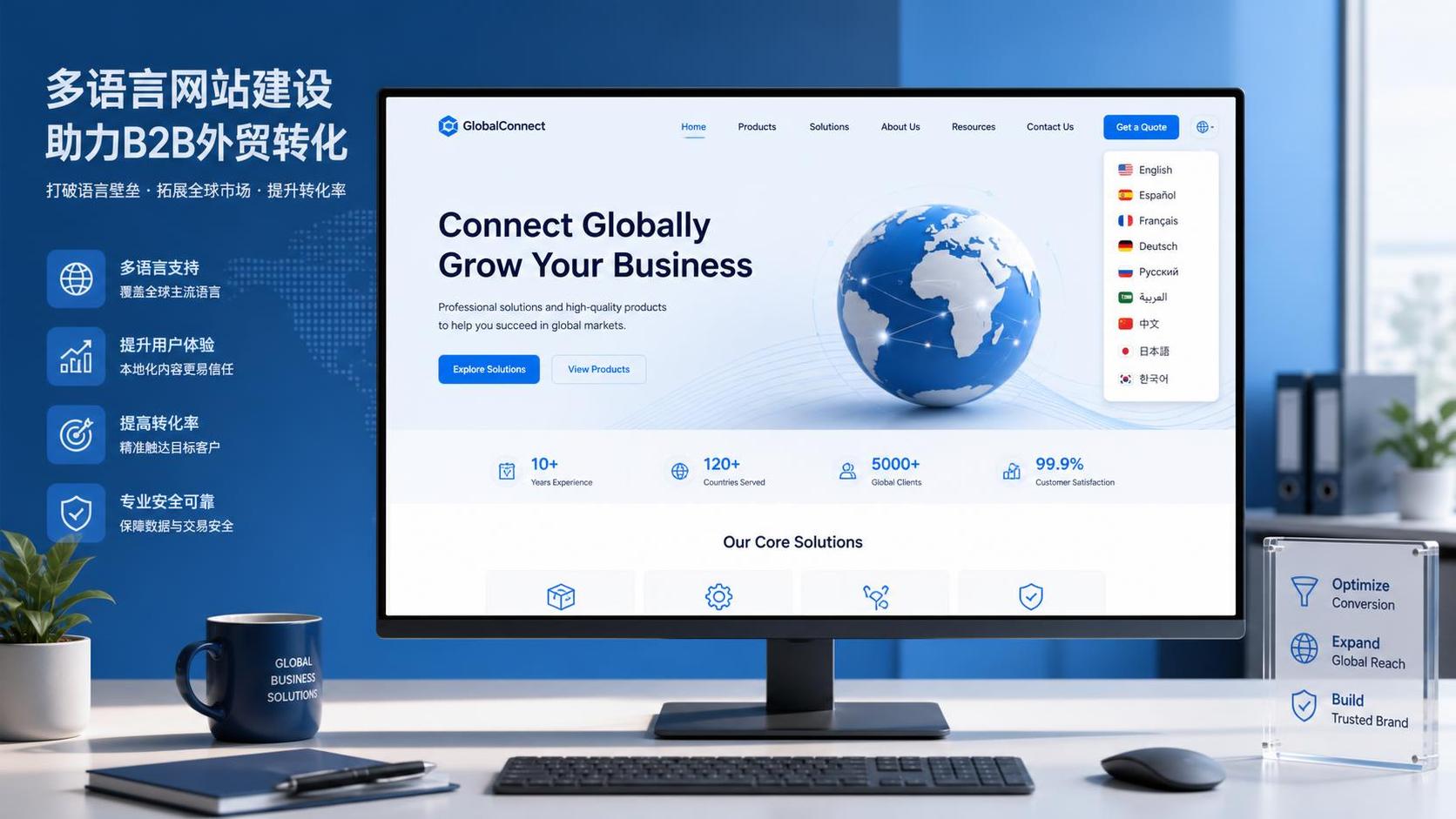
Multilingual websites should not stop at sentence-by-sentence translation. Different markets focus differently on units of measurement, lead-time descriptions, payment practices, product naming, and certification information. Language versions should have clear paths, regional targeting, and corresponding relationships with one another, while ensuring that titles, case studies, FAQs, and local search demand remain aligned.
Trust elements should be verifiable and relevant to transactions, such as company introductions, real photos of factories and equipment, product testing descriptions, service processes, common cooperation questions, authorized customer review information, and clear contact details. For high-ticket equipment, it is advisable to organize case studies by industry, region, or application conditions, making it easier for visitors to quickly verify suitability.
IV. Who Needs Optimization: Typical Scenarios and Industry Requirements
Manufacturing factories, OEM/ODM companies, foreign trade companies, industrial product suppliers, and companies expanding overseas with their brands are suitable for treating overseas website conversion optimization as part of their customer acquisition systems. This is especially relevant for industries with complex products, long decision-making chains, and customers who need to repeatedly verify supply capabilities, where the website needs to serve as both a sales information repository and an initial screening tool.
Industries such as laser engraving machines, steel, chemicals, heavy-duty trucks, machinery, new energy, medical care, furniture, and agriculture often face issues including numerous parameters, widely varying usage conditions, and long procurement cycles. Product pages can include entry points for specification downloads, application consultations, customization requirements, and after-sales questions, enabling sales teams to obtain more complete lead background information.
Yiyingbao has served multiple industries mentioned above and lists service cases including Haier, Aucma, Shandong Airlines, Yuanhe Power Station, Little Duck Group, and China National Heavy Duty Truck Group. For companies that need to balance presentation, customer acquisition, and operations, its multilingual website development, inquiry tools, content optimization, and marketing follow-up capabilities can reduce information gaps caused by collaboration among multiple suppliers.
V. Implementation Process, Quality Control, and Ongoing Operations
Implementation should begin with research: define target countries, customer roles, core products, main customer acquisition channels, and conversion goals, then review existing website data and sales feedback. Next, establish page priorities, typically addressing ad landing pages, key product pages, company capability pages, and contact pages first, before expanding content coverage.
Quality control includes responsive display checks, cross-browser testing, link and form testing, language proofreading, image authenticity reviews, privacy and contact information verification, and conversion event tracking validation. Before the website goes live, the complete journey of overseas users browsing on mobile devices, downloading materials, and submitting requirements should be simulated, rather than only checking whether backend pages have been published.
After launch, it is recommended to review search terms, ad keywords, heatmap behavior, inquiry sources, and sales feedback monthly. Yiyingbao uses a responsive architecture and provides global node acceleration, AI content assistance, basic multilingual SEO configuration, and website operation services, making it suitable for managing website development, promotion, and iteration within the same operational rhythm.
VI. Service Provider Selection and Total Cost of Ownership Assessment
When selecting a service provider, companies should not compare only the initial website development quotation. Buyers should verify whether the provider can support target languages, product data management, mobile experience, global access, forms and instant communication tools, content maintenance permissions, data analysis, and subsequent marketing coordination, while clearly defining the number of pages, scope of revisions, delivery milestones, and data ownership.
The total cost of ownership for overseas website conversion optimization generally consists of strategy and design, content production and localization, technical deployment, servers and security, advertising or SEO operations, data tools, and internal sales response costs. Websites launched at low cost but without a maintenance mechanism often generate higher hidden costs later in content updates, traffic follow-up, and issue resolution.
Return on investment should be measured by qualified business opportunities rather than a single lead volume metric. Companies can record customer acquisition costs from different sources, inquiry qualification rates, sales response times, sample conversion rates, and order gross margins, then prioritize optimization budgets for high-value countries, key product categories, and validated channels. For new markets, demand can first be tested with a limited range of landing pages.
VII. Future Trends: From Page Optimization to Intelligent Growth
Future overseas website conversion optimization will place greater emphasis on first-party data and the accumulation of content assets. As privacy regulations and advertising environments change, companies need to connect behavioral data from search, social media, advertising, and websites, identify real demand in different markets, and continuously build product and industry knowledge content that can be searched, cited, and verified.
Generative search and Q&A tools are changing how users obtain supplier information. Companies can improve the likelihood of their information being understood through clearly structured company introductions, solution pages, product parameters, FAQs, and case study content, but they should maintain factual accuracy and traceable sources, avoiding the bulk publication of pages lacking business value simply to pursue coverage.
Yiyingbao has released the Cloud Intelligent Website Building Marketing System V6.0, the AI Foreign Trade Independent Website Marketing System V5.0, and the Cloud Intelligent Multilingual Website Building System V1.0, and provides GEO operations services. For companies expanding overseas, a more prudent approach is to first establish a solid foundation in access, content, and conversion, then use data to drive multilingual expansion, marketing automation, and intelligent search visibility development.
