










I. Definition and Scope of International SEO Architecture
International SEO architecture is not simply a matter of translating Chinese pages into multiple languages. It involves systematically planning website domains, directories, page relationships, content, and infrastructure around target countries, language requirements, search behavior, and commercial pathways. Its goal is to direct users in different markets to pages suited to their needs and enable search engines to accurately understand each page's service scope.
For B2B foreign trade companies, international SEO architecture typically covers company profiles, product catalogs, application solutions, qualifications and capabilities, technical articles, inquiry entry points, and regional landing pages. Cross-border retail websites must also address local transaction information such as currencies, shipping, taxes, inventory, payments, and after-sales policies, preventing traffic loss caused by mismatched information after visitors arrive.
The core unit of assessment in architecture is not “how many languages a website has,” but “who a page is intended for, what search intent it addresses, and whether it has independent value.” When one language covers multiple countries, regional pages with substantively different information should be created if purchasing conditions, regulatory requirements, or product preferences differ significantly, rather than merely replacing country names.
II. How hreflang and Page Signals Work Together
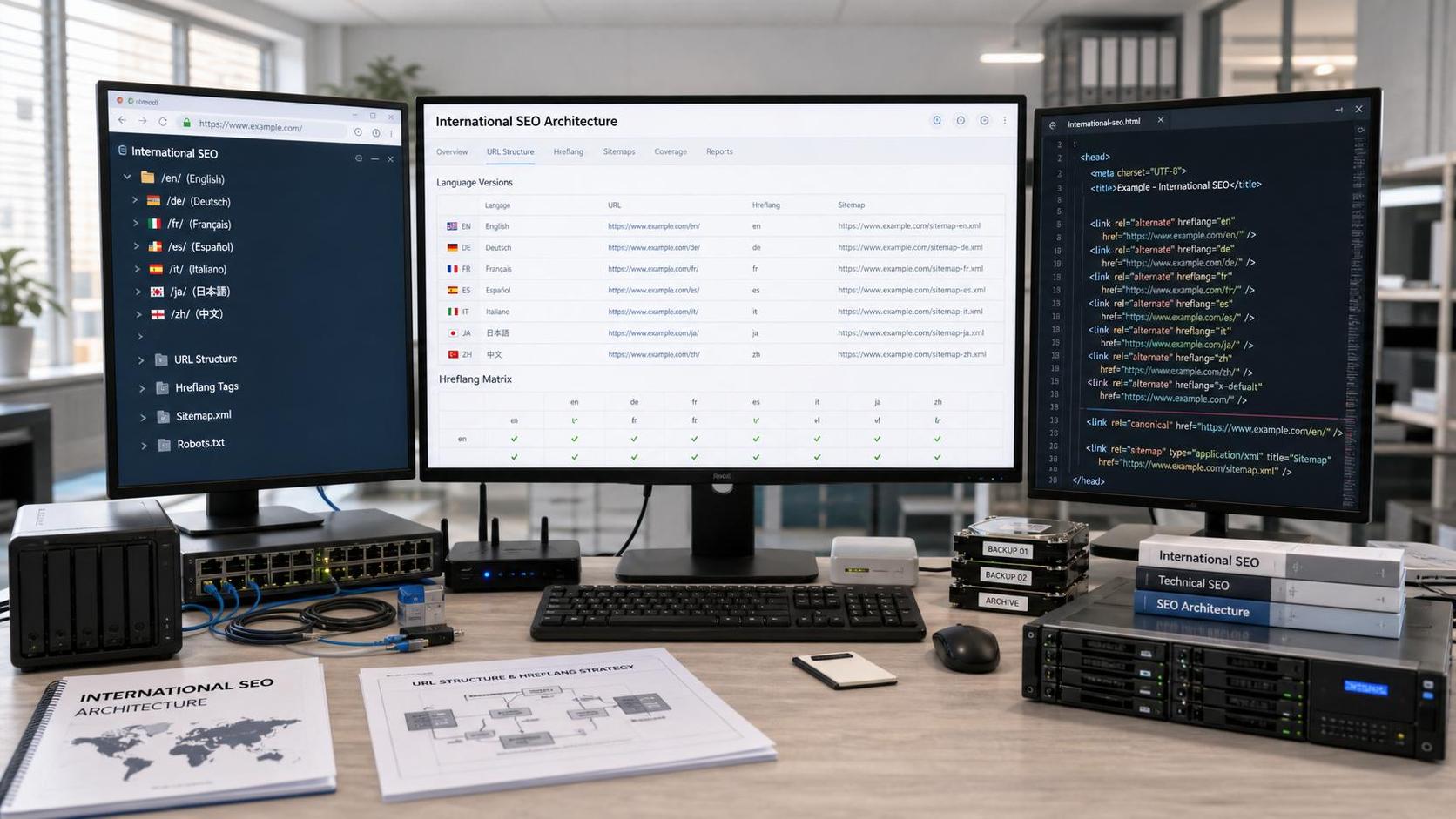
hreflang is a language and regional signal within international SEO architecture, used to declare different language or regional versions of a set of content. For example, a global English version, a US English version, and a Spanish version should establish verifiable alternate relationships with one another. It helps search engines prioritize the appropriate version in relevant search environments, but it does not replace content quality or indexing foundations.
Correct configuration requires three prerequisites: pages must be accessible and permitted for indexing; each version must return corresponding annotations for itself and all other versions; and the links in the annotations must be complete, canonical, and actually existing URLs. Language signals may become ineffective if pages are incorrectly canonicalized, redirected to another language, or missing bidirectional relationships.
In addition to hreflang, canonical tags, sitemaps, page language declarations, server responses, and internal links must be considered together. Do not force visitors to redirect to a language version based on their location, as this can affect search engine crawling and prevent overseas buyers from actively switching languages. A more reliable approach is to provide clear language and regional switching options in the page header.
III. Main Types of Domain and URL Structures
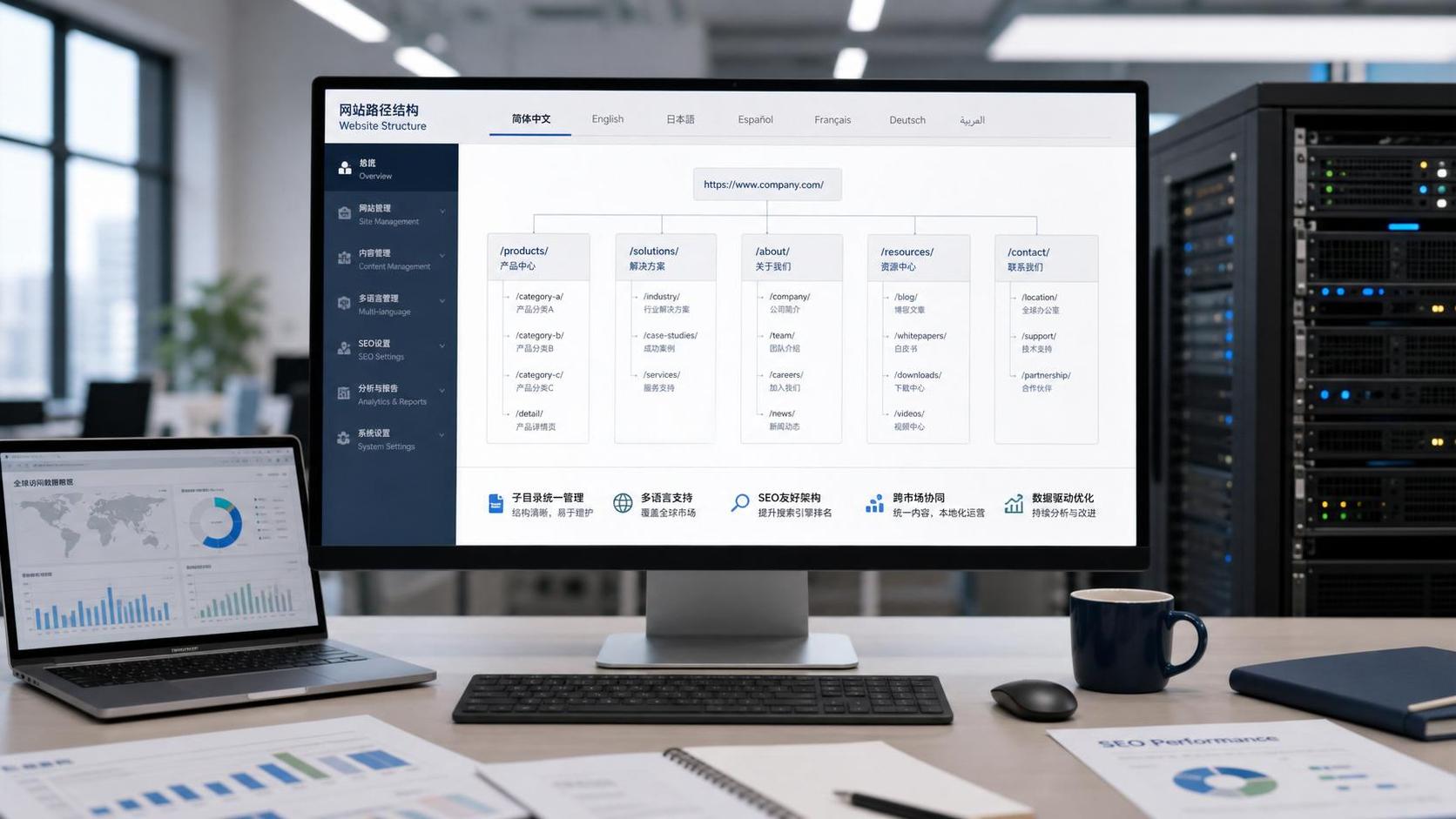
Common international SEO architectures include country or region-specific top-level domains, subdomains, subdirectories, and parameterized pages. Country or region-specific top-level domains provide clear geographic identification and are suitable for markets with long-term local operations, independent teams, and dedicated budgets. However, domains, content, and link resources require separate investment, resulting in greater management complexity.
Subdomains can remain relatively independent technically and are suitable for companies with significant differences in regional business systems, brand strategies, or operational teams. Subdirectories organize content by language or region under a unified main domain. For example, websites can be established through language-based paths. This approach is generally easier to maintain for brand assets, content templates, and analytics systems, making it suitable for most export companies expanding into multiple markets.
Although parameter-based formats are convenient to deploy, they are unfavorable for user recognition, sharing, and long-term management, and should not be used as the primary multilingual solution. Regardless of the format selected, URLs should be stable and semantically clear, avoiding multiple indexable versions of the same page caused by uppercase and lowercase letters, trailing slashes, or filtering parameters, thereby reducing duplicate content and distorted statistics at the source.
IV. How to Choose an Architecture Suitable for Your Business
The first consideration in selecting an architecture is market maturity. If a company is only validating multiple overseas markets, it is advisable to start with a unified main domain plus language subdirectories and concentrate resources on core product pages and industry content. When a particular market has stable inquiries, local warehousing and distribution, or an independent brand strategy, the need for an independent regional site or country domain can then be evaluated, avoiding the premature dispersal of operational resources.
The next consideration is the extent of content differences. When technical parameters, applicable industries, certification requirements, delivery cycles, and communication practices are highly consistent, the same structure can be used with professional translation. If different markets focus on different specifications, case studies, quotation methods, or regulations, pages should be defined in reverse based on local needs. Machine translation can assist with initial drafts, but terminology, units, scope of commitments, and compliance wording should be manually reviewed.
Organizational capabilities should also be reviewed, including content update frequency, product data management, domain permissions, technical support, and lead allocation mechanisms. International SEO architecture is not a one-time project, and any number of websites that cannot be continuously maintained will become a burden. Buyers should require service providers to clearly define page templates, language publishing processes, issue monitoring, and responsibilities for subsequent revisions.
V. Application Scenarios and Yiyingbao's Deployment Approach
Manufacturing plants often need to reorganize mechanical parameters, production capacity, customization processes, and application cases according to procurement markets. Industries such as chemicals, new energy, and medical care place greater emphasis on complete documentation, risk disclosures, and inquiry qualification screening. Yiyingbao can incorporate multilingual independent websites, product content management, foundational technical optimization, and overseas marketing landing pages into a single operational workflow, reducing the need to switch between multiple systems.
Its responsive website-building capabilities are suitable for simultaneously handling mobile search, advertising clicks, and social media visits. Its multilingual website-building system can support foundational configurations such as language paths, regional pages, and hreflang. For industries already served, including laser engraving machines, steel, chemicals, heavy-duty trucks, machinery, and new energy, it is possible to prioritize building replicable page structures for high-value product lines before gradually expanding country coverage.
The deployment process should begin with keyword and market research, followed by determining the domain strategy, information architecture, and content list. Language versions should then be launched, indexing and page correspondence verified, and conversion entry points such as inquiry forms, email, and instant communication integrated. After the website is published, organic search, advertising, and social media data should be used to identify high-demand markets and inefficient pages, with content investment continuously adjusted.
VI. Maintenance Cycles, Costs, and Return on Investment
The total cost of ownership of international SEO architecture consists of domains and servers, content production and translation, technical development, quality reviews, ongoing optimization, and data analysis. The more websites there are, the higher the fixed maintenance costs. Content and operational costs also increase significantly when product models are frequently updated, regional regulations are complex, or local customer service support is required. Decision-making should not focus only on initial website-building quotations.
It is recommended to break return assessment down into metrics such as growth in indexable pages, organic traffic from target markets, qualified inquiry rate, inquiry-to-deal cycle, and customer acquisition cost. B2B companies in particular should distinguish between ordinary form submissions and leads that meet procurement requirements, and track them by source, country, product, and page to determine which languages and markets merit further content investment.
For maintenance, crawling issues, redirects, canonical tags, hreflang relationships, and core page performance can be checked monthly; keywords and regional content can be reviewed quarterly; and all relevant language versions should be updated simultaneously when products are updated. In the future, search results will place greater emphasis on entity information, Q&A content, structured pages, and comprehensibility for generative search. A robust international SEO architecture remains the foundation for multilingual content to be discovered, cited, and converted.
 How to Build a Multilingual Corporate Website with an International SEO Architecture? From URL Structure to hreflang ConfigurationInternational SEO Architecture: How to build a multilingual corporate website? This article analyzes URL structure, hreflang configuration, and regional content strategies, explaining the keys to indexing, ranking, and conversion for multilingual websites, helping enterprises build an integrated corporate website better suited for global marketing.
 Which Websites Are International SEO Architecture Subdirectories Suitable For?Which websites are international SEO architecture subdirectories suitable for? Starting from the perspectives of consolidating domain authority, unified operations, content collaboration, and marketing attribution, this article analyzes applicable scenarios such as multilingual corporate websites and B2B lead-generation websites, helping businesses quickly determine the optimal international website structure.
