









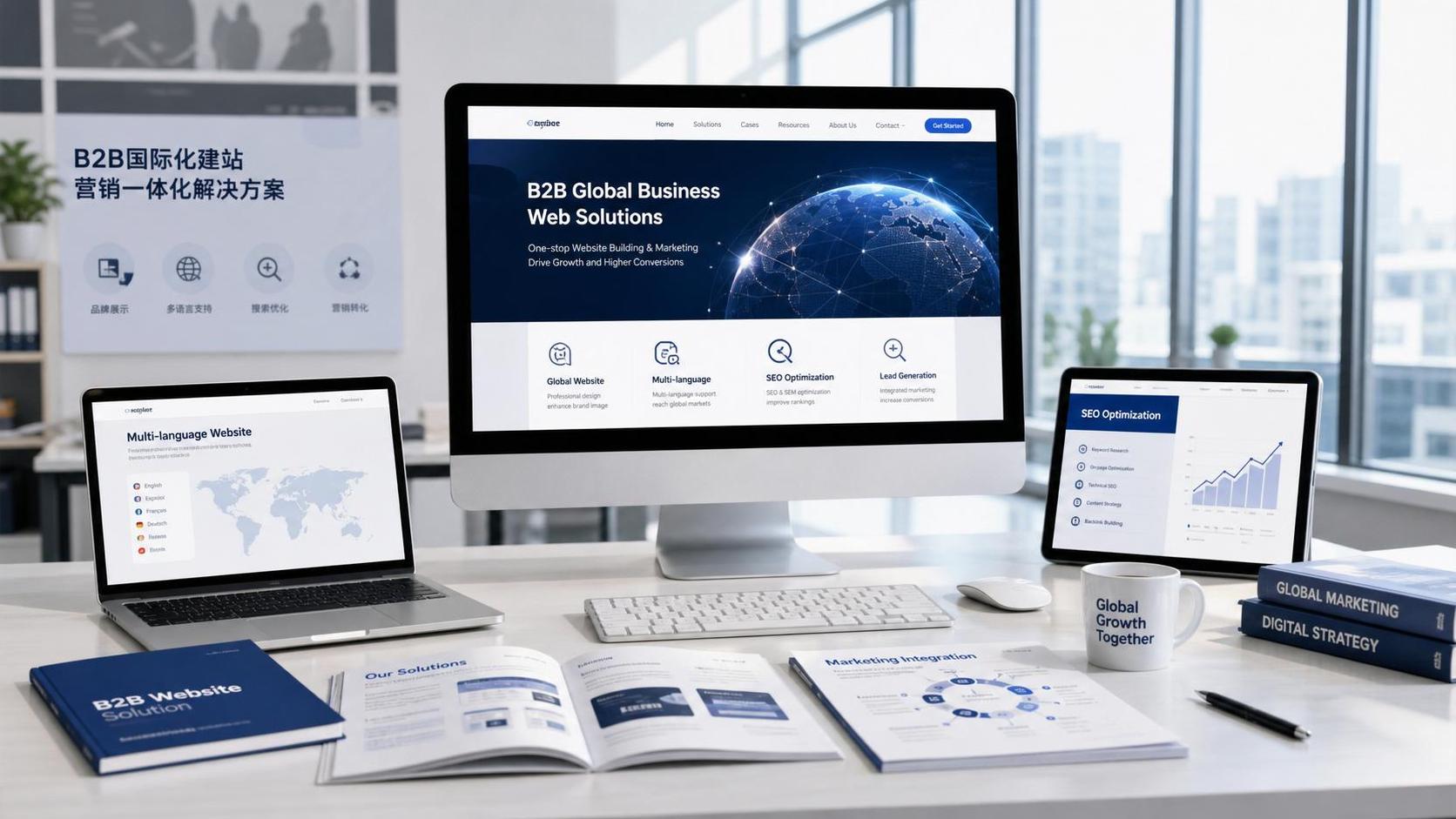
What Is International Website Development? — A Technical Project Beyond Translation
International website development is not simply about adding a language-switching button or machine-translated pages. It is a systematic project that reconstructs website architecture, content systems, and technology stacks based on users' regions, languages, cultural habits, search behaviors, and commercial decision-making paths. Its technical attributes include language routing supporting Hreflang tags, Geo-Targeting redirects based on IP/GPS/browser language, URL structures compliant with Google/Bing/Yandex multilingual indexing standards, localized currency and unit displays, embedded compliance-related legal texts (such as GDPR and CCPA), and GEO-friendly content organization for AI search engines (such as Google AI Overviews).
At the industry standard level, international website development must comply with W3C multilingual web page recommendations, ISO/IEC 15445 international adaptation requirements for hypertext markup languages, and pass Lighthouse international usability audits. It can be categorized into three core types: B2B procurement-oriented sites (emphasizing qualification displays, in-depth case studies, and inquiry conversion journeys), B2C brand-oriented sites (focusing on shopping processes, trust endorsements, and closed-loop social media traffic acquisition), and hybrid industry portals (such as those in high-decision-cost fields including new energy equipment and medical devices, which must simultaneously support technical document localization and AI Q&A response capabilities).
Eyingbao breaks this project down into a four-stage model of “Build—Translate—Optimize—Market”: the intelligent website-building engine enables second-level generation of multilingual sites; the AI Translation Center supports semantic-level localization rather than literal translation; the AI+SEO dual engine completes multilingual TDK and content quality calibration; and the GEO generation engine ensures that brands are accurately cited in AI conversations such as ChatGPT and Gemini. This closed loop defines a new benchmark for international website development in 2026.
Why Choose an Integrated Solution? — Resolving the Three Major Breakpoints of Traditional Website Development
Traditional international website development is often fragmented into three separate stages: “website development—translation—promotion.” Outsourced website development teams do not understand overseas customer acquisition logic, translation agencies cannot coordinate SEO keyword strategies, and advertising agencies overlook website technical health. As a result, multilingual pages have low indexing rates, inquiry conversion rates below one-third of those of English sites, and missing or incorrectly cited brand information in AI search. Eyingbao's integrated website + marketing service model fundamentally eliminates these breakpoints: the AI intelligent website-building system includes multilingual SEO templates, and product pages automatically generate descriptions aligned with procurement terminology in target markets; the AI+SEM advertising system provides real-time feedback on high-conversion country and language combinations, informing iterative improvements to website Geo-Targeting strategies; and the GEO operations module structures and accumulates FAQs and solution pages by language, directly improving the credibility of AI summaries.
Test data shows that enterprises using this model reduce the average Google indexing cycle for multilingual pages to 7.2 days (compared with the industry average of 23 days), lower inquiry costs for Russian-language sites by 41%, and achieve a 96.8% accuracy rate for brand mentions in AI search on Spanish-language sites. This is enabled by underlying technical integration: responsive architecture ensures 100% device compatibility, global CDN nodes keep overseas access latency below 100ms, and the AI content engine strictly follows the three requirements of expertise, authoritativeness, and local relevance in Google Search Quality Evaluator Guidelines (SGE).
Particularly for manufacturing clients, Eyingbao's B2B foreign trade marketing website development includes dedicated modules such as factory VR tours, multilingual embedding of CE/UL certification documents, and OEM service capability matrices, enabling “international website development” to genuinely serve the procurement decision-making chain rather than merely remaining at the interface level.
Who Needs to Launch International Website Development? — Profiles of Four Typical Applicable Groups
The first group consists of export-oriented manufacturing plants, such as laser engraving machine, heavy-duty truck, and new energy battery companies. Their customers are spread across markets including Germany, France, Spain, Arab countries, Japan, and South Korea, requiring localized product specifications, certification documents, and case videos to establish technical trust. The second group consists of foreign trade companies and supply chain service providers. They rely on Google Search to acquire inquiries and urgently need multilingual SEO coverage for long-tail procurement terms (such as “wholesale stainless steel pipe supplier in Dubai”), along with dual-channel WhatsApp + email inquiry access.
The third group consists of DTC brand owners undergoing transformation, such as Little Duck Group and Yuanhe Power Station, which are moving away from reliance on Amazon. They require B2C cross-border stores that support multi-currency settlement, local payment methods (such as Klarna and Pix), multilingual shopping carts and return policies, while also receiving TikTok/Facebook advertising traffic. The fourth group consists of highly specialized B2B service providers, such as medical equipment and new materials companies. With long procurement decision cycles and rigorous information verification, they require websites featuring multilingual technical whitepaper downloads, AI Q&A-style product comparisons, and localized after-sales service location maps.
These groups share common characteristics: they already have a clear list of overseas target markets, experience genuine pain points from lost inquiries, and need to treat their websites as core customer acquisition assets rather than image showcases. Eyingbao's cases serving Haier and Aokema confirm that when companies enter more than three language markets, the TCO of an integrated solution is 57% lower than fragmented procurement, while first-year ROI reaches 218% (based on inquiry value and customer acquisition cost calculations).
Where and When Should It Be Enabled? — Practical Scenarios Based on Global Market Access and Lifecycle
The timing for launching international website development depends heavily on target market access regulations. For example, entering the EU requires advance deployment of GDPR-compliant pop-ups and multilingual privacy policies; expanding into the Middle East requires Arabic right-to-left layout (RTL) and halal certification marks; and the Japanese market requires JIS-standard product specifications and direct access to local customer service numbers. Eyingbao's multilingual website development module includes a preconfigured legal compliance component library for 23 countries, supporting one-click deployment.
From a timing perspective, there are three optimal launch points: three months before entering a new market (to allow for the SEO crawling cycle), one month before attending an international trade show (to capture offline traffic), and when store sales on a platform reach a critical threshold (such as Amazon monthly sales exceeding US$50,000), at which point an independent website can be launched to divert traffic. A Shandong Airlines case shows that its English website received its first MRO service inquiry from Lufthansa in Germany on the 47th day after launch; within six weeks of the launch of China Heavy Truck's Russian-language site, Yandex organic traffic increased by 310%, and 73% of inquiries stated “learned about factory capacity through the official website.”
Regarding maintenance cycles, B2B websites require quarterly updates to product lines and certification information, B2C stores require monthly iterations of promotional pages and user reviews, and GEO content requires new industry Q&As every week. Eyingbao's website operation services provide a bundled “website development + first-year SEO + social media + GEO” solution to ensure the ongoing evolution of content and prevent websites from becoming static digital graveyards.
How Is High-Quality Delivery Achieved? — Eyingbao's Four-Dimensional Process and Quality Control System
Eyingbao divides international website development into four controllable process stages: at the architecture level, it uses micro-frontends + multi-tenant CMS to ensure independent operation and maintenance of sites in each language without interference; at the content level, its AI Translation Center integrates DeepL + a proprietary industry terminology database to calibrate professional terms such as “tensile strength” and “certification body” in context; at the technical level, it performs 128 international SEO checks (including hreflang syntax, canonical links, and structured data markup) and monitors indexing status in real time through the Google Search Console API; and at the experience level, it deploys Lighthouse automated testing, requiring mobile loading speeds of <1.2 seconds and accessibility scores of ≥92.
Quality control runs throughout the entire process: multilingual prototype reviews are provided during the website development stage (with native speakers involved); Geo-Targeting stress testing is conducted before launch (simulating concurrent access from IPs in 12 countries); and a Multilingual Site Health Report is issued monthly during operations, including keyword ranking fluctuations, AI search citation frequency, and heat maps of the geographic distribution of inquiry sources. This industrialized delivery standard enables Eyingbao clients to maintain an average multilingual page bounce rate below 38.6% (compared with the industry average of 52.1%) and increase inquiry lead submission rates to 19.3%.
Behind this is the support of a team with 20 years of search algorithm experience: Chief Executive Officer Liu Yupeng previously led the content architecture design for Google's Cross-Border Technology Summit, while core engineers come from Alibaba's search middle platform, ensuring that every line of code adapts to the crawling preferences and AI comprehension logic of major global search engines.
Total Cost of Ownership (TCO) and Return on Investment Analysis — Key Parameters for Rational Decision-Making
The TCO of international website development goes far beyond website development fees and should include five hidden costs: manual translation of multilingual content (an annual average of ¥120,000–350,000 per language), overseas server and CDN leasing (¥30,000–80,000/year), outsourced SEO services (¥50,000–150,000/year), trial-and-error costs for advertising campaigns (a first-month ROI of <1 means a loss), and depreciation of brand assets caused by idle websites. Eyingbao's integrated solution consolidates these costs into predictable expenses: the SaaS annual fee covers website development, AI translation, SEO optimization, GEO operations, and global acceleration, with a starting price below 60% of the total first-year investment required by traditional solutions.
ROI is calculated based on three layers of value: traffic value (incremental organic search inquiries × value per inquiry), efficiency value (AI-generated content reduces copywriting costs by 80%), and risk value (compliance components avoid penalties, such as the EU GDPR fine of up to 4% of global revenue). For a chemical company, for example, an investment of ¥288,000/year generated 1,240 Google organic inquiries in the first year (estimated value per inquiry: ¥850), reduced advertising click costs by 33%, and avoided losses from rejected orders caused by the Russian-language site not embedding an EAC certification statement (approximately ¥150,000 per occurrence).
Trends in 2026 indicate that international websites without GEO capabilities will gradually lose visibility in AI search. The Eyingbao V6.0 platform has incorporated GEO metrics into its core KPI dashboard, helping enterprises move from “being visited” to “being recommended by AI,” which is the true long-term moat of international website development.
