









I. Industry Definition and Scope of Development
Photovoltaic new energy foreign trade website development refers to the creation of marketing and information platforms for photovoltaic module, inverter, energy storage system, mounting structure, cable, and project service companies serving overseas markets. Such websites must clearly present products while addressing buyers' assessments of technical capabilities, delivery, compliance, production capacity, and after-sales service.
Compared with ordinary corporate websites, their core task is to capture visits generated by search, advertising, social media, and trade shows, guiding anonymous traffic toward model inquiries, solution discussions, sample requests, or project quotations. The website should serve the sales funnel rather than remain limited to company news and image displays.
The development scope usually includes multilingual websites, product catalogs, technical documentation, solution pages, factory and quality pages, inquiry channels, data analytics, and ongoing content operations. As B2B projects have long cycles, page information must support multiple rounds of customer comparison and internal decision-making.
II. Technical Information Architecture for Procurement Decisions
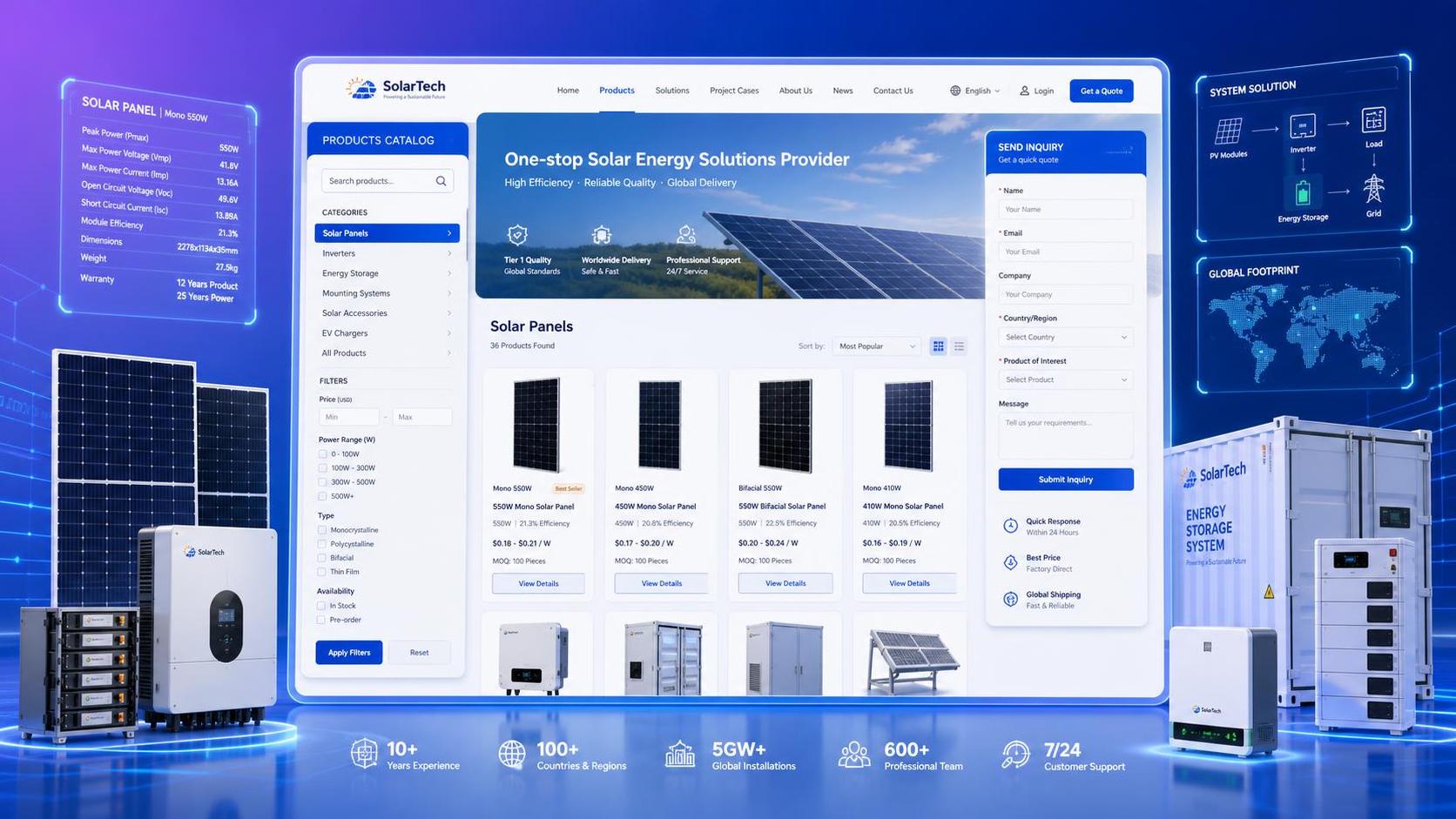
Product pages are the core units of photovoltaic new energy foreign trade website development. They should be categorized by application, power or capacity, installation method, and market region, rather than simply listed by internal product lines. Clear filtering and related recommendations can reduce the time buyers need to identify suitable models.
Each key model should be equipped with specifications, structural or system descriptions, application scenarios, optional configurations, packaging and delivery information, and document download links. Technical parameters should use consistent units and field names to avoid inconsistencies across pages that may affect customers' side-by-side comparisons.
For energy storage, inverters, and system solutions, it is not enough to emphasize selling points. The applicable boundaries, supporting requirements, and data needed for communication should also be explained, such as installation environment, electricity demand, project scale, and target market. This helps screen inquiries with greater follow-up value.
III. Main Website Types and Suitable Users
Manufacturing plants are suited to brand websites combined with product catalogs, highlighting R&D, production lines, quality management, customization capabilities, and export experience. Trading companies should strengthen their supply chain integration, delivery schedule coordination, and multi-category services, avoiding the use of the same narrative for different business roles.
Companies serving engineering contractors and distributors can add solution pages for residential, commercial and industrial, and utility-scale power stations, connecting modules, inverters, mounting structures, and energy storage products through system logic. Brand websites targeting end consumers require more complete product, pricing, shopping, or quotation request journeys.
A multilingual website is not simply a replicated translation. English can serve as the language for the core market, while Russian, Japanese, Korean, Arabic, French, German, or Spanish pages should be prioritized based on product terminology, search habits, and business priorities in target countries.
IV. Search Visibility and Internationalization Standards
Photovoltaic new energy foreign trade website development requires keyword matching with page intent first. Procurement-oriented terms are suitable for product or solution pages; knowledge-oriented terms are suitable for technical articles and FAQ pages; and brand and corporate capability terms should be covered by company, factory, and case study pages.
Internationalization fundamentals include dedicated language paths, accurate language and region labels, crawlable links, standardized page titles and descriptions, and responsive structures suitable for mobile reading. Images, parameter tables, and downloadable materials should also have clear semantics to avoid becoming barriers to search and access.
At this stage, Yiyingbao can provide multilingual independent websites, AI-assisted content generation, and technical optimization capabilities, supporting the continuous expansion of product pages, article pages, and regional pages. Its responsive architecture and global node deployment capabilities are suitable for evaluation by export companies that prioritize overseas user experience.
V. Methods for Inquiry Conversion and Trust Building
High-conversion pages should enable customers to naturally find the next step while reading, such as obtaining model selection recommendations, submitting project requirements, requesting catalogs, or contacting sales. Form fields should not be overly long, but should retain basic qualifying information such as country, product requirements, estimated quantity, and contact details.
Channels such as WhatsApp, email, and online customer service should remain consistently visible on key pages and complement forms. For project-based procurement, forms can be set up to collect project requirements; for standard products, information such as model, quantity, and destination port can be prioritized to improve subsequent response efficiency.
Trust-building content should be based on verifiable facts, including company profiles, production capacity, quality processes, service scope, technical documentation, and industries served. Yiyingbao's public information shows that its service experience covers industries such as new energy, machinery, chemicals, and automobiles, providing a reference for cross-industry overseas website operations.
VI. Solution Selection, Delivery, and Total Cost of Ownership
When selecting a service solution, companies should not compare only homepage visuals or one-time quotations. They should also review the convenience of content management, multilingual maintainability, product quantity scalability, page speed, data ownership, permission management, and ongoing operational support to avoid repeated redesigns after launch.
Total cost of ownership typically consists of domain names and servers, design and development, document organization, multilingual content, technical optimization, advertising landing pages, content updates, and data analysis. If low initial costs result in high maintenance burdens or an inability to capture promotional traffic, long-term investment may not be lower.
It is recommended to divide launch into five steps: information organization, website development, content verification, testing and publishing, and operational iteration. Return on investment should be measured by the number of qualified inquiries, inquiry quality, organic traffic, conversion rates of key pages, and sales follow-up results, rather than website visits alone.
VII. Maintenance Cycles and Future Trends
After website publication, indexing, traffic sources, popular pages, inquiry paths, and broken links should be checked monthly; key products, project solutions, articles, and market pages should be updated quarterly. When product specifications, delivery policies, or target markets change, content that affects procurement decisions should be updated first.
Future photovoltaic new energy foreign trade website development will place greater emphasis on multilingual content governance, structured product data, coordination between short videos and social media, and the accumulation of question-and-answer knowledge for generative search. AI can improve first-draft efficiency, but technical facts, market messaging, and compliance information still require company review.
Yiyingbao has released versions related to its cloud intelligent website development marketing system, multilingual website development system, and AI foreign trade independent websites, and provides website development, search optimization, advertising, social media, and website operation services. For companies lacking overseas digital marketing teams, integrated services help reduce the cost of coordinating multiple suppliers and maintain data continuity.
