
I. Core Definition & 3 Strategic Values of Google Ads Policies
1. Authoritative Definition of Google Ads Policies
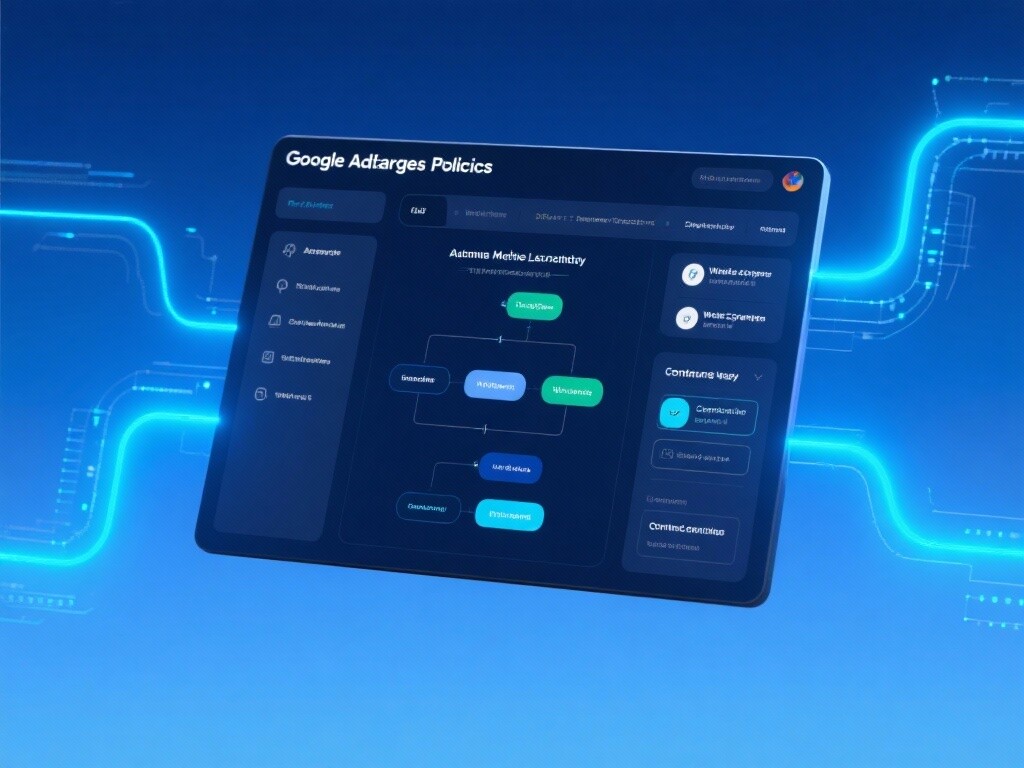
**Google Ads Policies** are a series of rules and standards established by Google to ensure ads are **safe, transparent, and relevant** to users. These policies cover **prohibited content, prohibited practices, restricted content**, and **editorial & technical requirements** across four main areas. Any ad series, ad copy, keywords, or landing pages must pass these policy reviews before going live.
2. 3 Strategic Values of Policy Compliance
Strict adherence to **Google Ads Policies** is not just an obligation but a strategic means to enhance ROI:
- **Client Safety & Continuity:** Compliance is the only safeguard against **account suspension or permanent bans**, ensuring business isn’t disrupted by sudden policy risks.
- **Improving Ad Quality Scores:** Policies encourage high-quality content and positive user experiences. Compliant landing pages typically achieve **higher landing page experience scores**, directly boosting ad quality scores.
- **User Trust & Brand Professionalism:** Avoiding false claims and poor experiences can **significantly increase user trust**, indirectly improving conversion rates and brand image.
3. Evolution & Trends of Google Ads Policies
Early stage (2000s): Policies were relatively lenient, mainly focusing on **illegal content**. Mid-stage (2010s): Policies became more detailed, introducing **financial services, healthcare**, and other restricted content. Modern era (2020s-present): Policies now emphasize **highly automated, AI-driven reviews**, focusing on **false claims, dishonest behavior, user data privacy**, and **landing page experience**. Policy updates occur more frequently, requiring advertisers to **continuously learn and quickly adapt**.
II. 5 Core Technical Principles of Google Ads Policies: Automated Review & Risk Control
Google’s ad review isn’t purely manual; its core lies in a complex AI-driven automated detection system:
1. Machine Learning (ML) Detection Principle
Principle: Google uses ML models to **initially scan** all **new ads, keywords, and landing pages**. Technical application: Models are based on **historical violation data, sentiment analysis, image recognition**, etc., to judge policy violations in real-time. Most common violations (e.g., **profanity, misleading clicks**) are caught by ML models **within hours**.
2. Website Crawler Deep Review Principle
Principle: Google’s crawlers aren’t just for SEO indexing but also ad reviews. Technical application: Crawlers deeply analyze **landing page content, privacy policies, contact methods, form functionality, and user experience (CWV)**. **Landing page compliance** is a **technical determinant** for ad approval.
3. Ad/Landing Page Content Consistency Principle
Principle: **Promises and pricing** in ad copy must **fully match** the **actual content** on landing pages. Technical application: The system **automatically compares** ad and page **keywords, pricing numbers, promotional descriptions**. Inconsistencies are flagged as **"misleading/false claims"**, severely impacting ad quality scores.
4. Malware & Data Security Scan Principle
Principle: Ensure landing pages don’t contain **malicious code, viruses, or trojans**. Technical application: Google’s system conducts **security threat scans**, including checks on **third-party scripts and redirects**. Any security risks lead to **"dangerous content"** violations and immediate account suspension.
5. Client History & IP Association Risk Control Principle
Principle: For repeat violators or policy circumvention attempts, the risk system performs **client correlation analysis**. Technical application: The system tracks **IP addresses, payment info, domain registrants, device fingerprints**, etc. If **penalty evasion** is detected, it’s flagged as **"circumventing systems"**, resulting in **permanent bans**.
III. 4 Technical Features & Practical Applications to Avoid Policy Risks
1. Technical Feature: Full Transparency of Landing Pages
Feature: **Compliant landing pages** must include clear, accessible **legal info**. Application: Ensure pages have **explicit privacy policies, T&Cs, refund/return policies**, with these links **prominently placed**. For pages collecting user data, **clearly state data usage purposes**.
2. Practical Application: Authorization & Certification for Restricted Content
Practice: For **restricted content** (e.g., gambling, financial tools, medical products), **pre-approval authorization** is mandatory. Application: Before running related ads, submit **necessary documentation, licenses** to Google. **Unauthorized placements** are **high-risk behaviors** leading to bans.
3. Practical Application: Avoiding Technical Pitfalls of "Dishonest Behavior"
Practice: Avoid any techniques that could be seen as **"circumventing systems" or "false advertising"**. Application: Don’t use **cloaking, hidden redirects, or pre-filled forms**. Ensure the post-click page is **fully consistent and functional** with the reviewed version.
4. Practical Application: Client Structure & Geographic Isolation
Practice: Set up **independent ad accounts or MCC structures** for different products/businesses with varying compliance risks. Application: If a business has higher violation risks, **isolate it from core operations** to **protect core accounts and business continuity** if penalties occur.
IV. Policy Violation Responses & SEO Synergy Strategies

1. Standard Response Process for Policy Violations
Response: Upon receiving a violation notice, immediately: **1) Pause all related ads**; **2) Thoroughly audit and fix all violations** (including landing page tech/legal text); **3) Submit detailed appeals and repair explanations** to Google; **4) Never resubmit unrepaired ads**, as this may lead to permanent bans.
2. SEO & Landing Page Compliance Synergy
Synergy: **SEO optimization for ad landing pages naturally ensures compliance**. Ensure landing pages meet **CWV, mobile-friendliness, original content, E-E-A-T completeness**, which not only boosts SEO rankings but also satisfies Google Ads’ **"good user experience"** requirements.
3. Proactive Monitoring Mechanism for Policy Changes
Monitoring: Establish **proactive monitoring for policy changes**. Regularly check **Google Ads policy update logs** and subscribe to industry alerts. Treat policy changes as **competitive warnings**, adjusting ad copy and landing pages preemptively to **maintain ad leadership** before competitors react.
V. Embrace Compliance Strategies Now for Stable Google Ads Accounts!
Are you facing challenges with **Google Ads Policies** or worried about sudden account suspensions? Policy risks are the Damocles sword over your digital business! Our expert Google Ads team offers **policy violation appeals, compliant landing page rebuilds, and client risk control systems**. We help you **precisely identify AI review blind spots, ensuring 100% compliance for ad copy and landing pages**, thereby **lowering CPC and improving ad quality scores**. **Schedule a free ad account policy risk assessment** today to safeguard your business continuity and stable ROI!
Click for Free Policy Risk Assessment ReportFAQ
1. What should I do if I receive a "Circumvention System" violation notice?
Answer: **The "Circumvention System" is one of the most severe violations.** Before appealing, you must **thoroughly review all associated assets of the account (domain, payment methods, IP)** to prove **there is no intent to hide or mislead users.** Provide **detailed business operation proof and website authenticity verification**, and submit a written commitment to strictly comply with policies in the future.
2. Which SEO factors on landing pages are directly affected by Google Ads policies?
Answer: Directly affected factors include: **1) Page loading speed (CWV)**, which impacts landing page experience scores; **2) Mobile-friendliness**; **3) Content originality and completeness** (to avoid being flagged as low-value content); **4) Accessibility of legal text** (privacy policies, terms of service).
3. How to resolve ad rejections due to "trademark/copyright" issues?
Answer: If you own the trademark, **submit trademark authorization documents to Google**. If merely describing a competitor’s product, **avoid using protected trademark terms in ad copy**. Some countries allow fair use, but consult experts and strictly follow Google’s **reseller policies**.
4. Why was my ad suddenly rejected despite no changes to the landing page content?
Answer: Common reasons: **1) Policy updates**—new policies render old content non-compliant; **2) Automated re-scanning**—systems detect previously missed violations; **3) Competitor reports**—triggering manual review. **Compare rejection notices with latest policies** to fix issues.
Customer Reviews
Mr. Chen, CEO of a cross-border financial services company
"We faced strict **Google Ads policy** restrictions; a client was suspended for **'misrepresentation'**. The team helped us **completely restructure the landing page’s legal text and disclosure mechanisms**, guiding us to **resubmit appeals compliantly**. Under their expertise, **the client was reinstated, with ad quality scores improving by 2 points**. Their policy mastery is our operational safeguard."
Ms. Wu, CMO of a health supplement e-commerce brand
"Our products fall under **restricted healthcare content**. They designed a **pre-screening and risk-isolating account structure**, ensuring all product pages **fully comply with Google Ads policies for免责声明 and功效描述**. Now we run ads stably without **sudden policy suspensions**, significantly enhancing professionalism and risk control."
 How to Choose a Google Service Provider? Three Tips to Identify Authenticity, Overseas Order Surge is Not a Dream!Choose the Right Google Service Provider, Easily Achieve Overseas Order Surge! Three Tips to Help You Distinguish Authenticity and Boost Your Foreign Trade!
 How can multilingual websites enhance overseas advertising effectivenessDoes a multilingual foreign trade website help with SEO optimization? This article provides an in-depth analysis of how multilingual websites can improve overseas advertising performance through precise localization, keyword consistency, and cultural adaptation, helping you achieve a 40%+ increase in CTR and optimized CPC costs.
 How to Improve Ad Conversion Rates and Maintain Consistency Across Multiple Languages for Foreign Trade Multilingual WebsitesHow to Improve Ad Conversion Rates for Foreign Trade Multilingual Websites? This article analyzes the setup process, cost structure, loading speed optimization, and AI-powered translation support, exploring strategies for custom domains, SEO optimization, and social media keyword alignment to help businesses build a high-ROI cross-language marketing system at low cost.
 How to drive traffic after building an independent website? How to achieve an integrated website + marketing service solution for the European market that combines search and social media for customer acquisitionHow to drive traffic after building an independent website? Is SEO optimization for independent websites difficult? Detailed explanation of the European market's search + social media collaborative customer acquisition solution, addressing unstable ad performance, unbalanced budget allocation, and challenges in evaluating SEO effectiveness.
 Purchasing personnel focus: Does EasyAd AI Advertising Smart Manager support localized ad review processes? Detailed explanation of compliance and permission managementEasyAd AI Advertising Smart Manager deeply supports localized ad review processes! Integrating the AI-driven marketing platform with global traffic ecosystems, ensuring controllable compliance and fine-grained permissions, helping enterprises expand safely overseas.
 Is the EasyProfit AI Digital Marketing Academy course suitable for beginners with zero foundation? Can I independently configure advertising plans after graduation?EasyProfit AI Digital Marketing Academy course is learnable from scratch! Upon graduation, you can independently configure advertising plans, covering full-chain B2B export capabilities including Eyingbao smart website building, SEO optimization, and multilingual ad placement.
 When evaluating suppliers for the YiYingBao AI marketing platform, don't just look at the number of case studies; focus on whether they have the qualifications to manage local advertising accounts in the target market.Is YiYingBao AI Marketing Platform supplier reliable? Don't just look at the number of case studies! Focus on whether they have the qualifications to manage local advertising accounts in the target market, ensuring the effectiveness of AI+SEM campaigns and the compliance of multilingual independent websites.
 Will AI-generated ad content be deemed non-compliant by Google?Will AI-generated ad content be deemed non-compliant by Google? The key issue is not whether it was written by AI, but whether the copy is misleading, makes exaggerated promises, or is inconsistent with the landing page. This article explains Google's key review criteria, common compliance risks, and practical self-check methods to help you pass reviews more reliably and improve campaign performance.