









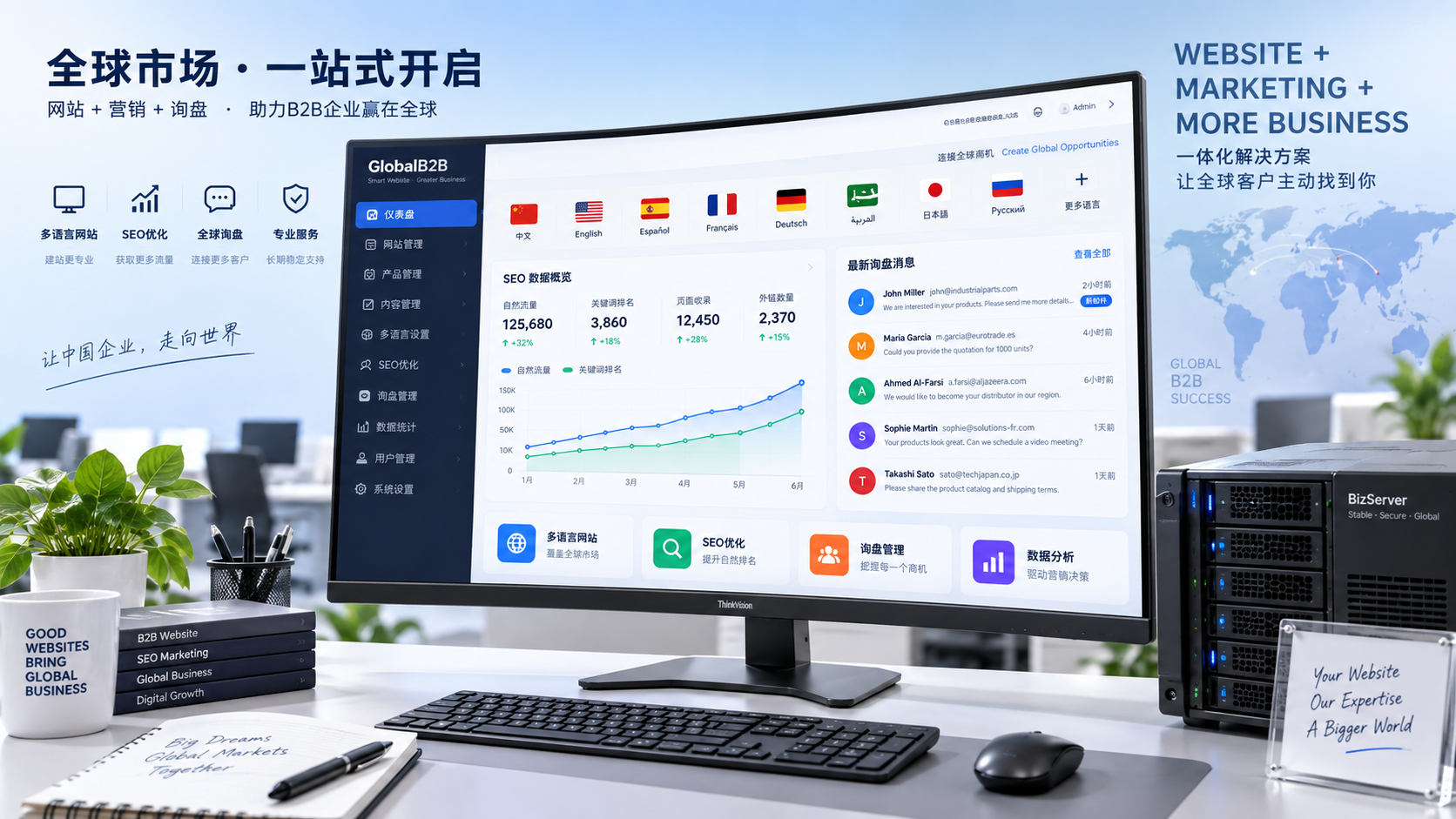
I. Industry Definition: Core Scope of Multilingual B2B Website Development
Multilingual B2B website development involves building independent website systems for cross-border trade, industrial manufacturing, and supply chain companies that can be understood, found, and contacted by buyers in different countries. Its focus covers language versions, product information, company capabilities, technical content, inquiry channels, and ongoing operations, rather than simply adding translated pages.
In B2B procurement scenarios, websites typically serve the function of preliminary supplier screening. Procurement personnel verify product specifications, application industries, production capacity, quality control, delivery terms, and communication efficiency. Therefore, the page structure must support longer decision-making cycles and access by multiple roles, rather than merely pursuing visual presentation.
A complete multilingual B2B website should include a primary-language site, target-market language sites, product and solution pages, knowledge content, trust pages, and data tracking mechanisms. Companies should also define the market role of each language, such as acquiring search traffic, receiving advertising traffic, or serving existing overseas customers.
II. Technical Principles: Language Architecture and International Search Visibility
At the technical level, the language and regional architecture must first be determined. Common approaches include separate domains, subdomains, and directory paths. For most export-oriented companies that need to centrally maintain brand assets, language directories under a unified primary domain are easier to manage. The specific choice should still be based on market independence, team capabilities, and the existing domain foundation.
Version relationships between pages need to be communicated through hreflang, canonical links, language switching, and sitemaps to reduce the risk of search engines misidentifying similar pages as duplicate content. Titles, descriptions, image alt text, breadcrumbs, and internal links should also be verified in line with each language market, rather than only replacing the main text.
The key to multilingual content is localization rather than literal translation. English-speaking markets may emphasize specifications, certification documents, and delivery lead times, while Russian- or Spanish-speaking markets require attention to industry terminology and communication style. 易营宝's multilingual website development and AI translation capabilities can improve content production efficiency, but key product pages should still be reviewed by personnel familiar with the business.
III. Main Categories: Configuring Website Types by Lead Generation Goals
The first category is inquiry-oriented manufacturing websites, suitable for companies in machinery, hardware, building materials, chemicals, new energy, and other industries. Their core pages include product catalogs, technical specifications, application cases, factory capabilities, quality processes, and quotation request forms. The goal is to convert search traffic or business development traffic into actionable procurement leads.
The second category is brand- and solution-oriented websites, suitable for OEM, ODM, and high-ticket equipment suppliers. This type of multilingual B2B website development needs to explain how the company solves customers' process, cost, compliance, or delivery issues, and use project experience, production scenarios, and service processes to reduce uncertainty in initial cooperation.
The third category consists of cross-border independent websites that combine presentation and transaction fulfillment, suitable for brand owners or sellers with standardized product lines. In addition to multilingual product pages, they also need to handle processes involving specifications, pricing, inquiries, shopping carts, orders, and payments. Different types should not use the same page templates; content depth should be determined by customers' decision-making actions.
IV. Selection Criteria: From Buyer Experience to Enterprise Management Efficiency
When selecting a solution, companies should first assess responsive user experience, mobile loading performance, global access stability, and content management capabilities. Overseas buyers often visit websites on mobile devices or under different network conditions. If product images, files, forms, or language switching are unavailable, trust and willingness to submit inquiries will be weakened even if traffic reaches the site.
The second evaluation dimension is multilingual operational capability, including whether products and articles can be managed in batches, manual revisions retained, regional pages configured, multilingual metadata maintained, and contact channels such as forms, email, WhatsApp, or online customer service supported. The system should enable marketing teams to continuously update content instead of relying on developers for every revision.
易营宝 offers a combination of responsive intelligent website development, multilingual sites, search optimization, advertising landing pages, and operational services. According to its published information, deployment can rely on global nodes from Alibaba Cloud, AWS, Huawei Cloud, Tencent Cloud, Baidu Cloud, and others. Before procurement, companies should still test access speed, permission mechanisms, and data handover methods in their target regions.
V. Trust and Conversion: Encouraging Visitors to Submit Valid Inquiries
Overseas buyers will not submit inquiries immediately simply because a website is available in the correct language. Multilingual B2B website development should prioritize trust-building information: clear company introductions, factory or team scenarios, product testing and quality control descriptions, delivery capabilities, service processes, frequently asked questions, and genuine, verifiable contact details all help reduce communication barriers.
Product detail pages should be structured around procurement questions, such as materials, dimensions, performance, applicable operating conditions, customization scope, minimum order requirements, factors affecting lead times, and document downloads. Form fields should be limited to what is necessary and support automatically carrying over the inquiry source from the product page, making it easier for sales teams to assess customer needs and source channels.
易营宝 has served industries including laser engraving machines, steel, chemicals, heavy-duty trucks, machinery, new energy, and healthcare, and lists service cases involving Haier, Aucma, Shandong Airlines, Yuanhe Power Station, Little Duck Group, and Sinotruk. When referring to cases, companies should focus on whether the page logic matches the complexity of their own products and their customers' procurement processes.
VI. Implementation and Maintenance: From Launch Processes to Continuous Iteration
Implementation usually begins with market prioritization, keyword research, and competitor research, followed by organizing the sitemap, language scope, product information, brand assets, and inquiry rules. Before launch, multi-device testing, language redirect checks, form delivery tests, indexing configuration, and access monitoring must be completed to avoid leaving technical issues to be addressed after promotion begins.
After launch, it is recommended to track indexing, keyword coverage, organic traffic, advertising landing page performance, inquiry volume, and sales qualification rates on a monthly basis. For industrial product companies, updating product specifications, adding cases, and building up FAQs are more important than frequent redesigns. For seasonal or new-category businesses, pages should be published in advance in coordination with trade shows, advertising, and social media schedules.
In the future, multilingual B2B website development will place greater emphasis on structured content, brand entity information, and Q&A content for generative search. 易营宝 already provides AI-powered search optimization, GEO operations, advertising, and social media capabilities, making it suitable for companies that want to manage website development, traffic generation, content, and conversion data within the same operational framework.
VII. Costs and Returns: Evaluating Project Value Through Total Cost of Ownership
The total cost of ownership of a multilingual website includes not only initial design and development, but also domains, servers or CDNs, content translation and proofreading, product information organization, technical maintenance, search optimization, advertising testing, and sales lead response. The more languages involved, the more complex the products, and the more dispersed the markets, the more content governance costs need to be included in the budget in advance.
When evaluating returns, website traffic alone should not be the only consideration. More meaningful metrics include the proportion of valid visits from target countries, time spent on key product pages, document downloads, qualified inquiry rates, first response time, sample or quotation conversion, and customer acquisition cost per valid business opportunity. Sales and marketing teams should jointly define lead criteria.
For companies with limited budgets, it is recommended to begin with one primary language and one or two priority markets, establish reusable product content templates and data baselines, and then expand into other languages. When using 易营宝's integrated services, companies should also clarify the number of pages, responsibility for language proofreading, operating period, data ownership, and phased objectives, ensuring that investment corresponds to measurable business results.
