









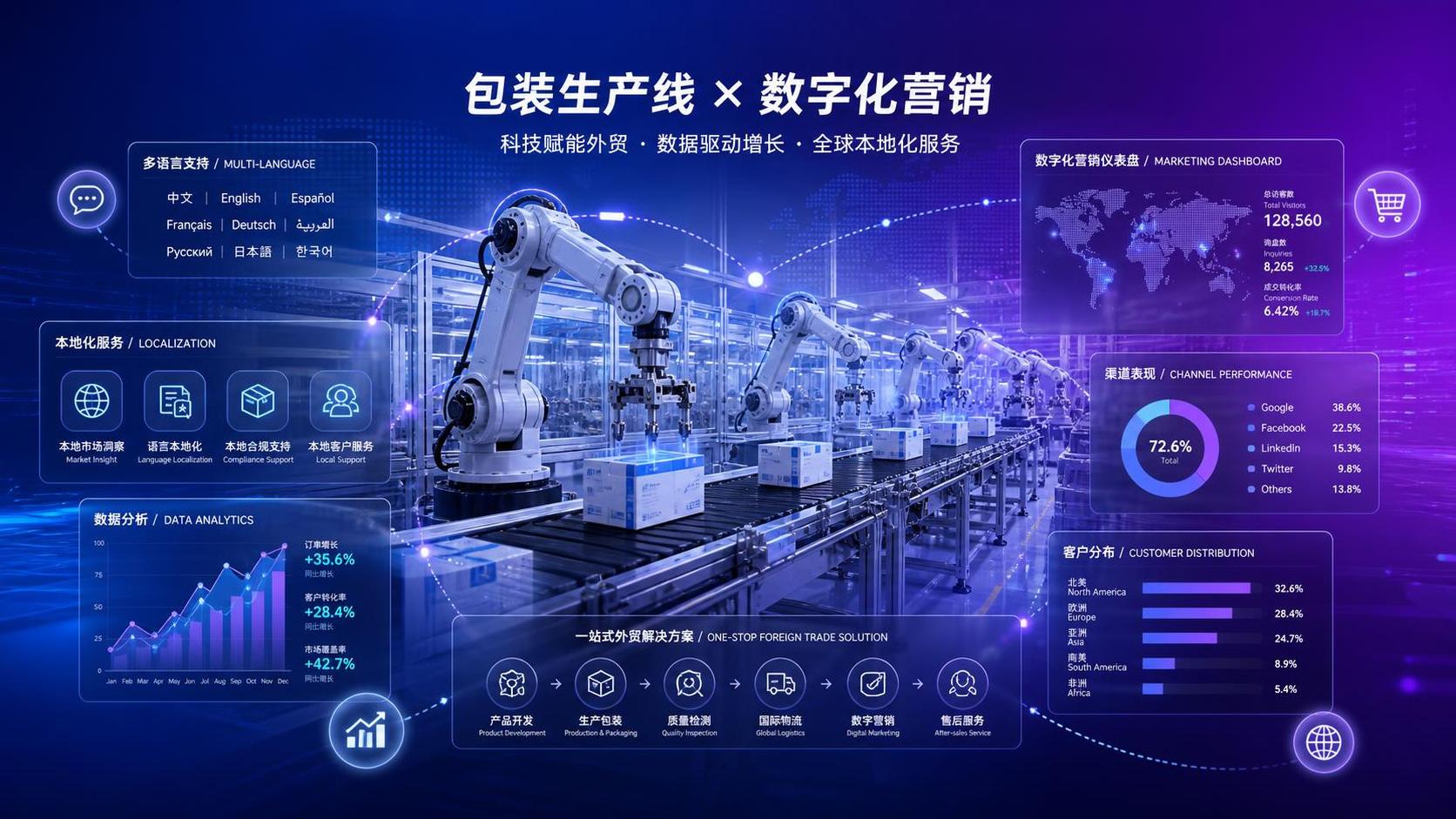
I. Definition and Scope of Foreign Trade Website Development for the Packaging Industry
Foreign trade website development for the packaging industry refers to building a multilingual digital marketing platform around the export business of packaging materials, packaging equipment, or packaging solutions. Its core task is to clearly present product specifications, application conditions, supply capabilities, and cooperation processes, while receiving overseas traffic from search, advertising, and social media channels.
Compared with general corporate websites, foreign trade website development for the packaging industry must address a longer procurement decision-making chain. Buyers typically verify materials, dimensions, thickness, printing processes, barrier properties, minimum order quantities, samples, lead times, and trade terms. Therefore, pages should support systematic filtering and accurate information retrieval.
The website may cover suppliers of flexible packaging, paper packaging, plastic packaging, metal packaging, glass containers, labels, cushioning materials, and packaging machinery. For factories offering customized services, the website should also explain how design, sampling, mass production, quality inspection, and after-sales service are coordinated.
II. Methods for Analyzing Target Markets and Buyer Roles
Market selection should not be ranked solely by country traffic. It should be evaluated in combination with product applications, transportation radius, regulatory requirements, language preferences, and customer concentration. For example, food, pharmaceutical, daily chemical, industrial component, and e-commerce logistics customers focus differently on packaging performance, document support, and sampling response.
Typical visitors include brand purchasing managers, packaging engineers, importers, distributors, e-commerce sellers, and project managers. Purchasing managers focus on pricing structure and delivery stability, engineers focus on technical specifications and compatibility, while decision-makers need more evidence of factory capabilities, quality control, case studies, and long-term cooperation.
It is recommended to create entry points by industry application, such as food packaging, pet food packaging, cosmetic packaging, protective packaging for electronic products, or automated packaging equipment. Each entry point should link to relevant products, material descriptions, frequently asked questions, and inquiry forms to reduce buyers' search costs within large catalogs.
III. Product Content, Localization, and Industry Information Standards
High-quality product pages should replace general selling points with verifiable information, fully explaining the product name, material structure, specification range, printing or forming method, applicable scenarios, optional features, packaging method, and information required for inquiries. Specification tables should use consistent units and avoid mixing performance descriptions for different products.
Multilingual content is not a word-for-word translation. Packaging terminology, measurement conventions, usage scenarios, and commercial expressions need to align with the target market. For different regions, personnel familiar with the business should review material names, technical commitments, lead-time descriptions, and compliance statements to reduce misunderstandings and subsequent communication costs.
Yiyingbao's multilingual website development and manually reviewable content management capabilities are suitable for expanding Chinese materials into English, French, German, Spanish, and other language websites, while configuring language paths and regional pages. For products that need to meet specific market requirements, the website should only display document information that the company can provide and verify.
IV. How Technical Architecture and Marketing Functions Work Together
The technical foundation of foreign trade website development for the packaging industry includes responsive pages, stable hosting, encrypted access, image compression, form delivery, and traffic analytics. Mobile experience is particularly important, as overseas purchasing personnel often initially screen suppliers on their phones at trade shows, warehouses, or customer sites.
Conversion functions should serve different inquiry stages. Standard products can offer quick quotation and catalog download entry points; customized products should include fields such as material, dimensions, quantity, application, print artwork, and target lead time; high-value equipment can add technical consultation, appointment scheduling, and solution document requests to facilitate tiered sales follow-up.
Yiyingbao provides responsive intelligent website development, product management, inquiry forms, email, and instant communication entry configuration, and can improve cross-regional access experience through global node deployment. During website development, sitemap, page title, link hierarchy, and basic data analytics configurations should also be completed to retain a data foundation for ongoing operations.
V. Service Provider Selection, Launch Process, and Quality Control
When selecting a service provider, companies should focus on whether it understands the product hierarchy and inquiry logic of the packaging business, rather than only comparing the number of templates. It is also necessary to confirm multilingual maintenance methods, content ownership, domain management permissions, data export capabilities, technical support boundaries, and whether subsequent advertising and content operations can work in coordination with the website.
A reasonable process usually includes market and keyword research, website structure planning, material organization, page production, multi-device testing, form testing, launch monitoring, and continuous optimization. Before launch, companies should verify product specifications, company names, contact details, image authorization, and downloadable files to prevent incorrect content from affecting business credibility.
Quality acceptance should not only assess visual results, but also check mobile readability, core page loading, language switching, inquiry notifications, redirect links, and privacy statements. Yiyingbao can connect website development, basic optimization, and operational services, making it suitable for packaging export companies that lack dedicated overseas digital teams but wish to build long-term website assets.
VI. Total Cost of Ownership and Customer Acquisition Return Assessment
The total cost of ownership for foreign trade website development in the packaging industry should not only consider the initial production cost, but also domain names, servers, content organization, translation and proofreading, visual material production, feature development, technical maintenance, traffic acquisition, and sales follow-up investment. The more complex the customized products are, the more standardized early-stage materials can reduce subsequent update costs.
When assessing returns, companies can track qualified visits, views of key product pages, form submissions, instant communication, sample requests, quotation opportunities, and transaction sources, rather than evaluating performance solely by page views. For packaging projects with longer decision cycles, they should also record the inquiry industry, region, estimated quantity, and repeat visit status.
A more prudent investment approach is phased development: first complete core markets, main product categories, and inquiry pathways, then expand languages, topic pages, and advertising landing pages based on data. Yiyingbao's combination of website development, search optimization, advertising, and website operations can reduce interface costs in multi-supplier collaboration, but the budget should still match the company's product margins and sales follow-up capabilities.
VII. Maintenance Rhythm and Trends in Foreign Trade Website Development for the Packaging Industry
After the website goes live, it should be updated according to the business rhythm. Product specifications, material supply, lead times, exhibition plans, and case studies should be revised promptly when they change. Traffic sources, inquiry quality, and the performance of key pages can be reviewed monthly, while market pages and content gaps can be reassessed quarterly. Long periods without updates can weaken buyers' perception of supply activity.
Future foreign trade website development for the packaging industry will place greater emphasis on multilingual entity information, question-and-answer content, structured product data, and cross-channel attribution. Buyers will learn about suppliers through search engines, social media, industry platforms, and generative Q&A tools simultaneously. Therefore, companies need to maintain consistency in brand materials and product facts across all channels.
In its service practice, Yiyingbao covers website and marketing needs across multiple industries, including machinery, new energy, chemicals, medical care, furniture, and agriculture, and can provide packaging companies with scalable content and operational frameworks. Companies should build on their actual capabilities and continuously accumulate evidence of their factories, products, applications, and services, allowing their websites to gradually become reusable overseas customer acquisition assets.
