











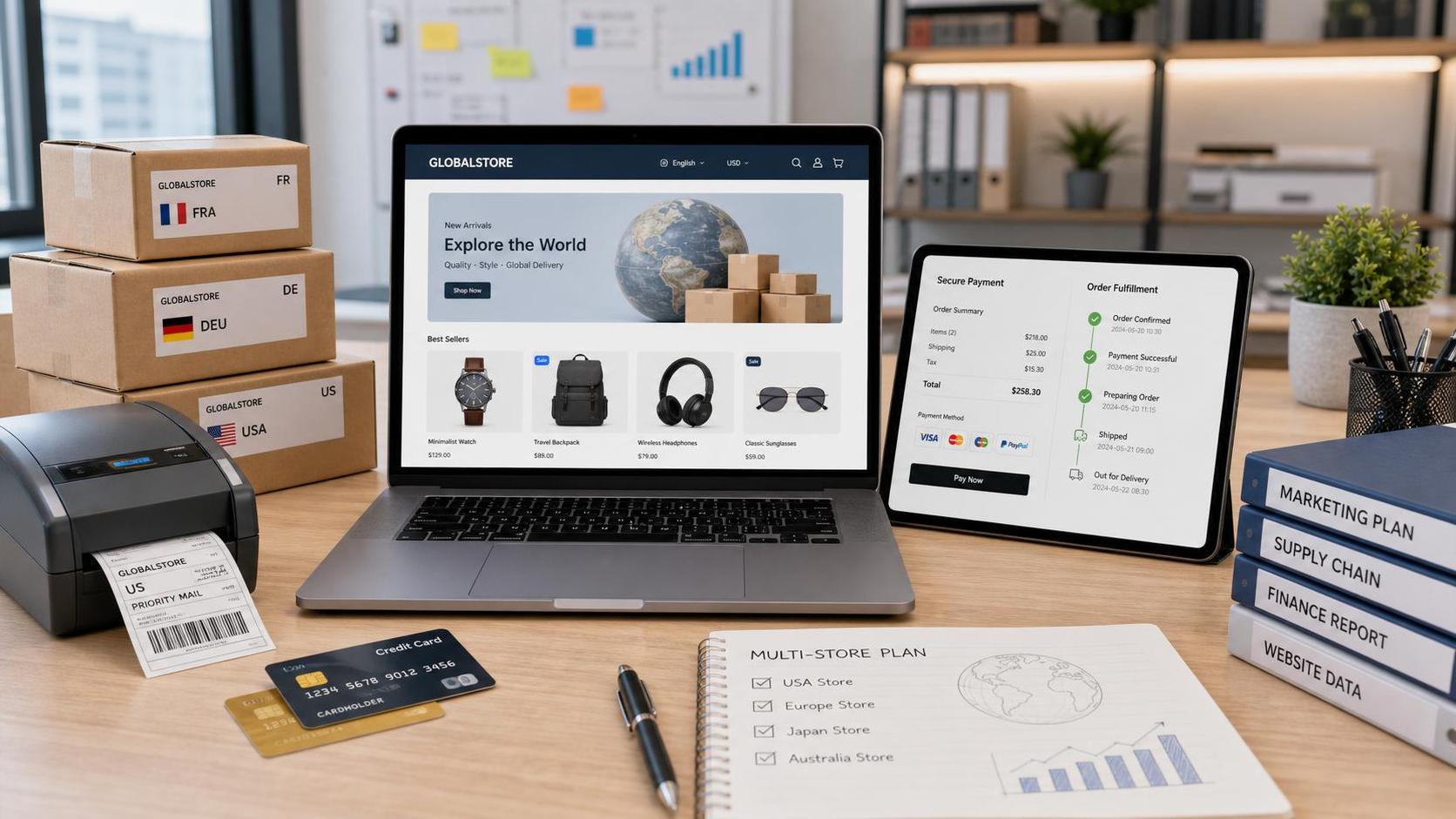
What Is B2C Independent Website Development? — Definition, Essence, and Core Categories
B2C independent website development is not simply the creation of a product display webpage. Rather, it involves building a digital commercial presence centered on a brand’s global expansion strategy, with its own domain name, independent server, complete shopping process, multilingual localization capabilities, and data sovereignty. Its technical architecture includes front-end presentation (responsive UI/multi-device compatibility), back-end logic (product management, order processing, payment integration), technical infrastructure (CDN acceleration, SSL encryption, IPv6 support), and a marketing hub (SEO structure, advertising landing pages, and social media traffic entry points).
By functional depth, it can be divided into three categories: basic type (static product display + inquiry form), e-commerce type (SKU management + shopping cart + multi-currency payments), and brand type (DTC narrative framework + user community + subscription-driven growth). Ecombao integrates all three into a “B2C Cross-Border Store and Independent Website System,” supporting one-stop deployment from lightweight landing pages to fully functional branded stores. It is particularly suited to typical scenarios such as factories transforming into global brands and cross-border sellers seeking Shopify alternatives.
Unlike B2B foreign trade websites, which focus on inquiries as their core objective, B2C independent website development places greater emphasis on the completeness of the user journey—from Google search clicks, TikTok short-video traffic generation, and Facebook ad redirects to building on-page trust, one-click add-to-cart, localized checkout, and after-sales engagement. Conversion efficiency and brand consistency must be maintained throughout the process.
Why Choose an Integrated Solution? — Three Major Breakpoints in Traditional Website Development Models
Traditional B2C independent website development often falls into the fragmented dilemma of “website development-promotion-operations”: technical teams exit after delivering the website, marketing teams struggle to gain traction due to a lack of content assets and SEO foundations, and operations teams are left helpless when dealing with low-quality traffic. Data shows that more than 68% of independent websites have fewer than 500 UVs of organic traffic within three months of launch, mainly due to missing page TDK, homogenized product descriptions, multilingual semantic misalignment, and gaps in GEO visibility.
Ecombao breaks through this challenge with its integrated “website + marketing services” approach, deeply coupling AI-powered website development, a multilingual AI translation center, dual AI + SEO engines, and an AI + SEM intelligent advertising system. For example, when creating a product page for a new energy outdoor power supply, the system automatically completes: multilingual title/description generation → structured copy output aligned with Google search intent → Hreflang tag configuration → GEO Q&A-style FAQ embedding → synchronized publishing to the Facebook/TikTok social media matrix. The entire process reduces the website development cycle to 72 hours while ensuring that every page has initial customer acquisition capabilities.
This integration is not merely a stack of functions; it is a collaborative logic built on 20 years of search algorithm experience—website development is marketing, going live means acquiring customers, and operations drive growth. Clients such as Haier and Aokoma have validated that, after adopting this model, Google organic traffic increased by 3.2 times in the first month, advertising CPL fell by 41%, and inquiry conversion rates rose by 2.7 times.
Who Needs B2C Independent Website Development? — Profiles of Four High-Potential Target Groups
The first group consists of cross-border e-commerce sellers, especially small and medium-sized sellers on platforms such as Amazon and Temu that face rising commissions, stricter rules, and inventory pressure. They urgently need B2C independent website development to gain pricing power, accumulate user data, and reuse private-domain traffic. The second group comprises manufacturing factories with their own product lines, such as laser engraving machine and heavy-duty truck parts manufacturers, which are upgrading from OEM to DTC brands and require independent websites to host professional content such as technical specifications, certification certificates, and installation videos.
The third group is emerging DTC brands in sectors such as new energy, medical aesthetics, and smart homes. These brands rely on strong visual storytelling and KOC word-of-mouth promotion, requiring their independent websites to offer functions such as dynamic product demonstrations, aggregated user reviews, and automated email subscriptions. The fourth group is regional brands expanding overseas, such as Shandong Airlines and Little Duck Group, which need to publish localized content simultaneously for Russian- and Arabic-speaking markets. B2C independent website development serves as compliance infrastructure for their entry into global markets—meeting the requirements of GDPR, PCI-DSS, and electronic signature laws in various countries.
Ecombao’s tiered services are precisely matched to these needs: template-based rapid website development for startup sellers; industrial-grade structured product page tools for factory clients; AI video script generation and YouTube channel hosting for DTC brands; and unified multi-regional website management back ends and audit logs for enterprise groups.
Where Is It Implemented? — Key Touchpoints for B2C Independent Website Development in Real-World Scenarios
The value of B2C independent website development becomes tangible in specific scenarios: to enter the Middle East market, Yuanhe Power Station launched an Arabic independent website within three weeks, integrating local payment (STC Pay), promotional pop-ups for religious holidays, and a halal certification document download module, reducing customer acquisition costs by 63% compared with trade shows in the first month; China Zhongzhongqi launched an independent website for light trucks targeting Southeast Asia, using AI to generate Thai/Vietnamese technical white papers and embedding a WhatsApp one-click inquiry floating window, reducing inquiry response times from 48 hours to 17 minutes.
These cases demonstrate three essential market-entry standards for B2C independent website development: first, global access performance—relying on multi-node CDNs from Alibaba Cloud/AWS/Huawei Cloud to ensure overseas latency below 100 ms; second, in-depth multilingual localization—not simple machine translation, but adjustment of keyword density and page structures based on local search habits; third, compliance readiness—automatic configuration of SSL certificates, GDPR Cookie banners, EU VAT number fields, and more.
Ecombao’s GEO generative engine optimization service further expands the boundaries of these scenarios: when overseas buyers ask “best portable solar generator for camping” in Google AI Overviews, the system automatically triggers a brand-specific answer card containing a product comparison table, links to user field-test videos, and a limited-time discount code, enabling direct navigation from AI Q&A to the independent website order page.
How Can Efficient B2C Independent Website Development Be Achieved? — An AI-Driven Nine-Step Closed-Loop Process
Step 1: Needs assessment—enter the industry, target market, and main products into Ecombao’s AI website development consultant system to automatically generate a “B2C Independent Website Development Feasibility Report,” including competitor website analysis, a keyword opportunity map, and multilingual priority rankings. Step 2: Architecture design—use a responsive SaaS website development system that supports 100% PC/mobile compatibility and page loading speeds ahead of 99% of the industry. Step 3: Content generation—AI generates multilingual product descriptions, brand stories, FAQs, and SEO articles in batches, with manual review needed only for localization details.
Step 4: Technical deployment—automatically configure Hreflang, structured data (Schema.org), GEO Q&A markup, SSL certificates, and IPv6 support. Step 5: Payment integration—pre-integrate Stripe, PayPal, and localized payment gateways (such as Klarna and MOLPay), supporting real-time multi-currency exchange rate calculations. Step 6: Ad conversion—generate high-conversion landing page templates compatible with Google Shopping, Facebook Catalog, and TikTok Pixel event tracking.
Step 7: Social media integration—AI rewrites product page content into Facebook posts, TikTok voiceover scripts, and long-form LinkedIn industry insights, enabling cross-platform content distribution. Step 8: GEO optimization—build a brand knowledge graph and optimize citation rates in AI search summaries. Step 9: Ongoing operations—connect to a website operations service package that generates weekly traffic-inquiry-conversion funnel reports and dynamically adjusts SEO keywords and advertising bid strategies.
Total Cost of Ownership (TCO) and ROI Calculation Model for B2C Independent Website Development
Three major variables affect the TCO of B2C independent website development: technical maintenance costs (server renewals, security updates, plugin compatibility testing), content production costs (multilingual copywriting, product photography, video production), and traffic acquisition costs (advertising, outsourced SEO, outsourced social media operations). Ecombao reduces costs at scale through AI: the AI Translation Center reduces manual translation costs by 85%; AI content generation reduces copywriting hours by 70%; and the global acceleration network eliminates hardware investment for self-built CDNs.
ROI calculations should focus on long-term asset value: on an annual basis, the customer LTV (lifetime value) generated by independent websites far exceeds platform commissions (typically 15%-30%). One case shows that a new energy accessories seller spent approximately RMB 2.4 million annually on platform commissions. After adopting Ecombao’s B2C independent website development solution, its first-year investment was RMB 1.38 million (including website development + 12 months of operations); in the second year, organic traffic accounted for 41%, overall customer acquisition costs declined by 52%, and break-even was achieved in the 18th month.
Companies are advised to adopt a “3-6-12” investment rhythm: focus on website development and foundational SEO during the first three months, achieve a stable inquiry flow within six months, and establish a repurchase and referral closed loop within twelve months. Ecombao provides phased delivery assurance—an online-ready version is delivered in the first phase, GEO and social media modules are added in the second phase, and a BI data dashboard is integrated in the third phase—ensuring that every investment corresponds to clear growth metrics.
