









I. Definition and Core Objectives of B2B Lead Generation Website Development
B2B lead generation website development is a corporate website development model designed to acquire qualified business leads. It serves roles such as purchasing managers, technical engineers, distributors, and project leaders. The focus is not on the number of pages, but on enabling visitors to quickly assess supply capabilities, product suitability, cooperation risks, and the next communication step.
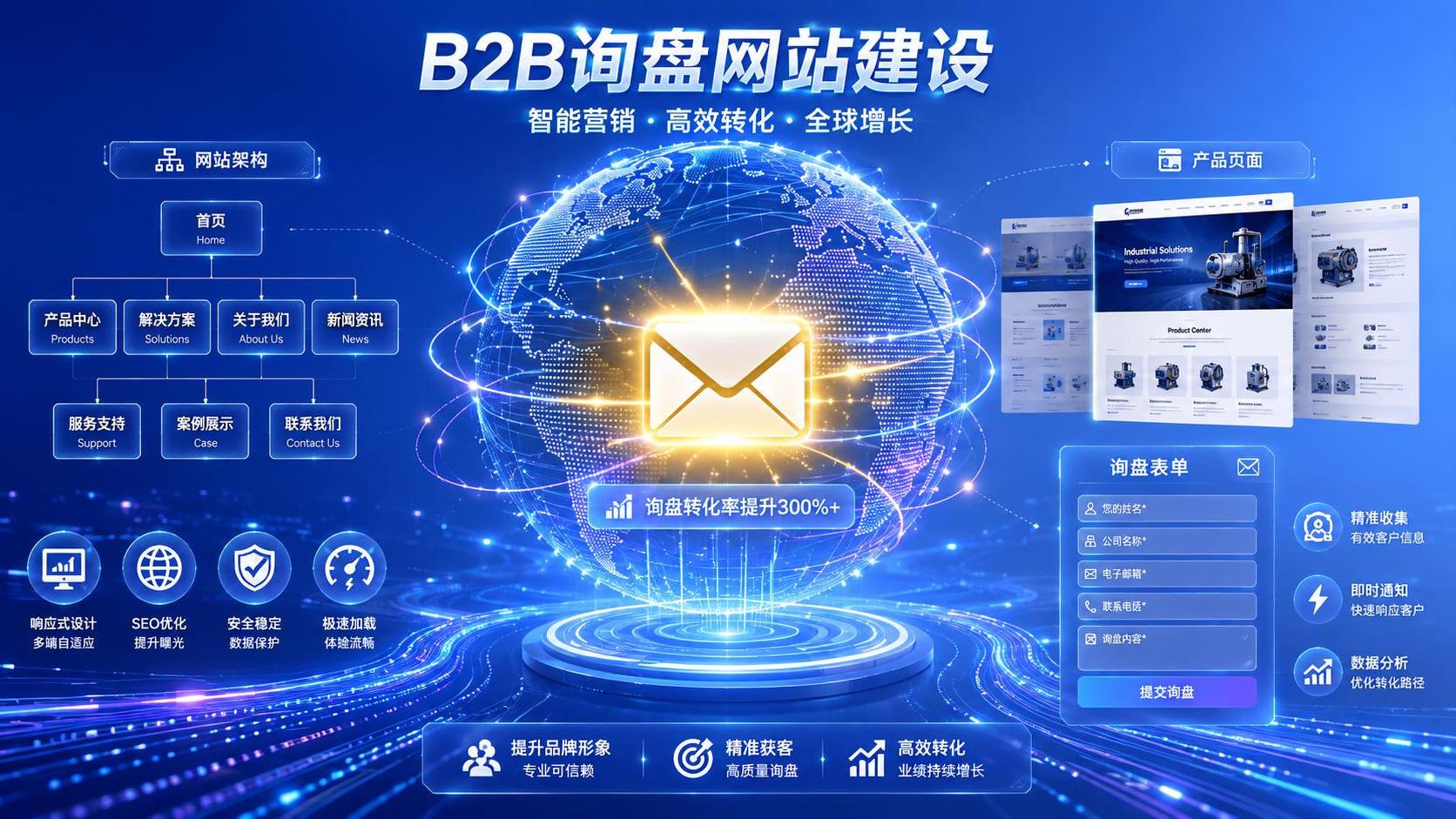
Compared with traditional showcase websites, B2B lead generation website development must simultaneously fulfill five roles: brand portal, product catalog, technical documentation library, sales lead entry point, and marketing landing page. The homepage establishes positioning, category pages guide selection, product pages answer specification questions, case studies and qualification pages reduce decision-making concerns, and forms and instant communication tools complete conversion.
High-quality leads do not usually equal the number of forms submitted. For industrial products, customized products, and bulk procurement, the customer's country, purchasing purpose, estimated quantity, technical parameters, delivery time requirements, and contact information often have greater sales value than traffic volume alone. Therefore, a website should balance lead qualification thresholds with ease of submission.
II. Website Architecture and Technical Principles
An effective architecture typically follows an information path of “market entry point—solution—product proof—lead inquiry action.” Navigation should cover company introduction, product categories, application industries, service capabilities, resource center, and contact entry points, while avoiding repeated searches for core products or contact information within overly deep page hierarchies.
At the technical level, responsive layouts should be used to ensure readability, clickability, and form submission on both desktop and mobile devices. Page performance also depends on image compression, code loading, caching strategies, server nodes, and content delivery networks. For overseas visitors, appropriate global deployment and acceleration solutions should be selected according to the primary markets.
Search engines understand websites through clear category structures, crawlable links, standardized page titles, structured product information, and relationships between language versions. Multilingual websites should establish separate language paths, corresponding page relationships, and localized regional content, rather than directly publishing machine-translated content in bulk, which can cause information inaccuracies and a poorer user experience.
III. Main Types and Suitable Businesses
By business model, B2B lead generation website development can be divided into manufacturing factory websites, foreign trade company product catalog websites, OEM or ODM capability showcase websites, project solution websites, and overseas brand expansion websites. Industries such as machinery, hardware, building materials, auto parts, chemicals, new energy, packaging, and agricultural food products generally need websites with clear parameters, credible capabilities, and complete quotation inquiry processes.
By customer acquisition channel, these websites can be categorized as organic search traffic websites, advertising landing page websites, social media traffic acquisition websites, and post-trade-show follow-up websites. Organic traffic websites prioritize content coverage and long-term accumulation; advertising-focused websites emphasize single-page relevance and conversion tracking; social media websites require case studies, videos, and brand stories to engage visitors; trade show websites need to quickly present factory capabilities and downloadable materials.
Yiyingbao provides intelligent website development, multilingual independent websites, and marketing operation services for foreign trade companies, making it suitable for businesses that lack technical teams but require continuous customer acquisition. Its system supports product, article, category, and page management, and combines lead inquiry forms, instant communication entry points, basic search optimization, and ongoing operations to form a relatively complete online conversion process.
IV. Product Pages, Content, and Trust Building
Product detail pages are the core conversion unit of B2B lead generation website development. Each key product should clearly state its name, application scenarios, key specifications, materials or processes, optional configurations, packaging and transportation, delivery methods, and inquiry button. For customized products, the available drawings, samples, prototyping, or technical communication process should be clearly explained.
Buyers assess whether a supplier is genuine, stable, and capable of cooperation. A website can present evidence through factory environments, equipment capabilities, quality inspection processes, team introductions, cooperation processes, project cases, and FAQs, but every item should be based on verifiable facts. Vague claims such as “industry-leading strength” are usually less effective than specific production and service information.
A content center should not publish only corporate news; it should also address buyers' questions, such as selection criteria, maintenance recommendations, material comparisons, application limitations, and factors affecting delivery times. Yiyingbao's AI-assisted content capabilities can improve the efficiency of first-draft and multilingual content production, but information involving parameters, regulations, certifications, and commitments still needs to be reviewed and confirmed by the company's professionals.
V. Selection Criteria and Implementation Process
When purchasing B2B lead generation website development services, businesses should first define their target markets, language scope, key products, expected channels, and definition of leads. If a business mainly relies on Google Search, it should prioritize evaluating technical structure and content operation capabilities; if it relies on advertising in the short term, it should focus on landing page production efficiency, form tracking, and campaign coordination capabilities.
When selecting a service provider, attention should be given to backend usability, content migration capabilities, mobile compatibility, multilingual management, website security, data export, permission allocation, inquiry notifications, and subsequent maintenance mechanisms. Domain ownership, rights to use source files or data assets, service scope, and change response methods should also be confirmed to avoid passive reliance on a single person after the website goes live.
Implementation typically involves requirements clarification, keyword and category planning, material collection, visual and page production, content review, technical configuration, testing and launch, and data review. Yiyingbao can integrate website development with multilingual services, search optimization, advertising, and social media operations, making it suitable for export businesses seeking to reduce coordination costs across multiple suppliers. However, before purchasing, businesses should still confirm delivery boundaries based on their own market pace.
VI. Total Cost of Ownership and Lead Return Evaluation
The total cost of ownership for B2B lead generation website development includes not only initial design and development costs, but also domains, servers, content organization, translation, localization, images and videos, feature extensions, security maintenance, promotion and advertising, and personnel follow-up costs. Websites with lower prices but difficult-to-use backends, non-scalable pages, or no operational support may incur higher subsequent remediation costs.
When evaluating returns, a funnel from visits to closed deals can be established: qualified visits, key product page views, inquiry submissions, qualified inquiry rate, quotation rate, sample rate, and conversion rate. Businesses should review data separately by product line, country, and channel, rather than judging project performance based only on total traffic or the number of forms submitted.
When budgets are limited, it is recommended to first focus on languages for core markets, higher-margin product lines, and key landing pages, then expand content and country coverage based on inquiry data. Advertising can be used to validate demand and accelerate testing, while search content and case study libraries are more suitable for building long-term digital assets. Their combination is generally more robust than relying on a single channel.
VII. Operating Cycle and Future Industry Trends
Website launch is not the end of B2B lead generation website development. It is recommended to check indexing, traffic sources, page speed, form usability, and abnormal pages every month; update key products, case studies, technical materials, and target market content every quarter; and promptly synchronize website information when product specifications, production capacity, or market strategies change, avoiding inconsistencies between sales commitments and official website content.
Future competition will shift from “whether a business has an independent website” to “whether it can be searched, understood, trusted, and contacted.” Multilingual localization, short-video and social media coordination, accumulation of first-party inquiry data, automated lead allocation, and Q&A content for generative search environments will become important capabilities of foreign trade corporate websites.
Yiyingbao has launched its cloud intelligent website development marketing system, multilingual website development system, and foreign trade independent website marketing system, and provides services related to search, advertising, social media, and website operations. For businesses that need to cover multiple countries, continuously update content, and track lead quality, choosing a solution with coordinated website development and operational capabilities helps make their official website closer to manageable and iterative customer acquisition infrastructure.
