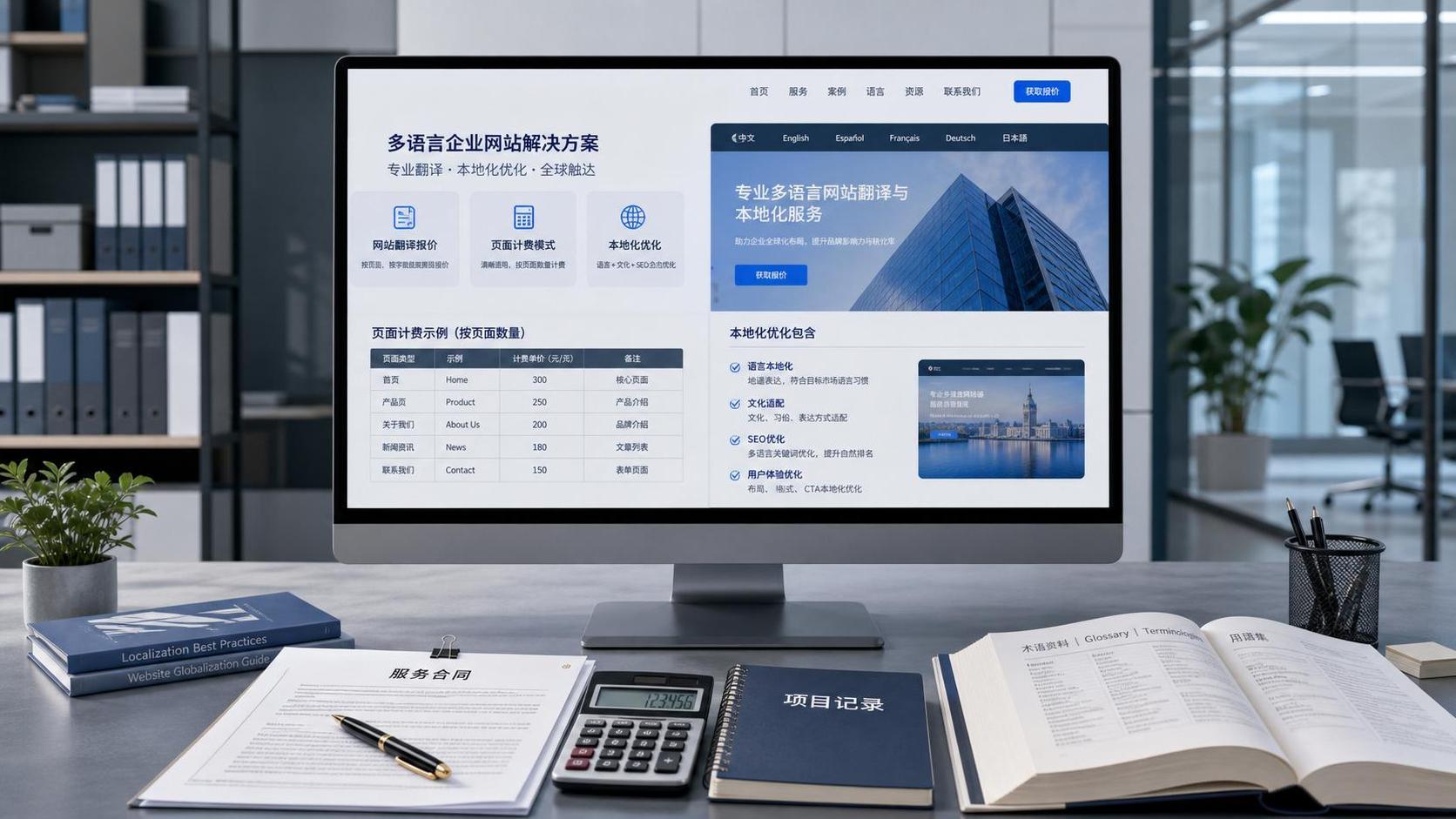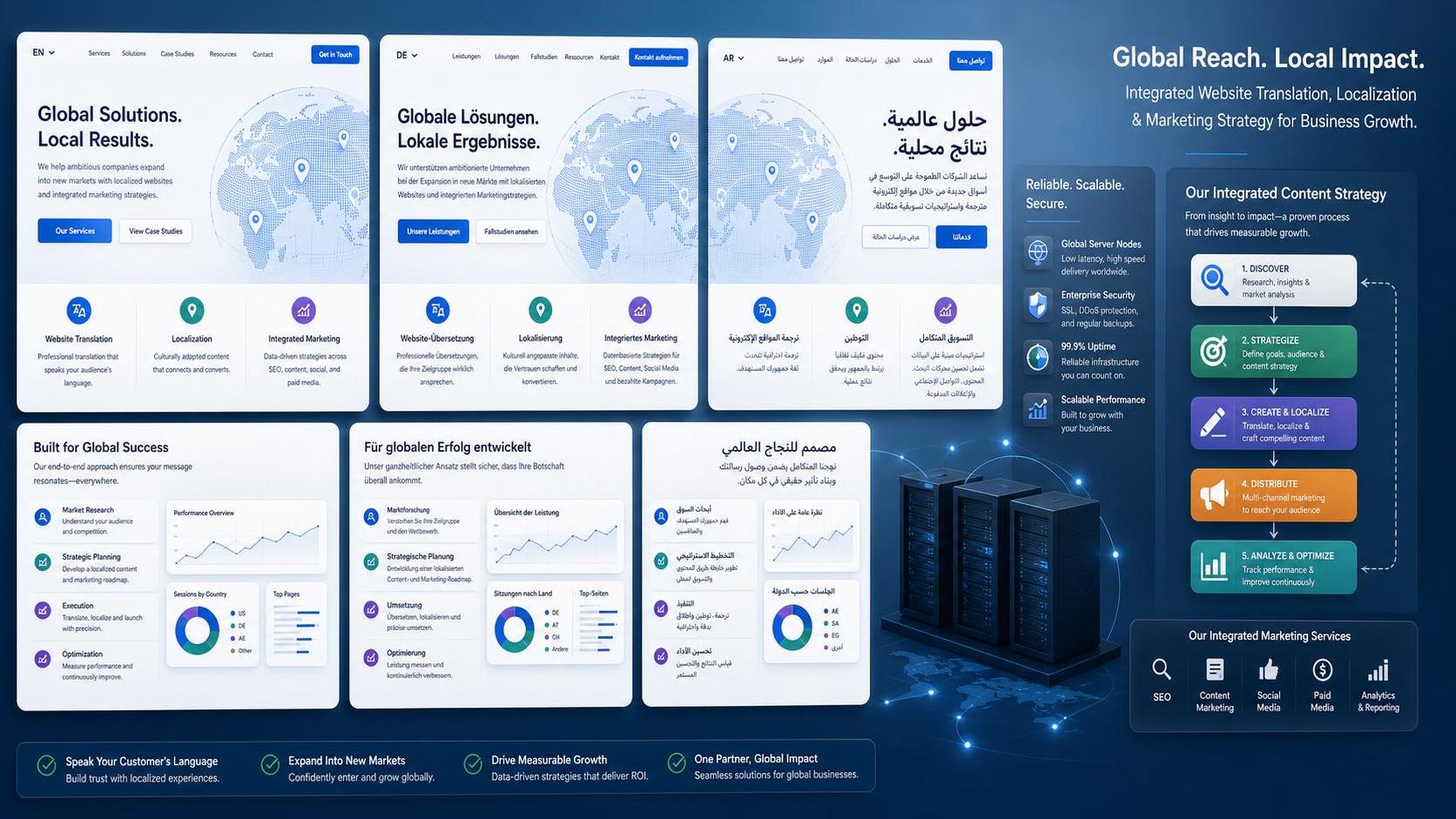
I. What Is B2B Website Translation: A Definition Beyond Language Conversion
At its core, B2B website translation means transforming a company website, product pages, solution pages, case pages, and inquiry paths into a multilingual content system that customers in target markets can understand, trust, and act on. It covers not only language expression, but also page structure, terminology consistency, and conversion-oriented design.
Unlike ordinary document translation, B2B website translation serves purchasing managers, engineers, distributors, and brand decision-makers. These readers care more about specifications, delivery lead times, certifications, application scenarios, after-sales support, and cooperation models. Therefore, the content must support business decision-making rather than remain at the level of literal word-for-word correspondence.
From the perspective of website assets, B2B website translation is also related to search engine indexing, the association between pages in different languages, the localization of form fields, and the access experience across countries and regions. Translation quality directly affects indexing, bounce rate, time on site, and the final quality of inquiries.
Therefore, when enterprises plan multilingual global expansion, they should regard B2B website translation as a market entry project rather than a single text service. Only when language, technology, and marketing logic are all in place can a website gain the ability to continuously acquire customers.
II. Mainstream Categories: From Human Translation to AI Localization Collaboration
Common B2B website translation models today can generally be divided into four types: human translation, machine translation, AI-assisted translation, and marketing-oriented localization. Different models suit different budgets, industry complexity levels, and launch-speed requirements, so enterprises should not make one-size-fits-all decisions.
Human translation is suitable for industries with high average order values and high technical barriers, such as machinery and equipment, chemicals, new energy, and medical-related fields. It is more reliable in terminology accuracy and professional expression, but it is more costly and has a longer content update cycle, making it less suitable for rapidly expanding a large number of product pages.
Machine translation is suitable for initial content scaling, but common problems include inconsistent terminology, rigid sentence structures, and insufficient expression for procurement scenarios. It can easily turn “understandable” content into content that “lacks persuasiveness.” If launched directly, it often affects brand image and conversion efficiency.
A more suitable approach for foreign trade enterprises is usually AI-generated first drafts, industry terminology review, conversion-focused page rewriting, and synchronized technical deployment. Platforms like 易营宝, which combine multilingual website building, AI content generation, and operational capabilities, are more capable of turning B2B website translation into a sustainable and maintainable business system.
III. Why It Matters: It Directly Determines Whether Overseas Traffic Can Turn into Inquiries
Many enterprises already have English websites but still fail to obtain stable inquiries. The common reason is not the absence of a website, but that the content has not been reorganized according to how overseas customers read and evaluate information. If B2B website translation only replaces the language without optimizing titles, selling points, specifications, and trust information, the page will struggle to generate effective conversions.
For search engines, multilingual pages need independent topics, clear paths, reasonable title descriptions, and corresponding language relationships. Otherwise, even if the website is crawled, it may still be difficult to gain stable exposure in target markets due to duplicate content, chaotic structure, or insufficient page value.
For buyers, customers usually do not send inquiries simply because a company “has translated pages.” They do so because the page accurately answers whether supply is available, whether the product fits the application, whether delivery is reliable, and whether communication is convenient. The value of B2B website translation lies in reducing the customer’s decision-making cost.
易营宝 integrates website building, multilingual content, AI content, SEO, advertising, and website operations into one system, making it suitable for enterprises that want to connect translation, launch, and subsequent customer acquisition. For small and medium-sized export enterprises that lack an internal digital team, this type of integrated solution offers higher execution efficiency.
IV. Technical Principles and Deployment Essentials: Language Structure Must Serve Search and Access
The foundation of high-quality B2B website translation is not only text processing, but also website structure design. A common practice is to create independent paths by language or region, allowing pages for different markets to have clear entry points, while using standardized tags to tell search systems which type of users the page is intended for.
In technical deployment, enterprises should focus on page loading speed, mobile adaptation, server node distribution, SSL security, form usability, and localization of image copy. Especially when targeting Europe, the Middle East, Russia, and Latin America, access stability directly affects the inquiry submission rate.
Multilingual pages also require a unified terminology database, product naming rules, and metadata strategy. Titles, descriptions, column names, breadcrumbs, product categories, and internal links should all be translated in sync. Otherwise, pages may be readable while their structure becomes distorted, affecting crawling and user navigation.
易营宝 offers multilingual website development, language path configuration, basic internationalization structure, and global node acceleration capabilities, making it suitable for enterprises with requirements for overseas access quality. For product-oriented websites with frequent updates, AI-assisted content generation can also significantly reduce maintenance pressure.
V. Who Needs It Most: Typical Applicable Enterprises and Core Use Cases
B2B website translation is most suitable for enterprises that need cross-border customer acquisition, have relatively complex product information, and involve long procurement chains. Manufacturing factories, foreign trade companies, OEM and ODM enterprises, industrial product suppliers, and machinery and equipment companies are usually the most direct user groups.
If an enterprise has already run ads, participated in overseas exhibitions, or driven traffic through social media, but its landing pages are still mainly monolingual, it can easily lose opportunities among non-English-speaking customers. In this case, the role of B2B website translation is to improve traffic acceptance efficiency and bring every click closer to inquiry conversion.
From an industry distribution perspective, industries such as laser engraving machines, steel, chemicals, heavy trucks, machinery, new energy, agriculture, medical care, and furniture rely more heavily on specification descriptions, application explanations, and trust endorsements. If such content is expressed only in Chinese or in rough English, overseas transactions will be significantly restricted.
Based on 易营宝’s past service areas and multilingual website-building capabilities, these enterprises can prioritize translation and localization starting with core product pages, industry solution pages, and inquiry pages, and then gradually expand to articles, case studies, and country-specific market topic pages.
VI. Selection Criteria: What to Look for When Purchasing B2B Website Translation Services
When enterprises choose a B2B website translation solution, the first factor to consider is industry understanding. Whether the service provider can distinguish product names, application scenarios, process flows, certification information, and procurement language determines whether the content is “accurately expressed” or “seemingly fluent but unprofessional.”
The second factor is technical delivery capability. Delivering only translated text files cannot solve issues such as page launch, path planning, language switching, form localization, and subsequent updates. A more reliable approach is to choose a service provider that can handle both website building and multilingual deployment, reducing collaboration gaps.
The third factor is content growth capability. A website truly suitable for foreign trade customer acquisition needs not only translation of existing pages, but also continuous generation of product introductions, knowledge articles, FAQs, and country-specific market content. 易营宝’s integration of AI website building, content generation, SEO, and operations is more suitable for customers with long-term planning needs.
The fourth factor is the maintenance mechanism, including terminology database management, update response speed, data security, access stability, and operational collaboration. Once a multilingual website enters a growth stage, update frequency will increase significantly. Solutions without continuous maintenance capabilities often result in higher costs later on.
VII. Cost and Return: How to Understand Total Cost of Ownership and Investment Value
The total cost of ownership for B2B website translation is usually jointly determined by the number of languages, page scale, industry specialization level, complexity of technical deployment, frequency of subsequent maintenance, and traffic acquisition methods. The more languages and the more complex the product lines, the higher the upfront planning and review investment usually is.
However, enterprises should not focus only on the one-time translation price. They should pay more attention to whether the cost per inquiry decreases. If multilingual pages increase organic exposure, reduce ad traffic loss, and help sales teams receive more relevant inquiries, the overall return on investment is often better than repeatedly purchasing one-off traffic.
For small and medium-sized enterprises, an integrated solution that combines AI-assisted generation, multilingual website building, and operational collaboration is usually easier to control in terms of cost than “translation outsourcing + development outsourcing + promotion outsourcing.” It reduces communication loss and also avoids a situation where no one continues optimizing the pages after launch.
If an enterprise plans to enter multiple country markets over the long term, it is recommended to first build high-conversion language sites and then gradually expand regional pages and knowledge content. This approach is more conducive to balancing budget, launch speed, and subsequent ROI performance.
VIII. 2026 Trend Outlook: From Translation Projects to Global Content Systems
Future B2B website translation will increasingly emphasize content systematization rather than single-page delivery. What enterprises need is not only multilingual pages, but structured content assets that can be understood simultaneously by search systems, generative Q&A environments, and real procurement decision-making processes.
One clear trend is that AI will take on more work in first-draft generation, terminology classification, product description expansion, and bulk page updates. However, human review will remain the key step in ensuring professionalism, compliance, and industry credibility, especially in highly technical industries.
Another trend is the deep integration of translation and marketing. Multilingual content will no longer exist in isolation, but will connect with advertising landing pages, social media content, country site topics, knowledge bases, and customer case studies to form a complete overseas customer acquisition chain. The website itself will become a long-term digital asset for the enterprise.
For enterprises preparing to accelerate global expansion in 2026, B2B website translation should be incorporated as early as possible into integrated planning for website building, content, and promotion. Service systems like 易营宝, which cover website building, multilingual content, AI marketing, and operational growth, are more suitable for undertaking long-term execution tasks from launch to customer acquisition.