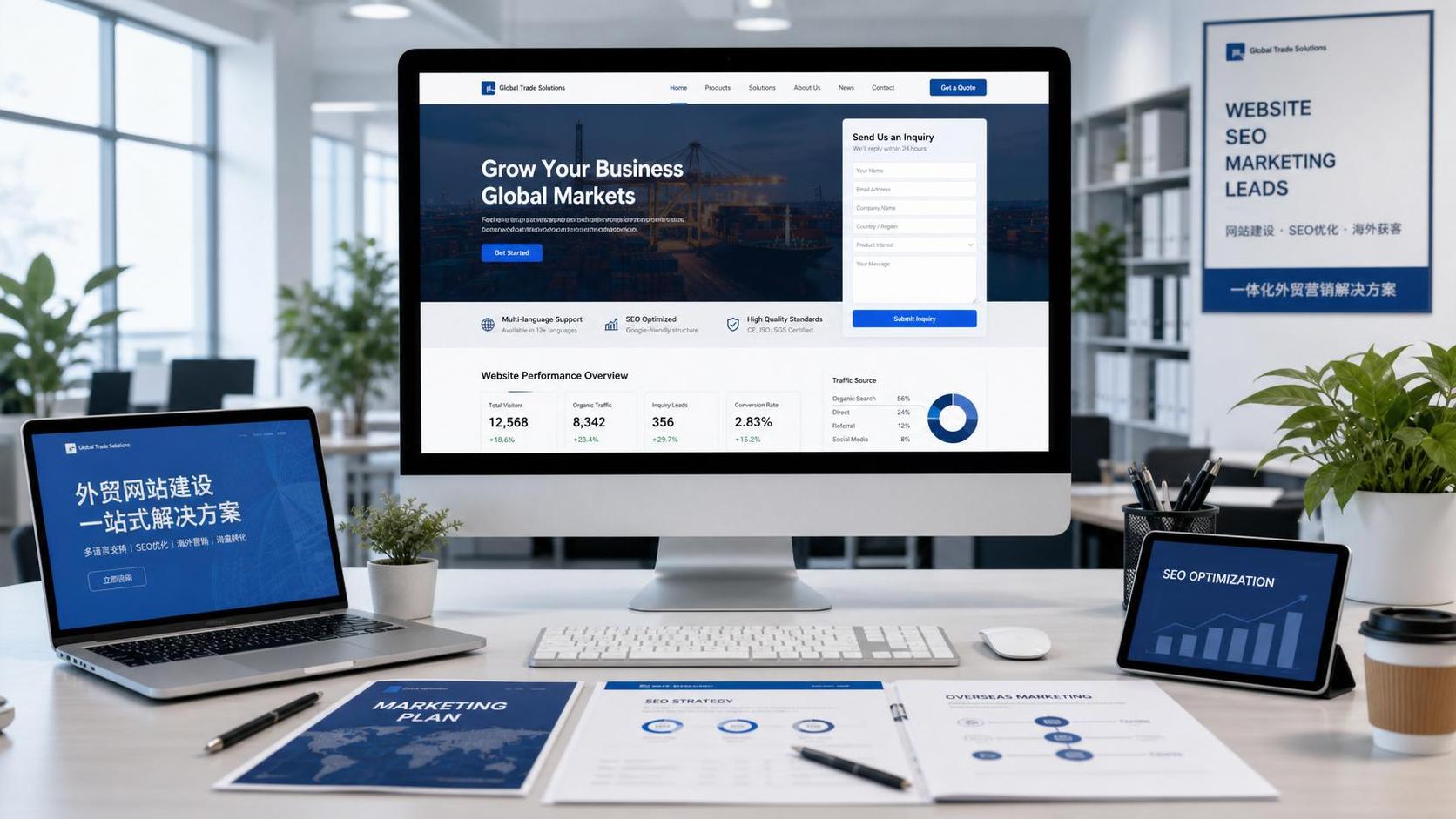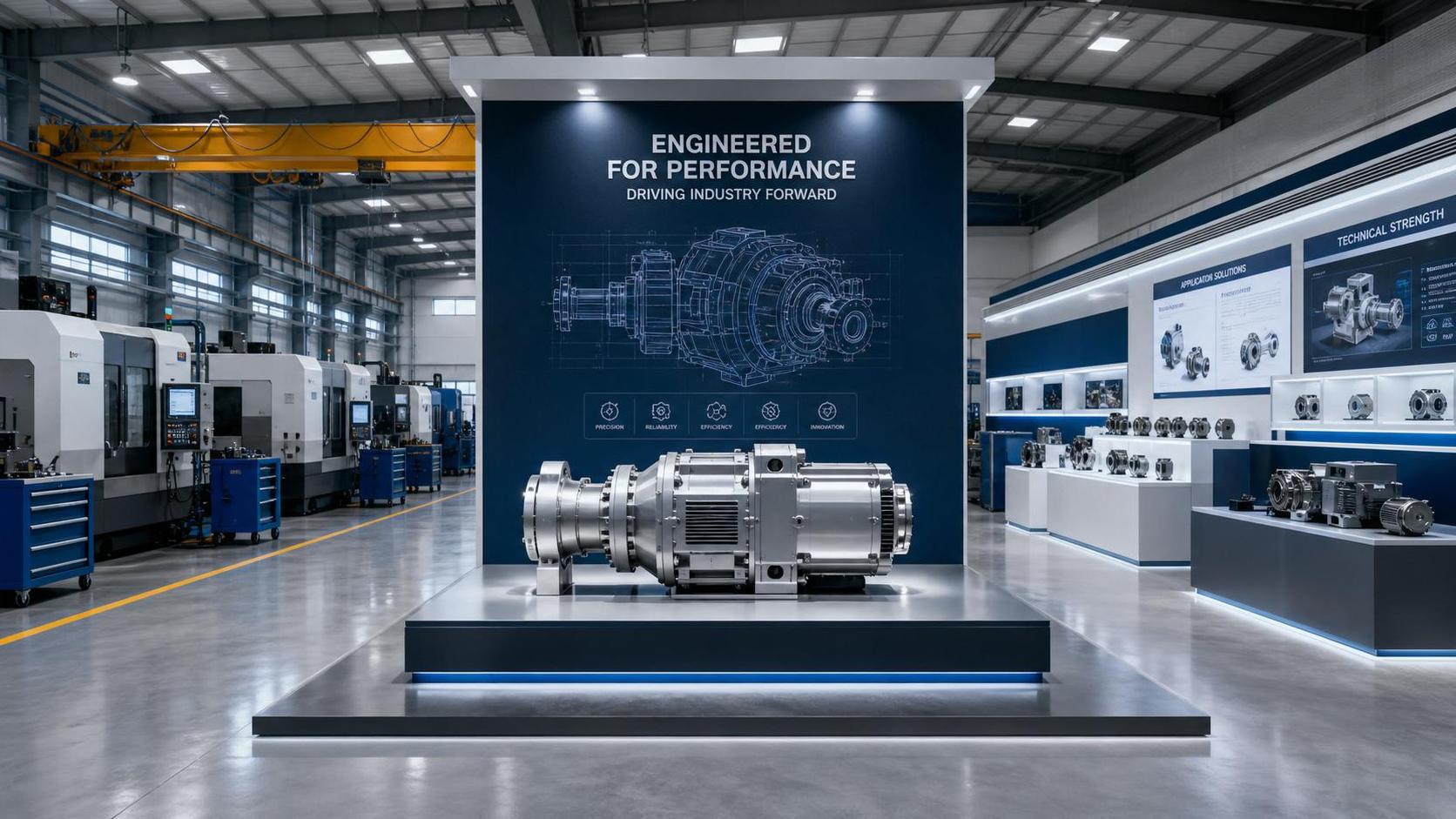
I. Industry Definition: What Is B2B Export Marketing Website Development?
The core of B2B export marketing website development is not simply creating a company website that looks good, but establishing a business system capable of receiving overseas traffic, presenting a professional image, and driving inquiry conversions. These websites typically serve manufacturing factories, foreign trade companies, wholesalers, and industrial product suppliers, with overseas buyers, distributors, and project decision-makers as their target audiences.
Compared with traditional showcase websites, this type of website places greater emphasis on search visibility, page persuasiveness, communication convenience, and data tracking capabilities. Website structure, product page content, inquiry forms, contact information, trust credentials, and multilingual pages can all directly affect whether overseas customers are willing to continue communication.
Therefore, B2B export marketing website development is essentially an integrated project combining brand presentation, content marketing, technical optimization, and sales lead generation. It serves as a company’s overseas storefront and an important infrastructure for continuously accumulating traffic and customer assets.
II. Technical Principles: How Website Architecture, Content, and Conversion Layers Work Together
From a technical perspective, a qualified B2B export marketing website typically consists of three layers. The first is the site architecture, including responsive design, page loading speed, server deployment, mobile adaptation, and secure access. A stable foundation provides the necessary support for subsequent search indexing and advertising traffic acquisition.
The second is the content structure, focusing on the coordination of the homepage, product category pages, product detail pages, industry application pages, case study pages, About Us pages, and FAQ pages. Buyers do not only look at company introductions; they are more concerned with product specifications, delivery capabilities, application scenarios, certification documents, and partnership credibility.
The third is the conversion structure, including inquiry forms, email access, instant chat, WhatsApp buttons, downloadable materials, and data tracking. Many corporate websites receive traffic but generate no inquiries. The problem is often not promotion, but the lack of clear action paths and conversion entrances.
Integrated solutions represented by Yiyingbao combine intelligent website development, multilingual management, basic SEO configuration, content generation, and overseas access acceleration in one system. This reduces repetitive communication costs during website development, redesign, and operation, making the solution suitable for foreign trade companies that require continuous lead generation.
III. Main Categories: Which Foreign Trade Website Model Suits Different Companies?
Based on business objectives, B2B export marketing websites can generally be divided into brand showcase, product inquiry, multilingual market coverage, and advertising landing page models. Brand showcase websites are suitable for manufacturing companies that need to strengthen their corporate history, factory capabilities, and industry image, with trust building as the primary focus.
Product inquiry websites are more suitable for companies with a large number of SKUs that rely on search-based customer acquisition, such as businesses in machinery, building materials, auto parts, chemicals, and new energy. Their core requirements are clear product categorization, complete detail pages, standardized specification presentation, and the ability to enable buyers to quickly submit inquiries or requirements.
Multilingual market coverage websites are suitable for companies planning to expand into non-English-speaking markets. In addition to an English website, they may extend to Russian, Spanish, French, Arabic, Japanese, or Korean versions to accommodate purchasing habits in different countries. Multilingualization is not simply translation; it is an expansion of market communication and search entry points.
Advertising landing page websites emphasize page conversion efficiency and are suitable for companies launching new websites or conducting short-term focused campaigns. In such projects, Yiyingbao typically combines website development, advertising copy generation, landing page creation, and form tracking to improve the efficiency of handling traffic after it enters the website.
IV. Who Is It For: Target Companies, Purchasing Scenarios, and Industry Applications
B2B export marketing website development is most suitable for three types of companies. The first is manufacturing factories and OEM and ODM companies. These companies typically have production capabilities and supply chain advantages, but weak online content presentation makes it difficult to convert their manufacturing strengths into overseas inquiries.
The second is foreign trade and supply chain companies. They often have broad product lines and diverse customer sources, and need to use their websites to present industry experience, service capabilities, and product solutions in a unified manner, thereby reducing customers’ uncertainty about intermediary trading processes.
The third is small and medium-sized companies planning to take their brands global. Companies that previously relied on platforms and trade shows increasingly need independent websites to accumulate customer data and brand assets. Once a website has SEO, advertising conversion, and multilingual capabilities, it can form a more stable customer acquisition channel.
In terms of industries, sectors such as laser engraving machines, steel, chemicals, heavy trucks, machinery, new energy, agriculture, medical products, and furniture have higher requirements for professional content and trust credentials. Yiyingbao has relevant industry service experience and is more suitable for such B2B scenarios with long decision-making chains and high purchasing barriers.
V. Selection Criteria: What Should Companies Focus on When Evaluating Website Development Solutions?
When selecting B2B export marketing website development services, the first consideration should be whether the solution supports marketing objectives, rather than focusing only on visual effects. A website may have a clean appearance, but without keyword planning, a product content framework, and inquiry design, it will be difficult to develop stable customer acquisition capabilities.
The second consideration is the technical foundation, including responsive adaptation, overseas access speed, page management efficiency, SSL security configuration, and future scalability. If a company plans to implement multilingual content, advertising, and regular content updates in the future, the usability of the backend will directly affect operating costs.
The third consideration is content support capabilities. Many foreign trade companies do not lack products; they lack page content that overseas customers can understand. The ability to quickly generate product descriptions, industry application content, TDK information, and multilingual pages determines whether a website can be continuously updated and whether its traffic entry points can be expanded.
The fourth consideration is the service loop. If a website development company is only responsible for launching the website but not for SEO, advertising conversion, social media traffic acquisition, and data optimization, the website can easily become a static business card. Yiyingbao’s advantage lies in placing website development, SEO, SEM, social media, and website operations within a unified service chain, making it more suitable for companies that value long-term return on investment.
VI. Application Scenarios and Case Value: How Websites Work in Real Markets
In actual overseas customer acquisition, B2B export marketing websites are most commonly used in three scenarios. The first is the search scenario. Buyers enter a website through product terms, application terms, or problem-related keywords. If the page structure is clear and the content is credible, the company has an opportunity to enter the inquiry pool.
The second is the advertising and social media scenario. Whether customers come from search ads, social platforms, or email marketing, they will return to the website after clicking to conduct further evaluation. At this point, the website must not only display products but also quickly answer customers’ key concerns regarding pricing, delivery time, customization capabilities, and qualifications.
The third is the offline extension scenario. Many companies first connect with customers through trade shows, business cards, and brochures, after which customers visit the official website to conduct background research. If the website lacks case studies, factory introductions, and multilingual content, offline leads can also be easily lost.
Yiyingbao has served industries including laser engraving machines, steel, chemicals, machinery, new energy, and medical products, and has covered complex business scenarios represented by cases involving Haier, Aucma, Shandong Airlines, Yuanhe Power Station, Little Duck Group, and Sinotruk. This demonstrates that its solutions are more suitable for companies that need to balance corporate image, content, and customer acquisition efficiency.
VII. Cost and Return: Is Website Development Investment Worthwhile from a TCO and ROI Perspective?
When evaluating B2B export marketing website development, companies should not focus only on the initial website development fee, but also consider the total cost of ownership. Common costs include domains and servers, page design, content organization, multilingual processing, basic SEO configuration, subsequent maintenance, and operational promotion. If the initial solution is unreasonable, the cost of later redesigns is often higher.
From a return perspective, the value of a marketing website lies in continuously accumulating organic traffic, receiving advertising traffic, and improving inquiry quality. Compared with one-time trade show promotions or platform commissions, an independent website is a long-term accumulable digital asset for a company, and its return usually demonstrates a medium- to long-term amplification effect.
For small and medium-sized companies, SaaS-based and AI-assisted solutions are generally more cost-effective than fully customized development, especially for companies without dedicated technical teams. Yiyingbao links website development, content generation, SEO, and promotional operations, helping reduce communication and execution losses caused by collaboration among multiple suppliers to a certain extent.
When making purchasing decisions, companies are advised to divide their objectives into three levels: whether the website can be launched quickly, whether it can be continuously updated, and whether it can generate effective inquiries. A website solution that satisfies all three requirements generally offers greater long-term value than simply choosing low-cost website development.
VIII. Future Trends: Multilingualization, AI Search, and Integrated Operations Will Become Standard
In the future, B2B export marketing website development will move beyond page creation and enter a stage of intelligent content and global operations. Companies will need more than just a website; they will need a unified platform centered on search, advertising, social media, and customer data.
The first major trend is multilingual localization. A single English website can no longer cover all markets. Independent content entry points for regions using Russian, Spanish, French, Arabic, and other languages will become important growth channels for more export companies. Multilingual SEO and regional page management capabilities will become increasingly critical.
The second major trend is content restructuring for the AI search environment. As intelligent question answering and generative search become more widespread, companies must not only compete for traditional rankings but also make their products, services, and industry knowledge easier to understand, cite, and recommend. The importance of structured content, FAQs, and solution pages will continue to increase.
The third major trend is the integration of website development and operations. Website launch is only the starting point. Subsequent SEO optimization, advertising, social media content, and conversion analysis must work together to drive results. Comprehensive solutions such as Yiyingbao, which combine AI website development, multilingual capabilities, GEO, SEO, and operational services, are more aligned with the current needs of foreign trade companies to balance efficiency and growth.
 How to evaluate B2B foreign trade marketing-oriented website development services? Review these 5 capabilities before looking at casesHow to evaluate B2B foreign trade marketing-oriented website development services? Do not just look at cases and quotations, first review 5 key capabilities: foreign trade market understanding、SEO foundation、conversion content、multi-channel collaboration and data optimization, to help you choose the right website + marketing service provider that can truly drive inquiry growth.
 How to determine the column structure and content focus for machinery industry B2B foreign trade marketing websites?When building a B2B foreign trade marketing website for the machinery industry, you cannot focus only on page aesthetics; you should first establish the column structure. This article combines complete machines, components, and non-standard customization scenarios to break down column planning, content focus, and inquiry conversion logic, helping companies create a machinery industry website that generates more leads.