













I. Industry Definition and Core Objectives
A B2B foreign trade Google Ads strategy refers to a systematic approach in which companies purchase keyword traffic in Google search results based on the search behavior of overseas buyers, and convert visits into measurable inquiries through website pages, forms, and sales follow-up. Its core objective is not to obtain as many clicks as possible, but to identify business users with purchasing potential.
Unlike retail advertising aimed at immediate transactions, B2B transactions typically involve technical communication, sample confirmation, price negotiation, and longer decision-making cycles. Advertising strategies should take into account product margins, minimum order quantities, certification requirements, delivery capabilities, and target regions, avoiding the misclassification of consumer traffic as valid business opportunities.
A complete process includes market selection, keyword research, ad account setup, search term management, landing page conversion, conversion tracking, lead qualification, and review-based optimization. Only by linking advertising data with actual inquiry quality can companies determine whether a particular country, product line, or keyword phrase is worth continued investment.
II. Technical Principles of Search Advertising
Google Search Ads are triggered by user queries and enter an auction, but opportunities for ad display are not determined by bids alone. Keyword relevance, ad copy quality, landing page experience, estimated click-through rate, and asset completeness all affect ad rank and actual cost per click. Therefore, B2B foreign trade Google Ads strategies should prioritize consistency between search intent and page content.
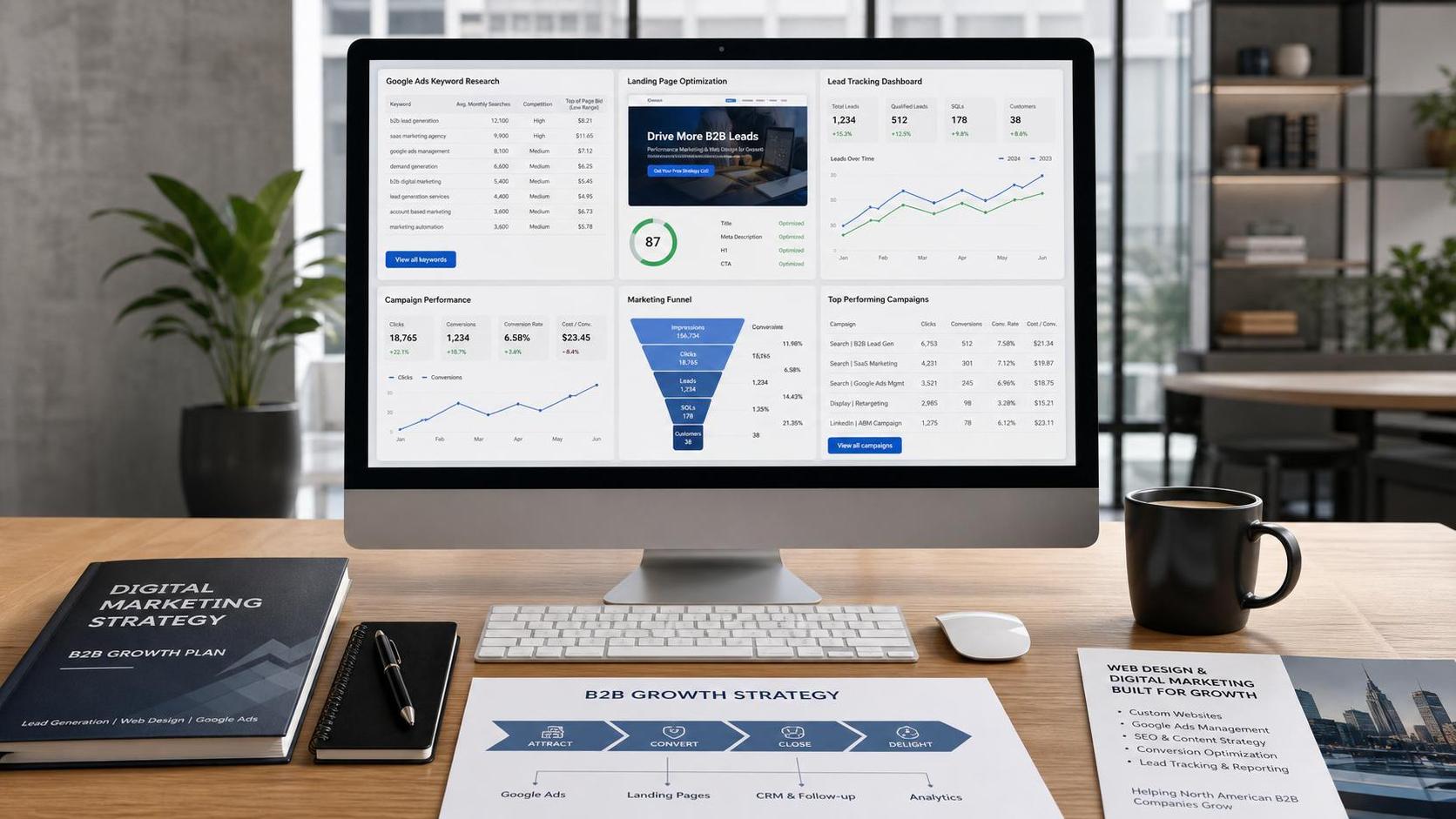
Conversion tracking is the foundation of optimization. At a minimum, companies should record key actions such as inquiry form submissions, phone clicks, email clicks, and WhatsApp conversation initiations, and label the country, product requirements, company type, and deal progress in the customer relationship management process. Evaluating performance solely by click volume or the number of forms can easily conceal low-quality lead issues.
Once an account has accumulated sufficient valid conversions, smart bidding can be used to support budget allocation; however, this requires reliable conversion definitions. If invalid inquiries, recruitment information, or spam forms are frequently counted as goals, the system will continue seeking similar traffic, reducing the sales team's trust in advertising leads.
III. Mainstream Account Structures and Keyword Classification
Common structures can be segmented by major product category, application scenario, country market, or purchasing intent. Product keywords are suitable for covering clear needs, such as equipment, materials, and component names; application keywords are suitable for reaching buyers seeking industry solutions; brand keywords are used to capture visitors who already have brand awareness. The cost and lead quality of each keyword category should be monitored separately.
Keyword match types determine the scope of coverage. Broad match is suitable for discovering new search terms, but requires stricter negative keywords and conversion data constraints; phrase match helps balance expansion and relevance; exact match is more suitable for high-value core keywords with clear intent. In the early stage of an account, sufficient segmentation should be retained to facilitate identification of the source of issues.
Negative keywords are an important cost-control tool in B2B foreign trade Google Ads strategies. Queries related to repair, recruitment, tutorials, used products, free offers, retail, and products unrelated to the business should be continuously excluded. At the same time, potential purchasing expressions should be retained based on actual business conditions, rather than prematurely blocking valuable demand simply because the wording is not sufficiently standard.
IV. Landing Page and Inquiry Conversion Design
The page after an ad click should directly address the search need, rather than requiring buyers to find products themselves on the homepage. An effective landing page typically includes product specifications, application industries, customization capabilities, production information, delivery time descriptions, quality documents, or frequently asked questions, while keeping the page title consistent with the ad promise.
Inquiry forms should collect sufficient information for an initial assessment of a business opportunity, such as contact person, company, country, required product, estimated quantity, and application scenario, but should not include too many fields. For complex industrial products, options for drawing uploads, technical parameters, or purchasing time can be added, with email, telephone, and instant messaging access provided as supplementary channels.
Yingyingbao provides marketing websites, multilingual product pages, form and communication entry configuration, and support for advertising landing page optimization for foreign trade B2B scenarios. For companies advertising in multiple languages and countries simultaneously, clear language paths, localized expression, and mobile experience help reduce advertising traffic loss during the conversion process.
V. Applicable Companies and Global Application Scenarios
This strategy is particularly suitable for manufacturing factories, OEM or ODM companies, industrial product suppliers, foreign trade companies, and businesses expanding brands overseas that seek to establish independent customer acquisition channels. Products such as machinery and equipment, hardware and building materials, auto parts, chemicals, new energy products, packaging, and medical products can typically obtain relatively clear demand signals through buyers' active searches.
When testing new markets, priorities should be set according to the countries that can be served, logistics and delivery capabilities, language support, product compliance documentation, and after-sales conditions. High-ticket products do not need to pursue a large volume of forms in the short term; greater attention should be paid to whether the buyer is genuine, whether the demand is a match, and whether sales can complete follow-up within a reasonable timeframe.
Yingyingbao's services cover industries including laser engraving machines, steel, chemicals, heavy trucks, machinery, and new energy, and it has listed service cases involving Haier, Aucma, Shandong Airlines, Yuanhe Power Station, Little Duck Group, and China National Heavy Duty Truck Group. The specific advertising objectives and results of different companies should still be based on their business stage, market conditions, and actual data.
VI. Budget, Cost, and Return on Investment Evaluation
The total cost of ownership of B2B advertising includes not only media click costs, but also account setup, creative production, landing page development, multilingual content, data tracking, sales follow-up, and ongoing optimization costs. Highly competitive countries, highly specialized keywords, and longer decision-making cycles all affect initial customer acquisition costs and payback periods.
Budget allocation should first use small-scale tests to validate combinations of products, markets, and keyword phrases, and then concentrate budgets on effective conversions. Calculations can be made progressively based on advertising spend, number of valid inquiries, number of qualified opportunities, number of quotations, and transaction value, rather than focusing only on the cost per click. A high click-through rate does not equal high inquiry quality, and low-cost forms do not necessarily generate orders.
Yingyingbao's AI+SEM advertising marketing system covers keyword recommendations, country suggestions, budget allocation, ad copy generation, data monitoring, and landing page optimization. When procuring services, companies should clarify account ownership, data access permissions, conversion criteria, reporting frequency, and sales feedback mechanisms, so that service investment can enter a traceable growth management process.
VII. Optimization Cadence and Future Industry Trends
During the first two weeks after an account goes live, the focus should be on checking tracking, locations, search terms, negative keywords, and page usability. Afterwards, keyword and ad group performance should be reviewed weekly, while budgets and landing pages should be adjusted monthly in combination with sales feedback. For industries with clear seasonality or long purchasing cycles, longer observation windows should be used to avoid frequent strategy changes caused by short-term fluctuations.
Future B2B foreign trade Google Ads strategies will place greater emphasis on first-party conversion data, automated bidding, and content coordination. Advertising is no longer an isolated channel: search ads capture high-intent demand, SEO builds long-term traffic, social media supports ongoing outreach, and websites jointly serve the functions of building trust, presenting information, and collecting leads.
As generative search and Q&A tools influence how buyers obtain procurement information, companies need to continuously maintain clear and verifiable product and corporate content. Yingyingbao provides AI website building, multilingual websites, SEO, SEM, social media, and GEO operation capabilities, helping export companies without internal digital marketing teams centrally manage website assets, promotional data, and ongoing growth activities.
 B2B Foreign Trade Google Ads Strategy: How to Align Keywords, Match Types, and Conversion TrackingHow can B2B foreign trade Google Ads strategies improve lead quality? This article explains keyword segmentation, match type selection, and the synergy of conversion tracking, combined with website landing pages and multilingual marketing, to help you optimize your budget and increase high-quality lead conversions.
 B2B Export Google Ads Campaign Strategy for the North American Market:Search Terms、Landing Pages and Conversion Follow-upHow can a B2B Export Google Ads Campaign Strategy for the North American Market be more effective?This article focuses on search term screening、landing page trust design and lead conversion follow-up,helping businesses connect the customer acquisition funnel,increase qualified inquiries and improve close rates。
