









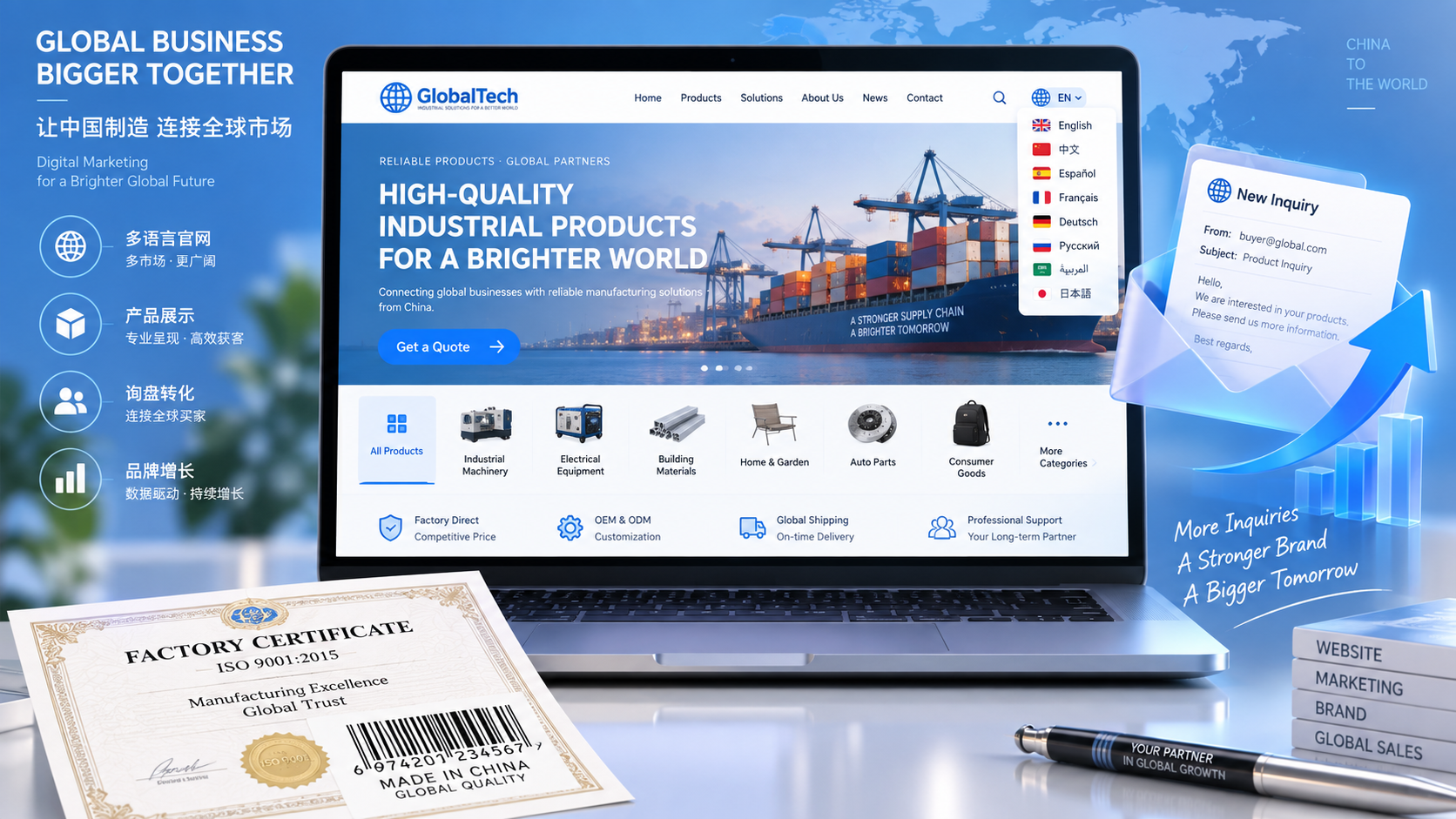
I. Definition and Value Scope of B2B Cross-Border Brand Website Development
B2B cross-border brand website development involves building independent official websites for manufacturers, trading companies, and service-oriented export enterprises, targeting overseas procurement decision-makers. Such websites not only serve as brand showcases but should also cover key stages such as product search, technical evaluation, qualification verification, communication and quotation requests, and sales lead accumulation.
Unlike ordinary corporate showcase websites, B2B cross-border brand websites need to organize information according to the procurement process. The homepage answers what the company can provide, product pages explain specifications and applications, solution pages clarify suitable scenarios, capability and case study pages reduce cooperation risks, and inquiry entry points shorten the steps for customers to initiate contact.
Its core asset is not merely the number of pages, but a content system that can be understood by search engines, advertising channels, and procurement personnel. The website should translate corporate capabilities into clear evidence, including production capacity, quality control, delivery methods, customization scope, service response, and verifiable industry experience.
II. Technical Architecture and Content Localization Principles
From a technical perspective, B2B cross-border brand websites typically use responsive pages, content management systems, global node acceleration, HTTPS secure connections, and scalable form systems. A responsive architecture enables procurement personnel to have a consistent browsing and inquiry experience on desktop computers, tablets, and mobile phones, making it a fundamental requirement for cross-device access.
Multilingual content is not simply sentence-by-sentence translation. True localization should take into account the target market's unit conventions, procurement terminology, product naming, compliance notices, delivery wording, and contact methods. For example, industrial buyers pay greater attention to specifications, materials, certification applicability, and after-sales service boundaries, while consumer goods channels may prioritize brand selling points and minimum order requirements.
An internationalized structure should also provide clear language paths, page correspondences, and regional positioning information, enabling content in different languages to have independent search value. Product specifications, image descriptions, downloadable materials, and FAQs should be maintained simultaneously to avoid missing content or conflicting information across language pages.
III. Mainstream Website Types and Suitable Enterprises
The first type is the manufacturing inquiry-driven official website, suitable for machinery, auto parts, hardware, building materials, chemicals, new energy, and equipment suppliers. Key pages include product catalogs, technical specifications, application industries, factory capabilities, quality processes, and quotation request forms, with the goal of attracting professional visitors with clear purchasing needs.
The second type is a brand solution website, suitable for enterprises with R&D, design, customization, or project delivery capabilities. Such websites should reduce the emphasis on simply listing products and strengthen the presentation of pain points, solution components, service processes, and project experience, helping customers understand how the enterprise can participate in their supply chain or project decisions.
The third type is a cross-border independent website that combines presentation and transaction fulfillment capabilities, suitable for brands and sellers with a high degree of standardization. In addition to product details, it must also manage specifications, pricing or inquiries, shopping carts, orders, and marketing landing pages. Enterprises should choose based on their sales model rather than mechanically stacking all functions together.
IV. Selection Criteria, Launch Process, and Quality Control
When procuring website development services, enterprises should first confirm their target markets, key products, target customer roles, and customer acquisition channels, and then evaluate system capabilities. Key considerations include page editing efficiency, product and article management, multilingual maintenance, access speed, security capabilities, form lead routing, data analytics, and ongoing operational support.
A standardized process usually begins with keyword and customer profile research, followed by the completion of the sitemap, page prototypes, visual design, content organization, multilingual proofreading, function configuration, and testing. Before launch, mobile display, form delivery, link status, image loading, privacy notices, and access performance in key markets should be checked item by item.
Yiyingbao provides AI-powered website development, multilingual independent websites, and coordinated marketing operations services, making it suitable for export enterprises that lack technical teams but need continuous customer acquisition. Its services can cover product content generation, basic search optimization, overseas access acceleration, and communication entry point configuration, facilitating the connection between website development and subsequent promotion.
V. Application Scenarios, Operating Rhythm, and Lead Growth
B2B cross-border brand website development is commonly used when new products enter overseas markets, factories shift from platform-based customer acquisition to their own channels, customers are engaged before and after trade shows, and multiple national markets are expanded simultaneously. Industries such as laser engraving machines, steel, chemicals, heavy trucks, machinery, agriculture, and healthcare typically need to present technical and delivery information more comprehensively.
After the website goes live, products, case studies, industry articles, and FAQs should be maintained monthly, while high-value pages should be analyzed based on traffic sources. Organic search is suitable for building long-term demand, advertising is suitable for market validation and rapid traffic acquisition, and social media content can be used for ongoing outreach; all three need to be supported by unified landing pages and lead rules.
Yiyingbao serves multiple export-related industries and lists service cases including Haier, Aucma, Shandong Airlines, Yuanhe Power Station, Xiaoya Group, and China National Heavy Duty Truck Group. For enterprises, case study references should focus on industry fit, project scope, and reusable methods, rather than using customer names alone as the basis for selection.
VI. Total Cost of Ownership and Return on Investment Assessment
The total cost of ownership for B2B cross-border brand website development includes domain names, servers or acceleration resources, design and development, content production, multilingual maintenance, function integration, security maintenance, and promotional operations. A low-cost launch does not necessarily mean lower costs; if products cannot be updated, leads cannot be tracked, or market expansion cannot be supported afterward, rebuilding costs are often higher.
Return on investment should be measured by qualified leads rather than traffic alone. Enterprises can track visits from target countries, time spent on key product pages, form submissions, email or instant messaging clicks, qualified inquiry rates, quotation conversions, and customer lifetime value, and review channel costs together with sales follow-up results.
In the future, official websites will place greater emphasis on structured content, Q&A-style pages, multilingual knowledge bases, and brand visibility in AI search environments. Enterprises should continuously accumulate verifiable product, service, and industry information, enabling their websites to support current customer acquisition while also becoming long-term digital assets for global markets.
