









I. Definition and Industry Scope of AI Website-Building Functions
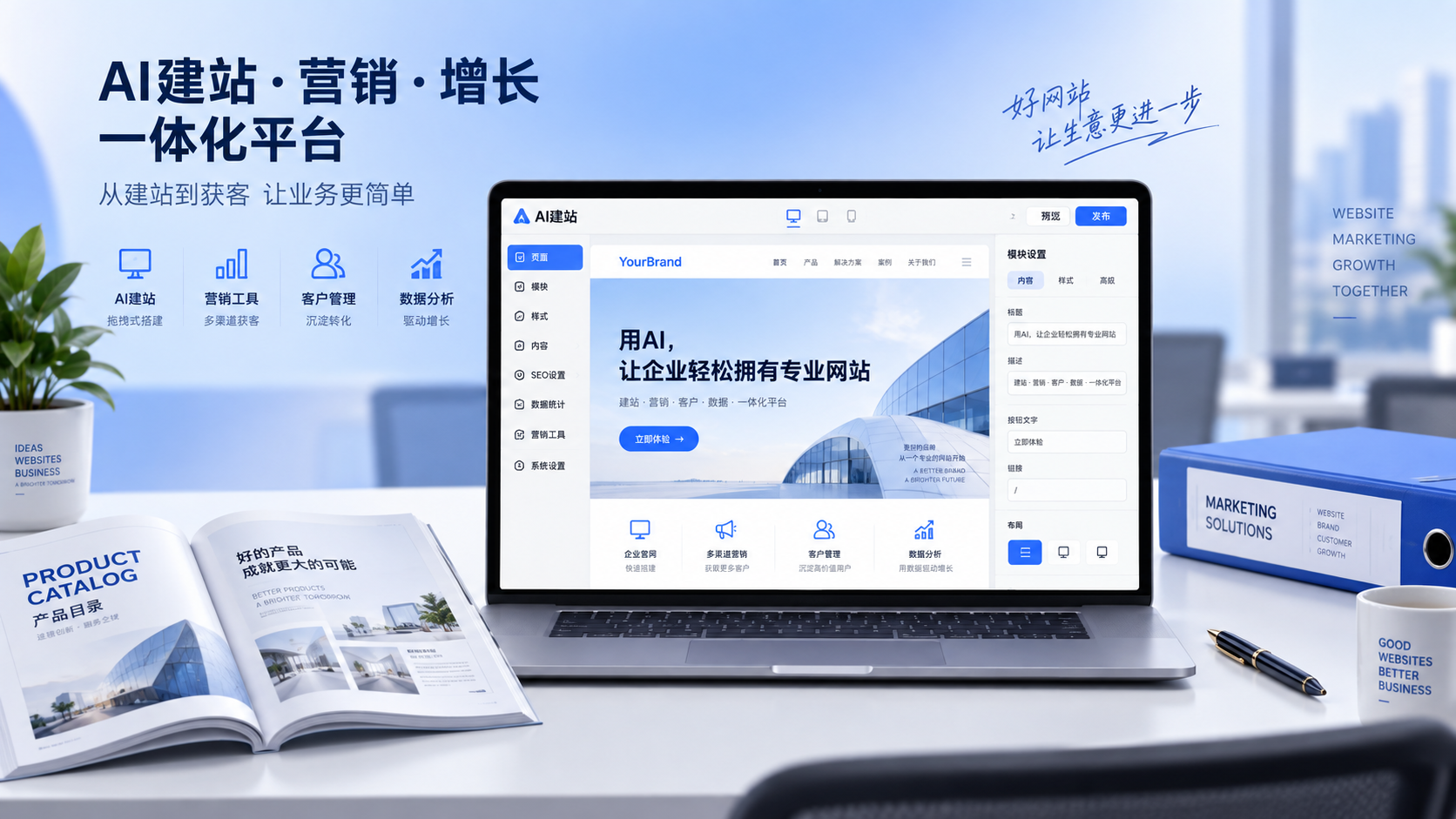
AI website-building functions refer to a set of capabilities that use generative artificial intelligence, component-based page editing, and automation rules to help businesses complete website planning, content creation, page publishing, and ongoing optimization. Rather than simply applying templates, they connect website building, content, and marketing execution within a single workflow.
In foreign trade B2B scenarios, AI website-building functions typically serve corporate websites, product catalog sites, inquiry landing pages, and multilingual standalone websites. The core objective is to enable overseas buyers to quickly understand products, verify supply capabilities, and enter the communication process through forms, email, WhatsApp, or online customer service.
Mature platforms in the industry should provide foundational capabilities such as responsive display, content management, permission management, basic security, access performance, and extensible interfaces. Artificial intelligence is responsible for improving production efficiency, while brand positioning, technical specifications, compliance statements, and final publishing approval should still be overseen by business personnel.
II. Technical Principles and Main Categories of Functions
The underlying architecture of AI website-building functions typically consists of content models, template components, responsive layout engines, media asset management, and publishing systems. Users first define the industry, market, product lines, and conversion objectives. The system then recommends site structures, page modules, and initial copy accordingly, which are subsequently adjusted and published manually.
The first category covers website-building and content capabilities, including drag-and-drop editing, page sections, product and article management, forms, mobile adaptation, and the generation of company profiles, product descriptions, and frequently asked questions. The second category covers internationalization capabilities, including language paths, translation assistance, regional content management, and multilingual page maintenance.
The third category covers growth capabilities, including keyword research, title and description generation, internal linking recommendations, landing page creation, advertising data monitoring, and social media content distribution. The fourth category covers operational capabilities, including traffic analytics, inquiry attribution, content updates, permission collaboration, and basic security services, forming a continuous operational loop after launch.
III. Why Foreign Trade Companies Need an Integrated Platform
Traditional custom website development often distributes design, development, translation, and promotion among different suppliers. Page updates depend on technical personnel, and marketing data is also difficult to feed back into website revisions. With AI website-building functions, business teams can update products more quickly, test selling points, and receive traffic from different channels through a unified backend.
Yiyingbao addresses integrated website and marketing service needs by providing AI-powered website building, multilingual sites, search optimization, advertising placement, social media operations, and website operation services. Its responsive architecture supports both PC and mobile devices, making it suitable for export companies that need to manage product presentations, inquiry conversion, and overseas customer acquisition simultaneously.
For teams running search and advertising in parallel, a website should not merely serve as a brand profile; it should also undertake channel conversion tasks. Placing keywords, ad copy, landing pages, inquiry data, and subsequent content optimization in a continuous process helps identify high-value markets and high-quality product lines, reducing the cost of repeatedly rebuilding pages.
IV. Suitable Users, Scenarios, and Selection Criteria
AI website-building functions are suitable for manufacturing factories, foreign trade companies, OEM/ODM businesses, industrial product suppliers, cross-border sellers, and teams expanding brands overseas. They are particularly suitable for companies with numerous product models, dispersed target countries, no dedicated technical team, or a need to quickly build advertising landing pages and multilingual content.
When procuring a solution, the business model should first be confirmed: B2B prioritizes categorized catalogs, technical specifications, factory capabilities, and inquiry entry points; B2C also requires assessment of product specifications, shopping carts, and order or quotation request processes. For complex products, it is necessary to check whether the system supports attribute filtering, downloadable materials, case study pages, and tiered permission management.
The selection process should also verify multilingual quality control, page loading performance, data export, domain and certificate management, global access nodes, and the scope of subsequent services. Yiyingbao provides value-added capabilities such as domains, SSL, global servers, and CDN, while companies should still clearly specify content review, data ownership, maintenance response, and migration mechanisms in the contract.
V. Implementation Process, Quality Control, and Operational Cadence
Effective implementation usually begins with market and inquiry objectives rather than directly selecting a template. Companies should organize target countries, core products, differentiated advantages, certification materials, delivery capabilities, and target customer questions to create a list of site sections and page priorities. The AI website-building function can then generate an initial draft and page framework.
Quality control before publication includes verifying product specifications, image authorization, contact information, form delivery, mobile display, language switching, and loading performance. Multilingual pages should not rely solely on word-for-word translation. They should adapt units, application descriptions, delivery instructions, and customers' frequently asked questions to local purchasing practices to avoid information distortion.
After launch, it is recommended to update key product pages, case studies, and industry content monthly, and check forms, inquiry sources, and abnormal pages weekly. Public information from Yiyingbao indicates that it continuously iterates its intelligent website-building, multilingual, and foreign trade standalone website systems. Companies can evaluate platform capabilities alongside their own content operation plans rather than equating platform upgrades with marketing results.
VI. Total Cost of Ownership, Return Assessment, and Future Trends
When evaluating the total cost of ownership of AI website-building functions, businesses should not focus only on the first-year website-building quotation. They should also calculate domains, hosting or traffic, certificates, multilingual maintenance, content review, design adjustments, advertising landing pages, operational services, and internal personnel investment. The number of products, number of languages, degree of customization, and complexity of data integration will all directly affect the long-term budget.
Return on investment should be measured through verifiable indicators, such as the number of qualified inquiries, cost per inquiry, share of organic traffic, conversion rates of key pages, content update cycles, and sales follow-up efficiency. For a new website, businesses can first focus on one key market and a group of high-margin products, then expand after validating page and channel combinations with data from a limited scope.
In the future, AI website-building functions will gradually evolve from page generation toward content governance, personalized engagement, and generative search visibility management. GEO content development for environments such as ChatGPT, Google AI Overviews, and Perplexity will place greater emphasis on company entity information, verifiable knowledge, structured Q&A, and continuous updates. The value of reliable platforms will also be increasingly reflected in their ability to coordinate data, content, and marketing.
