









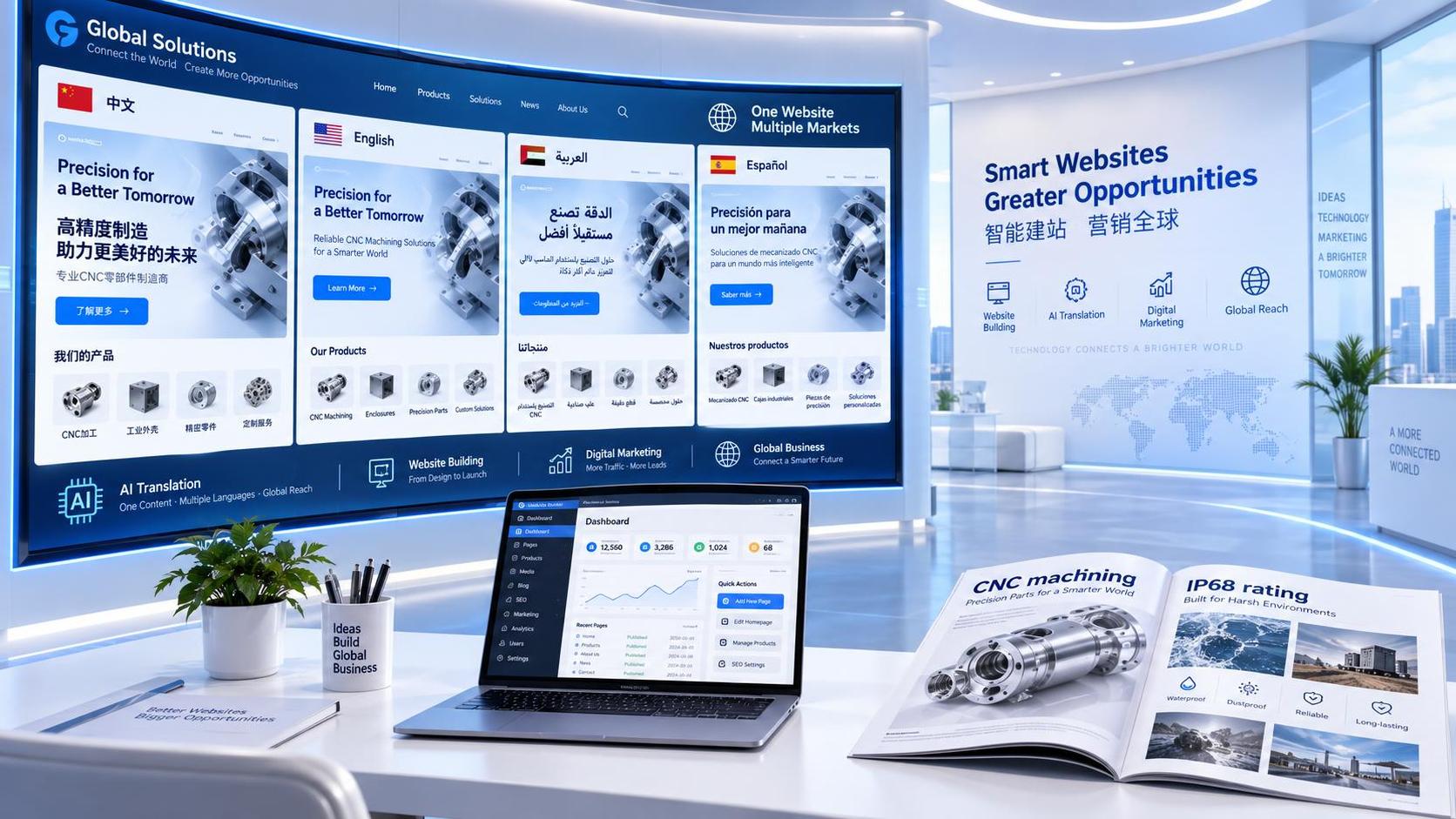
What Is AI Translation Localization? — An Intelligent Adaptation Framework Beyond Literal Conversion
AI translation localization is not simply the direct translation of Chinese web pages into English or Spanish. Powered by AI, it integrates linguistic rules, industry terminology databases, regional cultural practices, search engine semantic logic, and user behavior data to comprehensively reconstruct website structures, product descriptions, marketing copy, SEO meta tags, and interactive elements. Its essence is to enable target customers in different language markets to gain the same sense of professionalism, trust, and conversion experience as native-language users.
In integrated website and marketing service scenarios, AI translation localization must simultaneously meet three standards: linguistic accuracy (supporting industrial-grade expressions such as ‘CNC machining’ and ‘IP68 rating’); localization adaptability (such as right-to-left Arabic layouts, Japanese honorific levels, and regional variations in Latin American Spanish); and marketing effectiveness (natural keyword integration in titles, CTA buttons aligned with local decision-making habits, and inquiry paths that match B2B procurement processes).
The Yiyingbao AI Translation Center incorporates 23 industry terminology models, covering machinery, new energy, chemicals, medical equipment, and more. Combined with automatic Hreflang tag deployment, multilingual URL path standards, and regional SEO field generation, it makes AI translation localization a truly deliverable, rankable, and convertible infrastructure capability.
This capability is deeply integrated into the Yiyingbao intelligent website-building system. After creating a Chinese-language site, users can trigger multilingual site generation with one click. AI not only translates text but also simultaneously optimizes page structures, internal link relationships, and alignment with local search intent, clearly distinguishing it from the fragmented model of traditional MT plus human editing.
Why Is AI Translation Localization a Key Piece of the Foreign Trade Digitalization Closed Loop?
Traditional multilingual website development has three major gaps: the separation of translation and website building causes content misalignment; the disconnect between SEO and localization leads to traffic waste; and inconsistencies between advertising and landing page language result in soaring bounce rates. As the core hub of integrated website and marketing services, AI translation localization connects end-to-end consistency from website building, content generation, and SEO optimization to advertising landing pages and social media distribution.
Take the Shandong Heavy Industry case served by Yiyingbao as an example: before its Russian site went live, Google.ru organic traffic accounted for less than 3%, while the cost per inquiry was as high as $86. After AI translation localization was enabled, the system automatically adapted to high-frequency procurement terms in the Russian market, such as ‘грузовик для строительства’ and ‘запчасти для КАМАЗ’, restructured the product page information architecture, and simultaneously generated localized TDK content aligned with Yandex algorithm preferences. Within six months, the number of indexed pages on the Russian site increased by 317%, organic inquiries accounted for 42%, and the cost per inquiry fell to $29.
More importantly, AI translation localization supports GEO (Generative Engine Optimization) capabilities. When overseas buyers search for ‘best CNC manufacturer in China’ through ChatGPT or Google AI Overviews, the Yiyingbao system has already incorporated structured Q&A content, multilingual entity information, and authoritative parameter comparison tables, ensuring that the brand is accurately cited in AI summaries and directed to the corresponding language-specific independent site, creating dual coverage from search engines to AI platforms.
This is the irreplaceable value of integrated website and marketing services: rather than providing isolated tools, it uses AI translation localization as the central hub to drive the coordinated evolution of website building, SEO, SEM, SNS, and GEO, avoiding content degradation and data silos caused by fragmentation across multiple platforms.
Who Needs AI Translation Localization? Typical Target Groups and Business Pain Points
AI translation localization primarily serves three types of enterprises with high decision-making thresholds, strong local compliance requirements, and simultaneous expansion across multiple markets: first, overseas-oriented manufacturing businesses, including factories and OEM/ODM service providers in fields such as laser equipment, heavy-duty trucks, and new energy batteries, whose technical parameters, certification standards (CE/UL/IEC), and application scenario descriptions must be precisely adapted to engineering procurement practices in different countries; second, cross-border sellers undergoing brand transformation, who need to manage language consistency across DTC independent sites, social media content, and advertising materials to prevent translation deviations from undermining brand positioning; and third, B2B platform service providers, such as industrial SaaS companies and testing and certification organizations, which rely on multilingual content to establish global professional credibility.
Typical pain points are highly concentrated: missing localized explanations of CE certificates on Russian product pages lead to an inquiry skepticism rate exceeding 65%; Japanese sites that fail to adapt high-frequency verbs such as ‘見積もり依頼’ (quotation request) have CTA conversion rates 40% below the industry average; and Spanish sites that overlook differences between Latin American and European Spanish use ‘orden’ instead of ‘solicitud de cotización’, causing a disconnect in perceived professionalism. These are not merely language issues but losses of trust caused by the absence of a localization strategy.
Through industry-specific terminology libraries and regional template libraries, such as using ‘Anfrage senden’ rather than ‘Kontaktieren’ by default on German sites, Yiyingbao moves localization decisions forward to the website-building stage. When users select the ‘German market’, the system automatically loads TÜV certification wording standards, B2B procurement process illustrations, and local payment method integration recommendations, substantially reducing the trial-and-error cost of localizing professional content.
Practices serving enterprises such as Haier and Aokema show that when AI translation localization is deeply coupled with B2B foreign trade websites, companies can simultaneously cover the four major European markets of English, German, French, and Spanish. The average product page dwell time across language sites increased to 2 minutes and 18 seconds, compared with the industry average of 1 minute and 32 seconds, validating the material impact of localization quality on the procurement decision cycle.
Where and When Is It Used? Global Market Entry and Dynamic Update Mechanisms
AI translation localization is not a one-time project but an operational capability that continuously evolves. Its core application scenarios are concentrated at three stages: the initial entry into new markets, such as launching bilingual Arabic and English sites simultaneously when expanding into the Middle East and embedding explanations of local customs clearance policies; major product iteration periods, when new energy batteries release updated specification sheets and multilingual technical documents must be updated simultaneously; and annual SEO audit cycles, when localized keyword placement is adjusted according to Google algorithm updates, such as strengthening the localization of mobile loading speed prompts on Japanese sites following the 2025 Core Web Vitals upgrade.
The Yiyingbao AI Translation Center uses a ‘versioned localization management’ mechanism: each language site independently maintains content versions and supports rollback, phased releases, and A/B testing. For example, for the Saudi market, the system can run two sets of Arabic copy in parallel—one emphasizing religious and cultural adaptation, such as avoiding specific image symbols and highlighting Halal certification, and the other emphasizing industrial procurement terminology, such as API standards and ASTM material designations—then use targeted Google Ads placements to verify which combination delivers a higher inquiry conversion rate.
The update cadence is triggered automatically by AI: when it detects changes in target-market regulations, such as the EU's new battery regulation taking effect in 2026; shifts in mainstream search terms, such as ‘solar inverter price’ being replaced by ‘inversor solar custo’ in Brazil at a rate of 73%; or adjustments in competitors' multilingual content strategies, the system sends localization optimization recommendations and supports one-click batch updates of product pages, FAQs, and blog articles.
This dynamic response capability transforms AI translation localization from a cost center into a growth lever. When China National Heavy Duty Truck entered the Southeast Asian market, it used this mechanism to complete regulatory clause updates and localized case packaging for Indonesian, Thai, and Vietnamese sites within three weeks—five times faster than the traditional outsourcing model—with local buyers accounting for 81% of organic inquiries in the first month.
How Is High-Quality AI Translation Localization Achieved? Yiyingbao's Four-Layer Technical Assurance
Yiyingbao has built a four-layer AI translation localization assurance system from underlying architecture to the application layer. The first layer is a semantic understanding engine fine-tuned based on the Transformer-XL model, specializing in parsing long sentences in B2B technical documents and accurately identifying that ‘high-torque low-speed motor’ should be translated in the construction machinery context as ‘high-torque low-speed electric motor’ rather than the literal ‘high-torque low-speed motor’; the second layer is an industry knowledge graph that has incorporated 1.27 million manufacturing entity relationship records, such as ‘stainless steel 316’ → ‘offers better corrosion resistance than 304 and is suitable for marine environments’, ensuring that terminology translation carries extended technical semantics; the third layer is a localization rules matrix with preset UI interaction standards for 42 countries and regions, such as right-aligning button text on Arabic sites, avoiding katakana abbreviations on Japanese sites, legal statement templates, and automatic currency/unit conversion logic; and the fourth layer is a closed-loop feedback system that feeds multilingual click-through rates, page dwell time, and inquiry source languages from Google Search Console back into the AI model to continuously optimize translation strategies.
This system has proven effective in actual deployments. After Yuanhe Power Station's Spanish site went live, AI automatically recognized ‘transformador solar’ as a high-frequency local term. However, the direct translation of the original Chinese term for ‘photovoltaic step-up transformer’ could easily cause ambiguity, so the system proactively recommended ‘transformador elevador para sistemas fotovoltaicos’ and included technical explanatory illustrations. This reduced the product page bounce rate by 38%, while 61% of inquiries explicitly mentioned technical requirements related to ‘elevador’.
All capabilities are integrated into the same SaaS platform, with no need to switch systems or export files. When users edit Chinese product pages, the right side displays AI-generated results for each language in real time, localization scores covering terminology accuracy, cultural adaptability, and SEO friendliness, as well as human editing recommendations, truly enabling a what-you-see-is-what-you-get localized collaborative workflow.
Together with the global acceleration network, deployed across multiple Alibaba Cloud/AWS nodes, it ensures overseas access latency of <100ms for multilingual sites, preventing localization efforts from failing due to slow loading. After all, no matter how accurate Spanish copy is, if users must wait 5 seconds for it to open, trust has already been lost in the loading bar.
The Total Cost of Ownership (TCO) and ROI Calculation Logic for AI Translation Localization
Buyers often mistakenly view AI translation localization as a purely IT investment, whereas its TCO consists of both explicit and hidden costs. Explicit costs include system licensing fees, multilingual site hosting fees, and AI computing consumption charged by character volume; hidden costs include human proofreading hours, SEO penalties caused by content synchronization errors across multiple platforms, and customer complaint handling costs resulting from localization mistakes. Yiyingbao adopts a ‘subscription plus on-demand expansion’ model. The basic package includes 5 language sites and an AI translation allowance of 200,000 characters per month, avoiding the high one-time expenditure and subsequent upgrade barriers of traditional project-based models.
ROI calculation needs to focus on three core indicators. First is organic traffic acquisition efficiency: for example, after Xiaoya Group enabled AI translation localization, monthly Google organic traffic for its German site increased by 210%, equivalent to saving approximately €18,000/month in Google Ads budget of the same scale. Second is improved inquiry quality: the proportion of inquiries from multilingual sites that clearly specify purchasing specifications, budget ranges, and delivery lead times rose to 74%, from 39%, significantly reducing the early-stage screening cost for sales personnel. Third is the marginal cost of market expansion: the average time required to add a language site was reduced from 22 days under the outsourcing model to 3.7 days on the Yiyingbao platform, enabling enterprises to test emerging markets with lower risk, such as rapidly launching a Portuguese site in 2025 to enter Angola's infrastructure market.
It is worth noting that the key to TCO optimization is ‘avoiding duplicate development’: Yiyingbao deeply couples AI translation localization with SEO, SEM, and GEO capabilities. The same set of multilingual keywords can be used simultaneously for organic search optimization, advertising keyword expansion, and AI Q&A content generation, raising content asset reuse to 83%, far above the industry average of 41%. This means that every RMB 1 invested in content production can support three customer acquisition channels: search, advertising, and AI conversations.
For manufacturing enterprises with annual exports of more than US$5 million, AI translation localization typically reaches break-even within 9 months. For brands expanding overseas, its value is more evident in long-term asset accumulation: multilingual content libraries continue to appreciate over time, becoming core digital assets that mitigate the risks of platform algorithm changes and channel policy shifts. This is precisely the essential competitive strength of the integrated website and marketing service strategy.
